At $2.80 a gallon for propane and $0.17 per kWh for electricity, a heat pump is the cheapest of the three to run, a high-efficiency propane furnace comes second, and electric baseboard or an electric furnace is the most expensive. Per million BTU of heat delivered, that works out to about $19 for a heat pump, $32 for a 95% propane furnace and $50 for electric resistance.
So in propane vs electric heat, the answer depends on which electric heat. Resistance heat loses to propane almost everywhere in the US. A heat pump beats propane unless your electricity is very expensive (above roughly $0.29/kWh) or your winters are cold enough to drag its efficiency way down.
Below are the formulas, a break-even table you can check against your own utility bill, and a full-year example for a 2,000 sq ft house. If you want to skip ahead, plug your own numbers into our heating cost calculator, which runs the same math for propane, gas, oil and electric.
Cost per million BTU: the formulas
The fair way to compare fuels is the cost of one million BTU (MMBtu) of heat actually delivered into the house, after equipment losses. A gallon of propane holds about 91,500 BTU; a kWh holds 3,412 BTU.
Propane $/MMBtu delivered = (1,000,000 ÷ 91,500) × price per gallon ÷ AFUE
Electric $/MMBtu delivered = (1,000,000 ÷ 3,412) × price per kWh ÷ COP
One million BTU is 10.93 gallons of propane or 293.1 kWh. AFUE is the furnace’s annual fuel utilization efficiency (0.80 for an older or basic unit, 0.92–0.96 for a condensing furnace). COP is the heat pump’s coefficient of performance: 1.0 for baseboard, wall heaters and electric furnaces, and roughly 2.0–3.5 for a heat pump depending on outdoor temperature.
Worked example: 95% propane furnace vs heat pump at COP 2.6
Propane: 10.93 gal × $2.80 = $30.60 of fuel. Divide by 0.95 AFUE = $32.21 per MMBtu delivered.
Heat pump: 293.1 kWh × $0.17 = $49.82 of electricity. Divide by COP 2.6 = $19.16 per MMBtu delivered, about 40% less than propane.
| Heating system | Efficiency | Cost per MMBtu delivered |
|---|---|---|
| Propane furnace, older/basic | 80% AFUE | $38.25 |
| Propane furnace, condensing | 92% AFUE | $33.26 |
| Propane furnace, condensing | 96% AFUE | $31.88 |
| Electric baseboard / electric furnace | COP 1.0 | $49.82 |
| Heat pump, cold weather (~17–25°F) | COP 2.0 | $24.91 |
| Heat pump, seasonal average | COP 2.6 | $19.16 |
| Heat pump, mild weather (~47°F) | COP 3.5 | $14.24 |
Assumes propane at $2.80/gal and electricity at $0.17/kWh. Even a heat pump struggling at COP 2.0 undercuts the best propane furnace by about $7 per MMBtu.
Break-even propane price vs electricity price
Set the two formulas equal and solve for propane. The 91,500 ÷ 3,412 ratio (26.8 kWh per gallon) does most of the work:
Break-even propane $/gal = price per kWh × 26.8 × AFUE ÷ COP
If you pay more per gallon than the result, the electric option is cheaper. If you pay less, propane wins. With a 95% furnace and $0.17 power, resistance heat breaks even at $0.17 × 26.8 × 0.95 ÷ 1.0 = $4.33/gal. At $2.80 propane, resistance would only win if electricity dropped below about $0.11/kWh, which is rare outside a few hydro-heavy states.
For a heat pump at COP 2.6, the break-even is $0.17 × 26.8 × 0.95 ÷ 2.6 = $1.67/gal. Propane would have to fall to about $1.67 before a 95% furnace matched an average heat pump. Flip it around and the heat pump keeps winning until electricity reaches about $0.29/kWh.
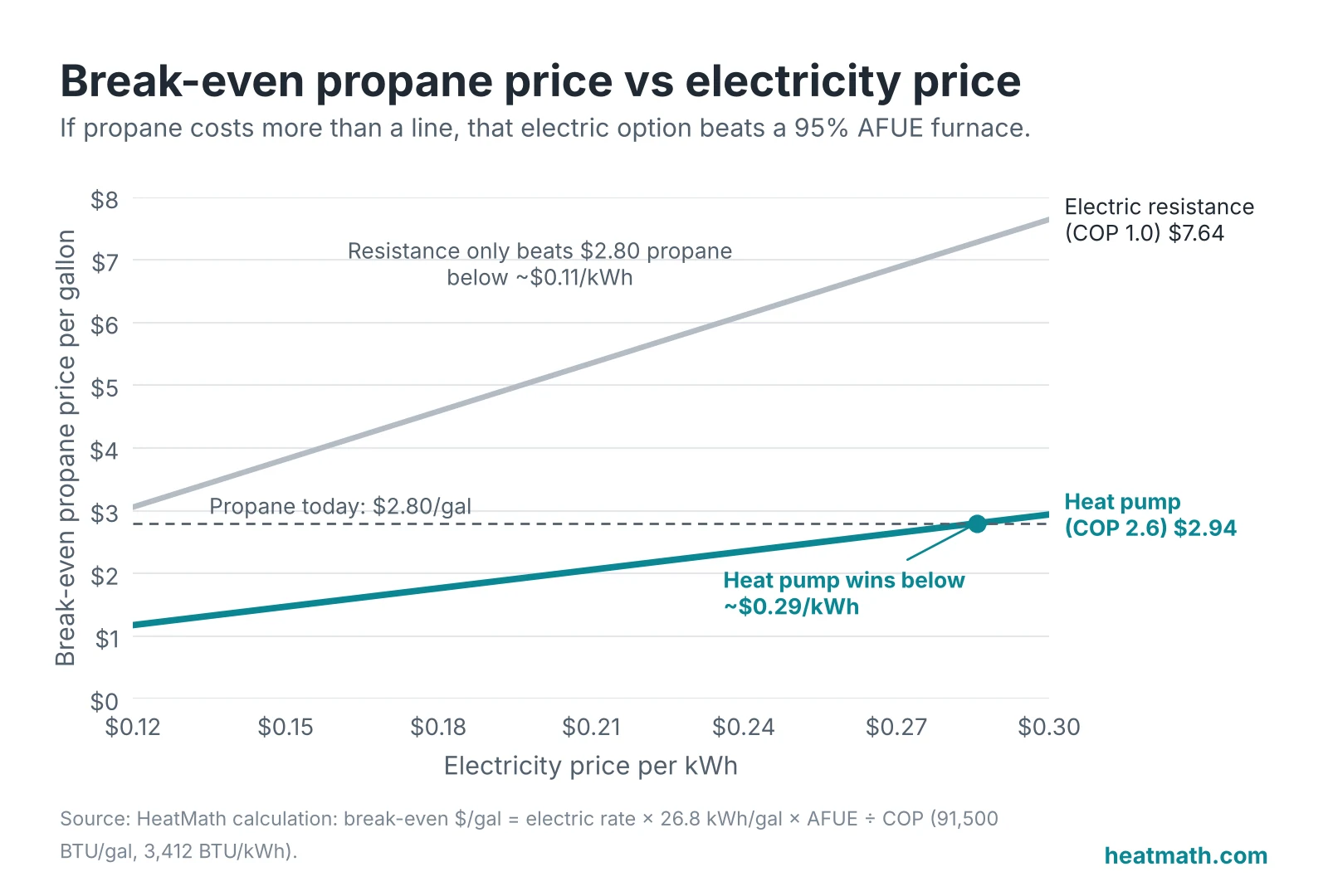
| Electricity price | Resistance (COP 1.0) | Heat pump COP 2.0 | Heat pump COP 2.6 | Heat pump COP 3.5 |
|---|---|---|---|---|
| $0.12/kWh | $3.06 | $1.53 | $1.18 | $0.87 |
| $0.15/kWh | $3.82 | $1.91 | $1.47 | $1.09 |
| $0.17/kWh | $4.33 | $2.17 | $1.67 | $1.24 |
| $0.20/kWh | $5.10 | $2.55 | $1.96 | $1.46 |
| $0.25/kWh | $6.37 | $3.18 | $2.45 | $1.82 |
| $0.30/kWh | $7.64 | $3.82 | $2.94 | $2.18 |
Break-even propane price per gallon against a 95% AFUE furnace. If your propane costs more than the number in your row and column, the electric option is cheaper to run.
A full year: 2,000 sq ft home, 60 million BTU
Assumptions: a reasonably insulated 2,000 sq ft house in a cold-ish climate (think the lower Great Lakes or interior Northeast, around 6,000 heating degree days) that needs about 60 MMBtu of delivered heat per year. Propane at $2.80/gal, electricity at $0.17/kWh. Because a colder climate means more hours below freezing, the heat pump gets a seasonal COP of 2.4 rather than the 2.6 national average, with backup strip heat folded in.
Propane furnace
95% AFUE: 60,000,000 ÷ 0.95 = 63.2 MMBtu of fuel. 63,200,000 ÷ 91,500 = 690 gallons × $2.80 = about $1,930 a year.
80% AFUE: 60,000,000 ÷ 0.80 = 75 MMBtu ÷ 91,500 = 820 gallons × $2.80 = about $2,300 a year.
Electric baseboard
60,000,000 ÷ 3,412 = 17,585 kWh × $0.17 = about $2,990 a year.
Heat pump
17,585 kWh ÷ 2.4 = 7,330 kWh × $0.17 = about $1,250 a year. At the national-average COP of 2.6 it would be 6,760 kWh, or about $1,150.
The heat pump saves roughly $680 a year over a 95% propane furnace, $1,050 over an 80% furnace and $1,740 over baseboard. For a deeper look at the electric side, see what it costs to run a heat pump.
Tank rental, delivery minimums and price swings
The per-gallon price is only part of a propane bill. Things that move the real number:
- Tank rental. If the supplier owns the tank, expect a yearly rental fee, often waived or reduced if you buy above a minimum volume. A household that cuts usage (for example, after adding a heat pump) can lose that waiver.
- Delivery minimums and fees. Many suppliers set a minimum gallons per delivery or add a small-delivery or will-call surcharge. Emergency or off-route deliveries cost more.
- Price swings. Propane prices move with crude oil, export demand and cold snaps. In the example above, every $0.50/gal change shifts the 95% furnace’s yearly bill by about $345. At $2.00/gal the bill is about $1,380; at $3.50/gal it is about $2,420.
Electric rates move too, but usually in slower, regulated steps, and many utilities offer lower winter or heat-pump rates.
Upfront cost: the other half of the decision
Electric baseboard is the cheapest to install by far and the most expensive to run. A propane furnace typically costs about $3,800–$10,000 installed, close to a natural gas furnace, as broken down in our furnace replacement cost guide. A ducted heat pump for a 2,000 sq ft home usually lands around $10,000–$20,000, with cold-climate models at the top of that range; see heat pump installation cost.
Using the year above, a heat pump that costs $6,000 more than a propane furnace and saves $680 a year pays back in about 9 years. Replace baseboard instead and the $1,740 yearly savings pays back the same $6,000 gap in under 4 years. Federal tax credits for heat pumps ended for equipment placed in service after 2025, so do the payback without them; state HEAR rebates may still apply depending on where you live.
Dual fuel: propane plus a heat pump
Many propane homes don’t have to choose. A dual fuel system pairs a heat pump with a propane furnace and switches to propane when the heat pump’s COP falls below the break-even point. At $2.80 propane, $0.17 power and a 95% furnace, that break-even COP is:
Break-even COP = price per kWh × 26.8 × AFUE ÷ propane $/gal = 0.17 × 26.8 × 0.95 ÷ 2.80 = 1.55
A standard heat pump usually stays above COP 1.55 down into the teens °F, so the furnace only carries the coldest hours. Revisit the switch point when either price changes. Our dual fuel heat pump guide covers setup and thermostat settings.
Outages and backup heat
A propane furnace is not outage-proof. It still needs power for the inducer motor, igniter, control board and blower, typically a few hundred watts, so it runs on a modest generator or transfer switch but not on nothing. On the parts counter, inducer motors, hot surface igniters and flame sensors are among the furnace parts we see fail most often, and none of them work without electricity. A heat pump needs far more power and a larger generator.
What propane does give you is fuel on site. A vented propane fireplace or wall heater with a standing pilot or millivolt valve can keep a room warm with the grid down, and a propane standby generator can run the whole house for days. In areas with long winter outages, that resilience is worth real money. Before doing any work on a furnace or heat pump beyond the filter, thermostat or breaker, shut off power at the disconnect and remember that capacitors in heat pumps hold a dangerous charge even when the unit is off.
When propane still wins
- Very cold climates with a standard heat pump. If long stretches sit below about 0°F, a non-cold-climate heat pump spends hours near COP 1.5 or on strip heat. A cold-climate model or dual fuel fixes most of that.
- Expensive electricity. Above roughly $0.29/kWh, cheap $2.80 propane in a 95% furnace matches an average heat pump.
- Cheap propane. Large-volume or pre-buy customers paying well under $2/gal close the gap fast.
- A working furnace and ductwork already in place. If the furnace has years left, the cheapest move is often adding a heat pump to it, not ripping it out.
Frequently asked questions
Is propane cheaper than electric heat?
Cheaper than electric resistance heat, almost always. At $2.80/gal and $0.17/kWh, a 95% propane furnace delivers heat for about $32 per million BTU versus about $50 for baseboard. A heat pump, at about $19, beats both.
At what propane price does a heat pump become cheaper?
With $0.17 electricity and an average seasonal COP of 2.6, a heat pump is cheaper whenever propane costs more than about $1.67/gal (against a 95% furnace). Use the table above for other electricity prices.
How many gallons of propane does a 2,000 sq ft house use per year?
In a cold-ish climate needing about 60 million BTU of heat, roughly 690 gallons with a 95% furnace or 820 gallons with an 80% furnace. Milder climates and tighter houses use much less.
Is 1 gallon of propane equal to how many kWh?
One gallon holds about 91,500 BTU, which equals about 26.8 kWh of energy. After a 95% furnace’s losses, it delivers about 25.5 kWh worth of heat.
Should I replace my propane furnace with a heat pump?
If the furnace is near the end of its life, a heat pump (or dual fuel system) usually lowers yearly heating bills. If the furnace is fairly new, adding a heat pump and keeping propane as backup often gives the best payback.