The typical oil to heat pump conversion cost is about $14,000 to $26,000 before incentives for a whole house, according to EnergySage marketplace data from March 2026. A single ductless zone can cost as little as $3,500 to $5,500. With residential heating oil near $6.19 a gallon in October 2026, many oil-heated homes in cold states would save $2,000 to $4,000 a year on fuel, which puts payback for a whole-home system at roughly 5 to 10 years.
Below you will find what makes up the price, a worked example for a real-size house, a savings table by climate, and a short list of decisions to settle before you ask for quotes.
What drives the oil to heat pump conversion cost
The heat pump itself is only part of the bill. A conversion also means removing or abandoning the oil equipment, and sometimes upgrading ducts or electrical service. These are the line items reported in a September 2026 cost roundup by Fixr, which pulls together installer and marketplace data:
| Item | Typical range | When it applies |
|---|---|---|
| Ducted whole-home heat pump, installed | $12,000 to $18,000 | House already has ducts from an oil furnace |
| Cold-climate whole-home system (Massachusetts example) | $15,000 to $25,000 | Larger homes, very cold design temperatures |
| Single-zone ductless mini split | $3,500 to $5,500 | Partial conversion or one open floor |
| Multi-zone ductless (2 to 4 heads) | $6,000 to $14,000 | Homes with an oil boiler and no ducts |
| New or modified ductwork | $2,000 to $5,000 | Boiler homes choosing a ducted system |
| Electrical panel upgrade to 200 amps | $1,500 to $3,000 | Older 100-amp services |
| Above-ground or basement oil tank removal | $500 to $1,000 | Most conversions |
| Underground tank removal | $1,500 to $3,000 or more | Buried tanks; soil testing can add cost |
| Old furnace disconnection and disposal | $50 to $400 | Often bundled into the install price |
The two biggest swing factors are ducts and electrical service. A house with an oil furnace and sound ducts can often take a ducted heat pump with little extra work. A house with an oil boiler and radiators has no ducts, so the choice is ductless heads, new ductwork, or an air-to-water heat pump. If your ducts are old or leaky, our guide to ductwork replacement cost shows what that piece adds.
Full or partial conversion?
You do not have to remove oil on day one. Some owners install a heat pump sized to carry most of the winter and keep the oil system as backup for the coldest days. That is the same logic as a dual fuel heat pump, just with oil instead of gas. It lowers upfront cost but keeps the tank, the annual oil service and the delivery contract.
Worked example: 1,800 sq ft house in a cold climate
Here is the math for a typical oil-heated home, using the same formulas as our heat pump savings calculator.
- House and climate. 1,800 square feet, average insulation, cold climate (7,500 heating degree days, typical of much of New England and the northern Midwest).
- Annual heating load. 1,800 × 7,500 × 6.3 × 1.0 = 85.05 million BTU.
- Oil use. At 84% furnace or boiler efficiency and 138,500 BTU per gallon: 85,050,000 ÷ 0.84 ÷ 138,500 = about 731 gallons a year.
- Oil cost. The EIA’s weekly survey put the U.S. residential average at $6.190 per gallon for the week of October 19, 2026. 731 × $6.19 = about $4,525 a year.
- Heat pump efficiency. An HSPF2 9.5 heat pump has a base seasonal COP of 9.5 ÷ 3.412 = 2.78. The calculator trims that by 12% for a 7,500 HDD climate to reflect colder hours and defrost: 2.78 × 0.88 = about 2.45.
- Heat pump electricity. 85,050,000 ÷ 3,412 ÷ 2.45 = about 10,170 kWh a year.
- Electricity cost. The EIA’s October 2026 Short-Term Energy Outlook forecasts an average residential price of 18.2 cents per kWh for 2026. 10,170 × $0.182 = about $1,852.
- Savings. $4,525 − $1,852 = about $2,670 a year.
If the conversion costs $20,000, simple payback is about 7.5 years. At $14,000 it is about 5 years; at $26,000, about 10 years.
Check your own rate. Electricity prices vary a lot by state. In this example the savings drop to about $2,290 at 22 cents per kWh and about $1,680 at 28 cents. Oil would have to fall to roughly $2.53 a gallon before this heat pump stopped saving money.
Annual savings by climate and house size
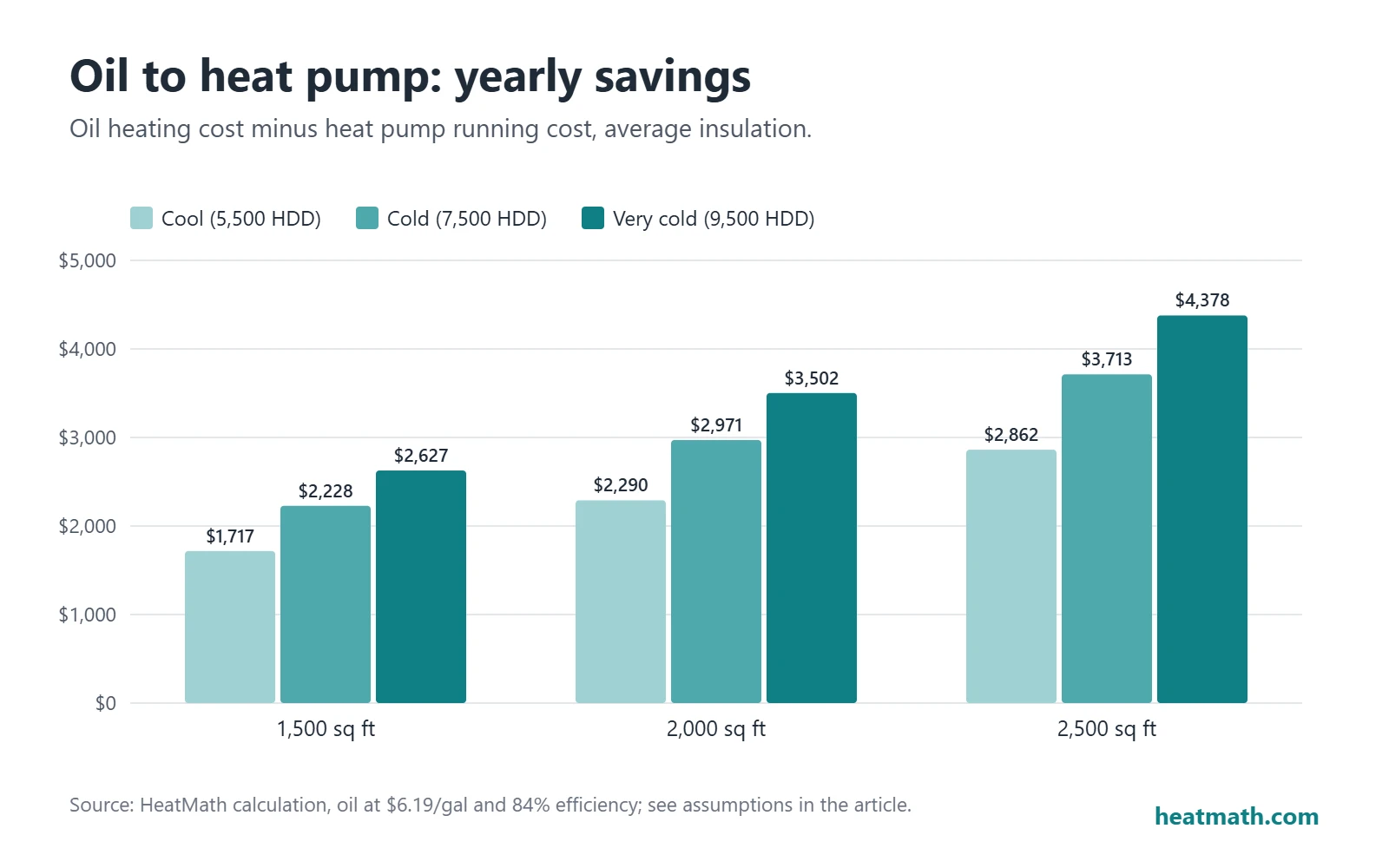
This table runs the same formulas for three house sizes and three cold climates. It shows yearly oil cost, yearly heat pump cost and the difference.
| House size | Climate (HDD) | Oil per year | Oil cost | Heat pump cost | Yearly savings |
|---|---|---|---|---|---|
| 1,500 sq ft | Cool (5,500) | 447 gal | $2,765 | $1,048 | $1,717 |
| 1,500 sq ft | Cold (7,500) | 609 gal | $3,771 | $1,543 | $2,228 |
| 1,500 sq ft | Very cold (9,500) | 772 gal | $4,777 | $2,150 | $2,627 |
| 2,000 sq ft | Cool (5,500) | 596 gal | $3,687 | $1,398 | $2,290 |
| 2,000 sq ft | Cold (7,500) | 812 gal | $5,028 | $2,057 | $2,971 |
| 2,000 sq ft | Very cold (9,500) | 1,029 gal | $6,369 | $2,866 | $3,502 |
| 2,500 sq ft | Cool (5,500) | 745 gal | $4,609 | $1,747 | $2,862 |
| 2,500 sq ft | Cold (7,500) | 1,015 gal | $6,285 | $2,572 | $3,713 |
| 2,500 sq ft | Very cold (9,500) | 1,286 gal | $7,961 | $3,583 | $4,378 |
Assumptions: average insulation, oil at $6.19/gal and 84% efficiency, electricity at $0.182/kWh, heat pump HSPF2 9.5 with the calculator’s cold-weather COP adjustment. Change any input in the heating cost calculator.
Oil prices move fast. The EIA’s October 2026 winter outlook expects oil-heated homes to pay about 21% more for fuel than last winter, with East Coast distillate stocks well below normal. At the $3.80 a gallon many guides still assume, the 1,800 sq ft example above saves only about $930 a year and payback stretches past 15 years. Run your numbers with the price on your last delivery ticket, not a national average.
Incentives after the federal credit ended
The federal 25C credit for heat pumps (up to $2,000) ended on December 31, 2025. Systems installed in 2026 do not qualify. What remains is local:
- State programs. Several Northeastern states run heat pump rebates aimed at oil and propane homes. Amounts and rules change often, so check your state energy office.
- Utility rebates. Many electric utilities offer per-ton rebates for qualifying cold-climate models, sometimes with a special heat pump electric rate.
- Tank removal help. Some towns and states offer grants for removing underground tanks because of leak risk.
Before you ask for quotes
- Pull 12 months of oil delivery tickets and add up the gallons. Subtract hot water use if your boiler also makes domestic hot water.
- Decide whether domestic hot water moves too. If the boiler heats your water, you will need a heat pump water heater or another source, which Fixr puts at $2,000 to $4,000 installed.
- Check your electrical panel rating and free breaker spaces.
- Note whether your tank is above ground, in the basement or buried.
- Ask every contractor for a room-by-room load calculation (ACCA Manual J), not a size based on your old furnace. Oil systems are often oversized. Our heat pump size calculator gives a first estimate to compare against.
- Ask for cold-climate models with published capacity at 5°F, and get a written plan for backup heat.
Oil to heat pump conversion FAQ
Can a heat pump fully replace oil heat in a cold climate?
Yes, if it is a cold-climate model sized to your design temperature. Many keep a share of their rated capacity down to 5°F or below. Electric resistance backup or a retained oil system covers the rare coldest hours.
Do I have to remove my oil tank?
Not always right away, but most owners do once oil is no longer needed. An empty, unused tank still needs proper decommissioning. Buried tanks carry leak risk and can complicate a home sale, so many buyers and insurers ask for removal.
Will my electric bill go up after converting?
Yes. In the 1,800 sq ft example, electricity use rises by about 10,000 kWh a year. The point is that your total energy spend drops because the oil bill disappears. Compare the two together, not the electric bill alone.