Attic insulation cost for blown-in fiberglass or cellulose usually runs about $1.25 to $2.75 per square foot in 2026, so a 1,000 sq ft attic costs roughly $1,250 to $2,750. Topping up an attic that already has some insulation sits at the low end; spray foam costs two to three times more. In a cold climate with a poorly insulated attic, the upgrade can pay for itself in about 2 to 6 years, depending on how you heat.
Prices below come from published 2026 contractor data. The savings and payback figures are our own, worked out with the same heating-load formula used in the HeatMath calculators.
Attic insulation cost by material
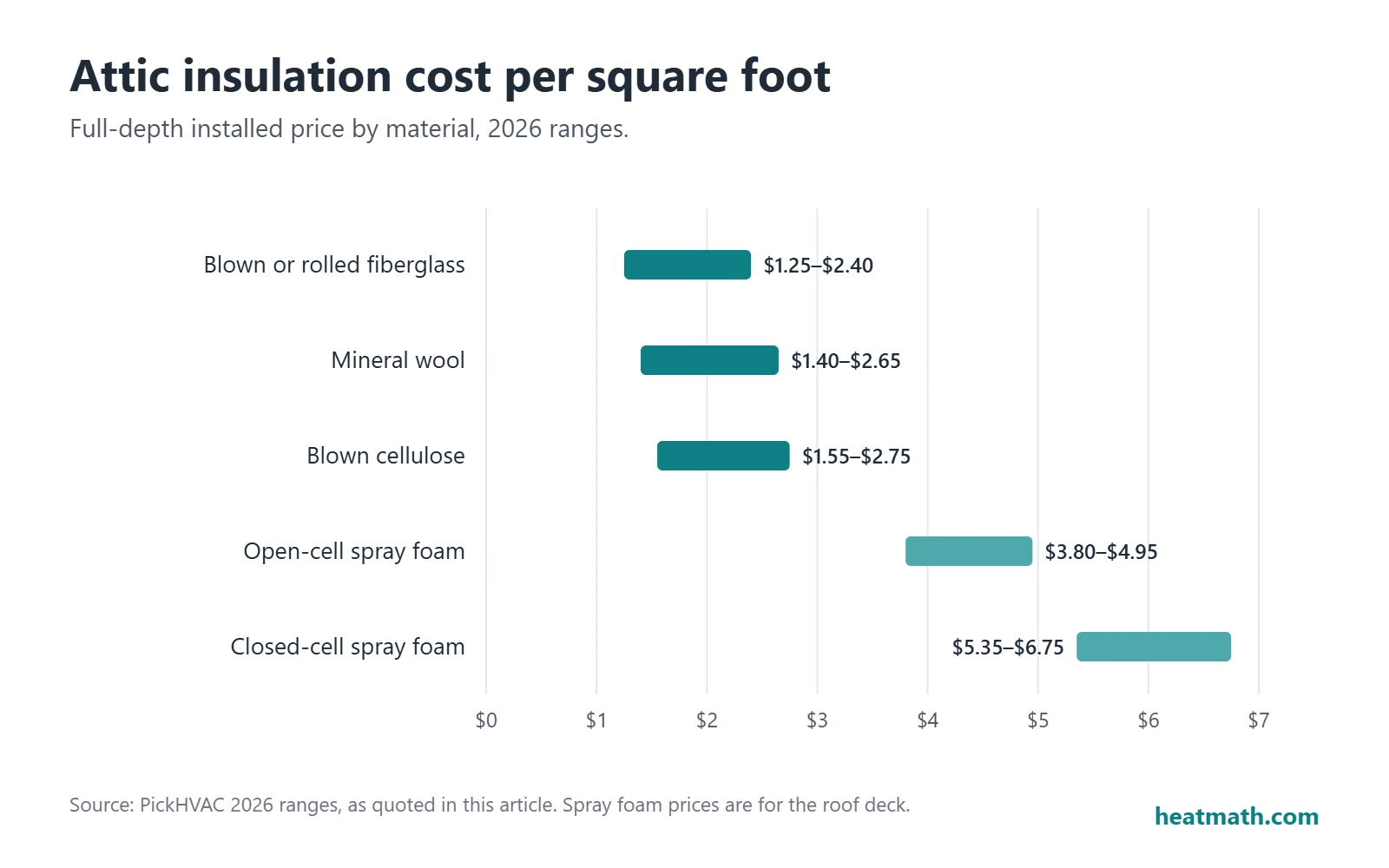
The 2026 ranges published by PickHVAC are a useful baseline. They include material and labor:
| Material | Full depth, per sq ft | Adding to existing, per sq ft |
|---|---|---|
| Blown or rolled fiberglass | $1.25 to $2.40 | $1.25 to $1.75 |
| Mineral wool (rockwool) | $1.40 to $2.65 | $1.40 to $2.00 |
| Blown cellulose | $1.55 to $2.75 | $1.55 to $2.25 |
| Open-cell spray foam (roof deck) | $3.80 to $4.95 | n/a |
| Closed-cell spray foam (roof deck) | $5.35 to $6.75 | n/a |
| Removing old insulation | $1.00 to $2.00 extra | |
Note that PickHVAC’s own page gives slightly different ranges in its table and text, so treat these as guides, not quotes.
What that means for your attic
Multiplying those rates by common attic sizes gives these installed totals:
| Attic floor area | Top-up with fiberglass | Full-depth fiberglass | Full-depth cellulose |
|---|---|---|---|
| 800 sq ft | $1,000 to $1,400 | $1,000 to $1,920 | $1,240 to $2,200 |
| 1,000 sq ft | $1,250 to $1,750 | $1,250 to $2,400 | $1,550 to $2,750 |
| 1,500 sq ft | $1,875 to $2,625 | $1,875 to $3,600 | $2,325 to $4,125 |
| 2,000 sq ft | $2,500 to $3,500 | $2,500 to $4,800 | $3,100 to $5,500 |
Your attic floor is roughly your ground-floor footprint, not your total living area. A 2,000 sq ft two-story house often has an attic near 1,000 sq ft.
How much insulation do you need?
ENERGY STAR’s recommended levels depend on climate zone and what is already there:
- Zone 1 (south Florida, Hawaii): R30 in an empty attic, or add R25 to an attic with 3 to 4 inches.
- Zones 2 and 3 (Gulf Coast, Southeast, Southwest, California): R49, or add R38.
- Zones 4 to 8 (Mid-Atlantic, Midwest, Northeast, Mountain West, Alaska): R60, or add R49.
Blown fiberglass gives roughly R2.2 to R2.7 per inch and cellulose about R3.2 to R3.8, so R49 takes something like 13 to 22 inches depending on the product. The bag label lists the exact depth and coverage for each R-value, and installers should leave depth markers in the attic so you can check.
Blown insulation also settles over time, especially cellulose, so the depth on day one should be a little above the target. If you already have R19 to R30 and live in zone 4 or colder, you are usually a good candidate for a top-up. In zones 1 to 3 the case rests more on summer comfort: an attic that stays cooler means upstairs rooms need less air conditioning, which can even let you choose a smaller unit later. Our guide to what size AC unit you need shows how insulation level changes the tonnage.
Savings and payback: worked numbers
Here is a scenario. An 1,800 sq ft single-story house with a poorly insulated attic gets a full upgrade. In our heating cost calculator, that moves the insulation setting from “poor” (load factor 1.3) to “average” (1.0). That is a conservative stand-in: the calculator’s setting covers the whole house, and the attic is usually the biggest single fix.
Load saved = 1,800 × HDD × 6.3 × (1.3 − 1.0)
In a cold climate (7,500 heating degree days) that is about 25.5 million BTU a year. Here is what that saves on the heating bill alone, by fuel:
| Climate | Natural gas | Propane | Heat pump | Electric resistance |
|---|---|---|---|---|
| Mixed (3,500 HDD) | $207 | $405 | $213 | $593 |
| Cool (5,500 HDD) | $325 | $636 | $352 | $932 |
| Cold (7,500 HDD) | $444 | $868 | $519 | $1,271 |
| Very cold (9,500 HDD) | $562 | $1,099 | $723 | $1,610 |
Assumptions: gas $1.60/therm at 92% efficiency, propane $2.80/gal at 90%, electricity $0.17/kWh, heat pump HSPF2 9.5 with the calculator’s cold-weather adjustment. Cooling savings are not included.
If the job costs $2,700 (1,800 sq ft at $1.50 per sq ft), simple payback works out to:
- Electric baseboard or furnace: about 2 to 5 years.
- Propane: about 2.5 to 7 years.
- Natural gas or heat pump: about 4 to 13 years, fastest in the coldest zones.
In hot climates the payback comes mostly from summer cooling instead. A cooler attic also reduces the load on ducts that run through it, a topic covered in our guide to ductwork replacement cost.
Five steps before you hire anyone
- Measure what you have. With a flashlight and a tape measure, check the depth in three or four spots. Note the type: pink or yellow fluff, gray fibers, or batts.
- Look for problems first. Signs of roof leaks, mold, wet spots, or knob-and-tube wiring need attention before new insulation goes in. Old vermiculite (gray-brown pebbles) may contain asbestos; do not disturb it and have it tested.
- Air seal before you insulate. Gaps around plumbing stacks, light fixtures, the attic hatch and top plates let warm air leak through insulation. Ask that air sealing be priced as a separate line.
- Protect the vents. Baffles at the eaves keep insulation from blocking soffit vents. Recessed lights must be rated for insulation contact or covered properly.
- Get the R-value in writing. The quote should name the material, final R-value, settled depth and square footage, not just “blow in insulation.”
Better insulation also changes how much heating and cooling you need. If your system is due for replacement, run the heat pump size calculator with the “good” insulation setting before you buy, so you do not end up with an oversized unit.
For a DIY attic check or top-up
As an Amazon Associate, HeatMath earns from qualifying purchases. These links open Amazon search results, so you can compare brands and prices yourself.
Attic insulation cost questions
Is it cheaper to add insulation or replace it?
Adding on top is cheaper when the old insulation is dry, clean and free of pests. Removal adds about $1 to $2 per square foot and is worth it only when the old material is wet, moldy, contaminated or hiding air leaks you need to seal.
Can I blow in attic insulation myself?
Many home centers lend a blowing machine when you buy enough bags. It is a two-person job. Wear a respirator, goggles and long sleeves, keep insulation away from flues and recessed lights, and install eave baffles first.
Is there still a tax credit for attic insulation?
No. The federal 25C credit, which covered insulation, ended on December 31, 2025. Some utilities and states still offer rebates for insulation and air sealing, so check your utility’s website before you book the job.