What size AC unit do I need? For most homes, a quick rule is 20 BTU of cooling per square foot, which works out to about 1 ton (12,000 BTU) for every 600 sq ft. A 1,500 sq ft home usually needs about 2.5 tons, and a 2,000 sq ft home about 3 to 3.5 tons. Climate, insulation, windows and ceiling height can move that up or down by half a ton or more, so treat the rule as a starting point and confirm with a Manual J load calculation.
What size AC unit do I need by square footage?
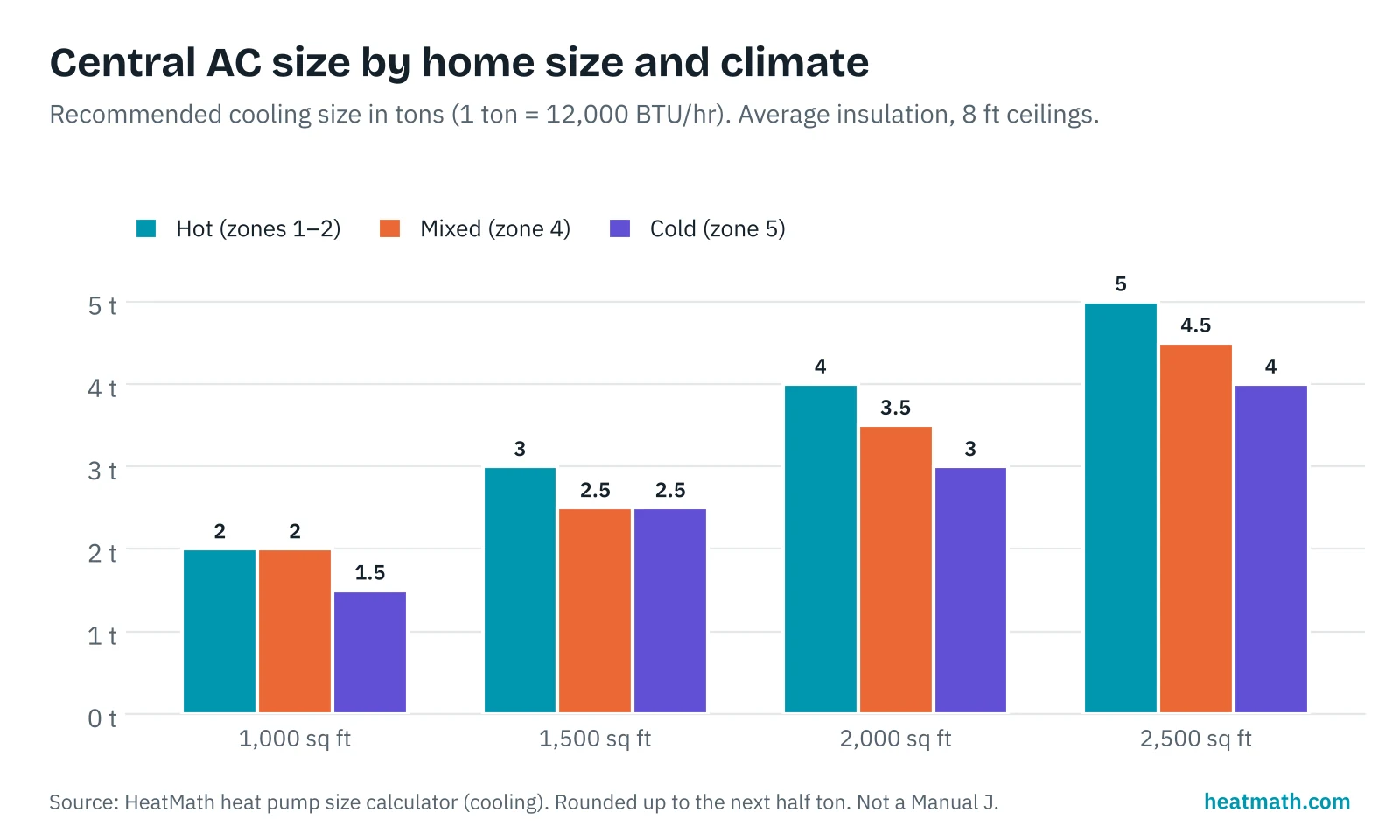
Central air conditioners are sold in half-ton steps, from 1.5 to 5 tons for most homes. One ton equals 12,000 BTU per hour of cooling. The chart below uses the 20 BTU per square foot rule and rounds to the nearest common size.
| Home size (sq ft) | Cooling needed (BTU/h) | AC size (tons) |
|---|---|---|
| 600 – 900 | 12,000 – 18,000 | 1 – 1.5 |
| 900 – 1,200 | 18,000 – 24,000 | 1.5 – 2 |
| 1,200 – 1,500 | 24,000 – 30,000 | 2 – 2.5 |
| 1,500 – 1,800 | 30,000 – 36,000 | 2.5 – 3 |
| 1,800 – 2,100 | 36,000 – 42,000 | 3 – 3.5 |
| 2,100 – 2,400 | 42,000 – 48,000 | 3.5 – 4 |
| 2,400 – 3,000 | 48,000 – 60,000 | 4 – 5 |
Homes above 3,000 sq ft often need two systems or zoning, because 5 tons is the largest standard residential split system.
The basic formula
Tons = (Square feet × 20) ÷ 12,000
Example: a 1,700 sq ft home needs 1,700 × 20 = 34,000 BTU. Divide by 12,000 and you get 2.83 tons, so a 3-ton unit is the likely fit. Our BTU calculator runs this math with the adjustments below.
BTUs you need
Standard air conditioner sizes (the size to buy is highlighted)
| AC size | Cools up to | Tons |
|---|
Adjust for your home and climate
The square footage rule assumes an average house in an average climate. Real homes vary. Adjust your estimate with these factors:
| Factor | Adjustment |
|---|---|
| Hot climate (South, Southwest) or poor insulation | Round up about half a ton |
| Mild climate or new, well-insulated home | Round down about half a ton |
| Ceilings over 8 feet | Add capacity for the extra air volume |
| Large south- or west-facing windows | Add capacity for solar heat gain |
| Heavy shade from trees | Can reduce the load |
| Kitchen open to living areas | Add about 4,000 BTU |
| More than two regular occupants | Add about 600 BTU per extra person |
| Leaky or uninsulated ducts in an attic | Fix the ducts before sizing up |
The kitchen and occupant figures come from ENERGY STAR’s room air conditioner sizing guidance. They are a good sense check for whole-home systems too.
Why a Manual J load calculation beats the rule of thumb
Manual J is the industry standard method from ACCA (Air Conditioning Contractors of America). It adds up heat gain through every wall, window, ceiling and duct, plus people and appliances, for your local design temperature. It often shows that a home needs less capacity than the old unit, especially after new windows or insulation.
Ask any contractor quoting a new system for a Manual J. If they size by looking at the old unit’s label, get another quote. For a sense of typical prices by size, see our AC replacement cost guide.
Problems with the wrong size
Oversized AC
A unit that is too big cools the air fast and shuts off before it has time to pull moisture out. This is called short cycling. You get a cold, clammy house, uneven rooms, more wear on the compressor and higher bills. Oversizing is the more common mistake, because many installers add “a little extra” to avoid complaints.
Undersized AC
A unit that is too small runs nonstop on hot afternoons and still cannot reach the set temperature. It wears out faster and costs more to run during heat waves. In a mild climate, slight undersizing is less harmful than oversizing, since the long cycles remove humidity well.
Variable-speed and two-stage systems are more forgiving. They can run at low output most of the time, which limits short cycling if the unit is a bit large.
Efficiency rules to know before you buy
Size and efficiency are separate choices. Tonnage decides how much heat the unit removes. SEER2 decides how much electricity it uses to do it. The federal minimum for a new central AC is 13.4 SEER2 in the North and 14.3 SEER2 in the South. If you are upgrading from an old unit, the SEER savings calculator shows what a higher rating is worth on your bill.
If you are replacing a central AC, consider a heat pump of the same size. It cools the same way and also heats. See heat pump vs. air conditioner for the trade-offs.
Sizing for a single room or addition
For one room, a window unit or ductless mini split is usually a better fit than extending ducts. Room units are rated in BTU, not tons. A 250 sq ft bedroom needs about 6,000 BTU, and a 450 sq ft room about 10,000 BTU, before adjusting for sun and kitchens. For ductless pricing, see mini split cost.
Signs your current AC is the wrong size
Before you copy the size of your old unit, check whether it ever worked well. These signs point to a sizing problem:
- Cycles under 10 minutes on a hot day, then shuts off. That is classic oversizing.
- Indoor humidity above 60% even when the thermostat is satisfied. The unit is not running long enough to dry the air.
- Big temperature gaps between rooms, often upstairs vs. downstairs. This can be sizing, but it is more often duct design or airflow.
- Runs all afternoon and never reaches the setpoint on normal summer days, not just record heat. That suggests undersizing or low refrigerant.
If you see these problems, tell your contractor. A new system sized the same way will have the same issues. Upgrades since the last install, such as new windows, attic insulation or air sealing, also lower the load, so the right size today may be smaller than the old one.
Handy gear for this job
As an Amazon Associate, HeatMath earns from qualifying purchases. These links open Amazon search results, so you can compare brands and prices yourself.
Frequently asked questions
What size AC unit do I need for a 2,000 sq ft house?
Most 2,000 sq ft homes need about 3 to 3.5 tons (36,000 to 42,000 BTU). A well-insulated home in a mild climate may do fine with 3 tons or less. A hot, sunny climate or older home may need 3.5 to 4 tons. A Manual J calculation gives the right answer.
Is it bad to get a bigger AC unit than I need?
Yes. An oversized unit short cycles, leaves the house humid and wears out sooner. It also costs more to buy. Pick the size that matches your calculated load, not one size up.
How many square feet does a 3-ton AC cool?
Using 20 BTU per square foot, a 3-ton unit (36,000 BTU) cools about 1,500 to 1,800 sq ft in a typical climate. In a mild climate with good insulation, it may handle up to about 2,000 sq ft.