Since January 1, 2023, air conditioners and heat pumps sold in the US are rated with SEER2, EER2 and HSPF2 instead of SEER, EER and HSPF. The equipment did not suddenly become less efficient. The test changed to reflect real homes more closely, mainly by assuming more resistance from ductwork, and the numbers came out lower.
What SEER2 measures
SEER2 (Seasonal Energy Efficiency Ratio 2) is the cooling delivered over a typical season, in BTU, divided by the electricity used, in watt-hours. A higher number means lower cooling bills. A 16-rated system uses about 20% less electricity for cooling than a 13.4-rated system of the same size.
What HSPF2 measures
HSPF2 (Heating Seasonal Performance Factor 2) is the heating equivalent for heat pumps: BTU of heat delivered over a heating season per watt-hour of electricity. Divide HSPF2 by 3.412 to get an approximate seasonal COP. An HSPF2 of 8.5 means the heat pump delivers about 2.5 times as much heat as electric resistance heating for the same electricity.
What EER2 measures
EER2 is efficiency at a single hot condition (95°F outside). It matters most in very hot, dry climates where the system spends many hours at full load.
Why SEER2 numbers are lower than old SEER numbers
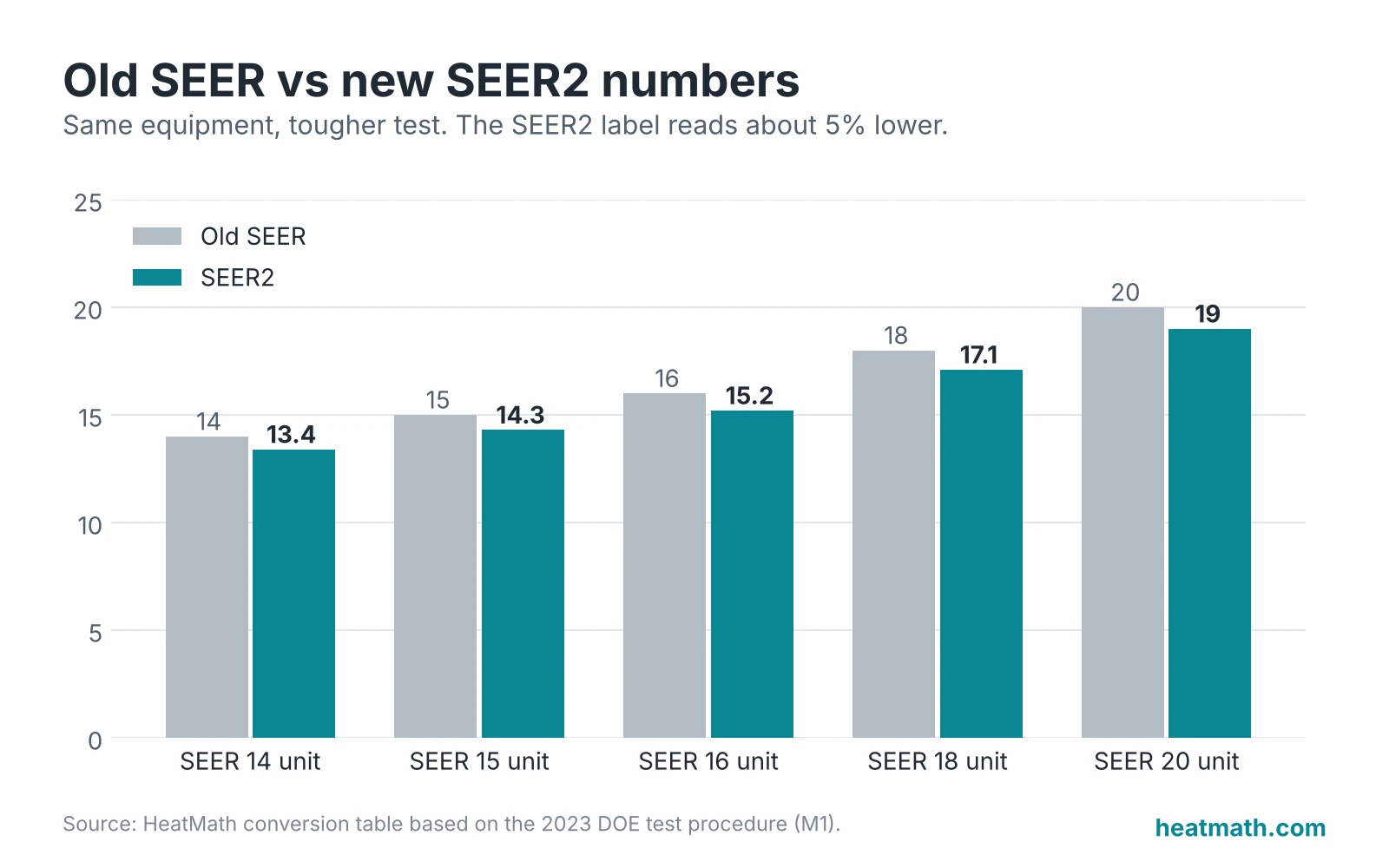
The new cooling number is lower than the old SEER number for the same machine. The equipment did not get worse. The test got tougher.
Real ductwork pushes back against the blower. Engineers call this external static pressure. The old SEER test assumed almost none. The new test procedure (known as M1) assumes about five times more, which is closer to what a typical home’s ducts produce.
| Test detail | Old SEER / HSPF | New ratings (2023+) |
|---|---|---|
| External static pressure | 0.1 in. w.c. | 0.5 in. w.c. |
| Blower effort | Light, lab-like | Closer to real homes |
| Result on the label | Higher number | About 5% lower for cooling, about 15% lower for heating |
| Required on new equipment | Before 2023 | Since January 1, 2023 |
So a 14 SEER unit from 2020 and a 13.4 SEER2 unit today can have the same efficiency. When you compare an old quote to a new one, convert first.
Converting old ratings
| Old rating | Approximate new rating |
|---|---|
| SEER 14 | 13.4 SEER2 |
| SEER 15 | 14.3 SEER2 |
| SEER 16 | 15.2 SEER2 |
| SEER 18 | 17.1 SEER2 |
| SEER 20 | 19 SEER2 |
| HSPF 8.8 | 7.5 HSPF2 |
| HSPF 9 | 7.7 HSPF2 |
| HSPF 10 | 8.5 HSPF2 |
Rough rule: SEER2 ≈ SEER × 0.95, and HSPF2 ≈ HSPF × 0.85.
Current federal minimums
| Equipment | North | South and Southwest |
|---|---|---|
| Central air conditioner (split) | 13.4 SEER2 | 14.3 SEER2 (plus EER2 minimums in the Southwest) |
| Heat pump (split) | 14.3 SEER2 and 7.5 HSPF2 | 14.3 SEER2 and 7.5 HSPF2 |
Which rating is worth paying for?
- Hot climates (lots of cooling): pay for SEER2 and EER2. Going from the minimum to 16–17 usually pays back.
- Cold climates (lots of heating): HSPF2 matters more than SEER2. Look for 8.5+ HSPF2 and, just as important, the capacity and COP at 5°F. See cold-climate heat pumps.
- Mild climates: the difference between 15 and 20 SEER2 is often only $50–$100 a year. Spend the money on ductwork and insulation instead.
Calculate your own savings with the SEER2 savings calculator.
How much a higher SEER2 rating saves
Cooling electricity scales with the inverse of the rating. You can estimate the cut with one line of math:
Savings % = 1 − (old rating ÷ new rating)
| Rating upgrade | Cooling energy saved | Every $100 of cooling power becomes |
|---|---|---|
| 13.4 → 15.2 | About 12% | About $88 |
| 14.3 → 16 | About 11% | About $89 |
| 14.3 → 18 | About 21% | About $79 |
| 14.3 → 20 | About 29% | About $72 |
Notice the diminishing returns. Each extra point saves less than the one before. With US residential power averaging about 18 cents per kWh in 2026, a big jump pays off fastest in hot climates with long cooling seasons. In a mild climate, the price gap for a top-tier system may never pay back. Plug in your own numbers with the SEER savings calculator.
Check the matched rating
SEER2 and HSPF2 apply to a matched outdoor unit, indoor coil or air handler, and sometimes furnace. The same outdoor unit can have a different rating with a different indoor coil. Ask for the AHRI certificate number of the exact combination on your quote.
ENERGY STAR and cold-climate thresholds
The federal minimum is the floor. ENERGY STAR sets a higher bar, and many utility rebates use it as the cutoff.
- ENERGY STAR split heat pump: at least 15.2 for cooling and 7.8 HSPF2.
- ENERGY STAR packaged heat pump: the same 15.2 cooling floor and at least 7.2 HSPF2.
- ENERGY STAR cold climate: 8.1 to 8.5 HSPF2 depending on type, plus a COP of at least 1.75 at 5°F and at least 70% of rated heating capacity at 5°F.
HSPF2 is a seasonal average for a moderate climate. It does not tell you how the unit behaves on the coldest nights. If winters in your area drop below 20°F, check the COP and capacity at 5°F on the spec sheet. Our cold climate heat pump guide explains what to look for.
To check a model, search the ENERGY STAR product finder by brand and model number. It lists all three ratings side by side, and it flags cold-climate models, which saves you from digging through spec sheets.
Frequently asked questions
What is a good SEER2 rating?
For most homes, 15.2 to 17 is a good target. That range meets ENERGY STAR and usually qualifies for utility rebates without a big price jump. Ratings above 18 make sense in hot, long cooling seasons. In mild climates, the extra savings are small and may not cover the higher upfront cost.
Is 14.3 SEER2 the same as 15 SEER?
Roughly, yes. The new rating runs about 5% lower than SEER for the same equipment, so 15 SEER converts to about 14.3. The machine is not less efficient. The newer test simply uses higher duct pressure, which lowers the number on the label.
Is a higher HSPF2 always better?
A higher HSPF2 means lower average heating costs, so it is better on paper. But HSPF2 is based on a moderate climate. In cold regions, performance at 5°F matters more. Two units with the same HSPF2 can behave very differently in deep cold, so check the low-temperature capacity too.
Related: AC replacement cost, heat pump vs air conditioner.