Yes. Heat pumps work in cold weather, and today’s cold climate heat pumps keep heating homes in Maine, Minnesota and Alaska. There is usable heat in outdoor air even at −15°F. What changes as it gets colder is how much heat the unit can move and how efficiently it does it.
How cold is too cold for a heat pump?
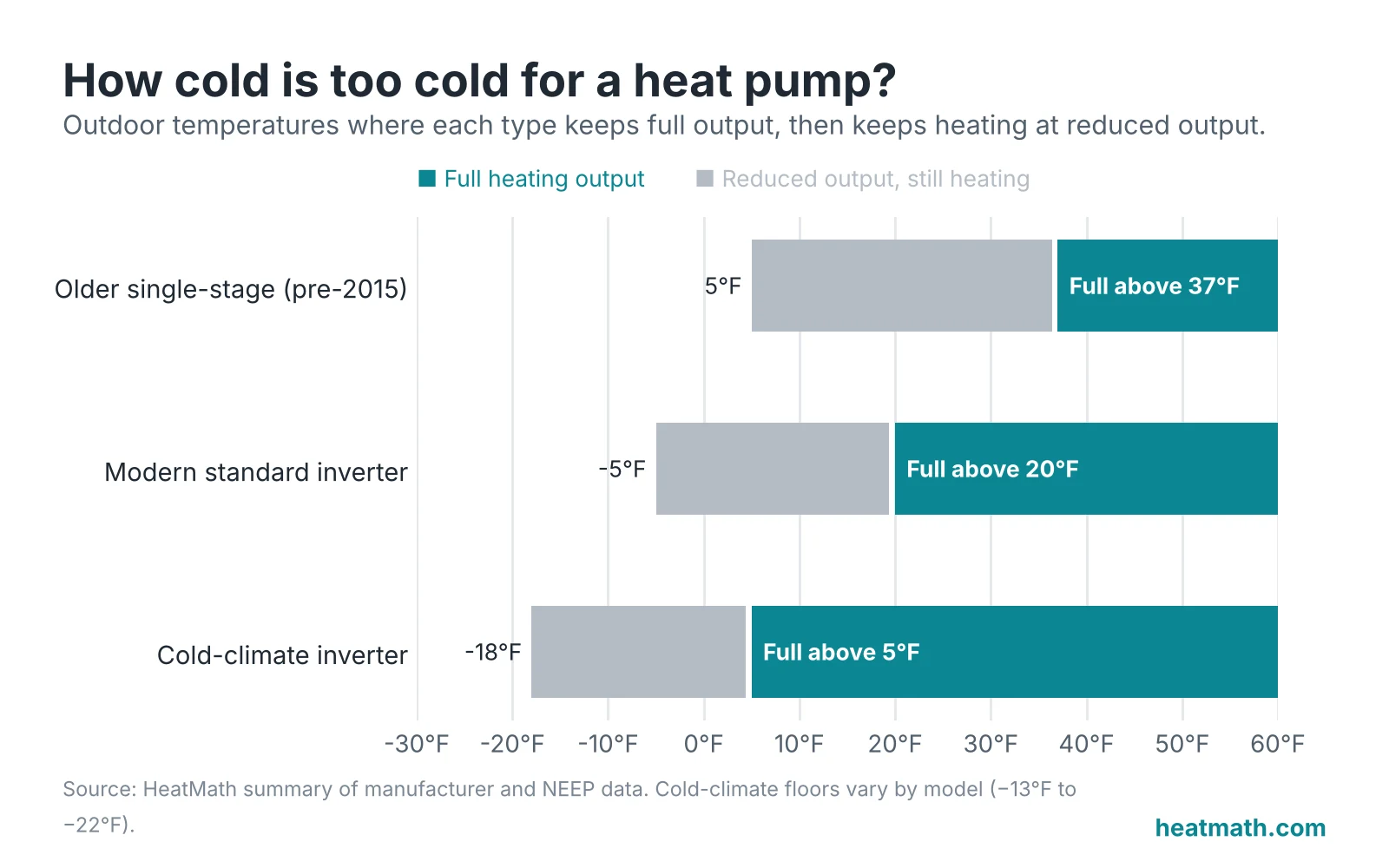
| Heat pump type | Keeps full heating output to about | Still produces heat down to |
|---|---|---|
| Older single-stage (pre-2015) | 35–40°F | about 0–10°F |
| Modern standard inverter | 17–25°F | about −5°F |
| Cold-climate inverter | 5°F | −13°F to −22°F |
Efficiency at low temperatures
Efficiency is measured as COP, the heat delivered per unit of electricity. Typical cold-climate models reach:
- COP 3.5–4.5 at 47°F
- COP 2.5–3 at 17°F
- COP 1.8–2.2 at 5°F
- COP 1.3–1.7 at −13°F
Even at 5°F, a COP of 2 means the heat pump delivers twice as much heat per kWh as electric baseboard or an electric furnace.
What makes cold climate heat pumps different?
In the US the usual benchmark is the ENERGY STAR cold-climate criteria (built on earlier NEEP specifications). A qualifying unit must deliver at least 70% of its rated heating capacity at 5°F and have a COP of at least 1.75 at 5°F. Variable-speed (inverter) compressors, enhanced vapor injection and larger outdoor coils make that possible.
How to verify a cold climate rating
“Cold climate” is a marketing phrase unless the numbers back it up. Two lists do the checking for you: the ENERGY STAR cold climate designation and the NEEP cold climate air source heat pump list. Both publish tested performance at 5°F, which matters far more in a northern winter than the standard ratings.
| Metric | ENERGY STAR cold climate minimum | Federal heat pump minimum |
|---|---|---|
| Efficiency (COP) at 5°F | 1.75 or higher | None |
| Heating capacity at 5°F | At least 70% of capacity at 47°F | None |
| HSPF2 | 8.1–8.5, by system type | 7.5 |
| SEER2 | 15.2 | 14.3 |
A COP of 1.75 means the unit delivers 75% more heat than a baseboard heater would for the same electricity, even at 5°F. The capacity rule matters just as much. A unit that keeps 70% or more of its output at 5°F needs far less backup heat on the coldest nights.
When you compare quotes, ask for the model’s 5°F capacity and COP from the NEEP or ENERGY STAR listing, not just the HSPF2. Our SEER2 and HSPF2 guide explains why HSPF2 alone can hide weak low-temperature performance.
Sizing a heat pump for a cold climate
In northern states the heating load is often twice the cooling load. Size the heat pump so it covers most or all of the heating load at your local design temperature, using the capacity the manufacturer lists at 5°F, not the nominal tonnage. A “3-ton” unit might deliver 36,000 BTU at 47°F but only 25,000 at 5°F. Our heat pump size calculator shows your approximate heating load.
Backup heat options
- Electric heat strips in the air handler: cheapest to install, expensive to run, but only needed for a few hours a year with a well-sized cold-climate unit.
- Dual fuel: keep your gas or propane furnace and let it take over below a chosen temperature.
- No backup: some homeowners with a correctly sized cold-climate heat pump and a wood stove or a few baseboard heaters skip central backup entirely.
Tips for cold-weather performance
- Mount the outdoor unit on a stand or wall bracket 12–24 inches above the typical snow depth.
- Keep the area under it clear so defrost water can drain instead of refreezing.
- Avoid big thermostat setbacks at night. Recovering from 62°F to 70°F on a cold morning pulls in expensive backup heat. Small setbacks of 2–3°F are fine.
- Seal air leaks and add attic insulation. Every BTU you don’t lose is one the heat pump doesn’t need to find in the cold air.
Is it cheaper to run than oil or propane in the cold?
Usually, yes. Even at an average seasonal COP of 2.3, a heat pump in a cold climate typically beats heating oil and propane at recent prices. Check your own numbers with the heating cost calculator.
Cold climate heat pump running costs by region
To see what the label is worth, we calculated a full heating season for a 2,000-square-foot home with average insulation in four climates, using the same formulas as our heat pump savings calculator. HSPF2 7.5 is the federal minimum, 8.1 is the ENERGY STAR cold climate floor for ducted units, and 9.5 and 10.5 represent better cold climate models.
| Climate (heating degree days) | Season load | HP at HSPF2 7.5 | HP at 8.1 | HP at 9.5 | HP at 10.5 | Gas furnace | Propane | Heating oil | Electric resistance |
|---|---|---|---|---|---|---|---|---|---|
| Mixed (3,500) | 44.1 MBtu | $1,058 | $980 | $836 | $756 | $767 | $1,499 | $1,440 | $2,326 |
| Cool (5,500) | 69.3 MBtu | $1,751 | $1,621 | $1,382 | $1,251 | $1,205 | $2,356 | $2,264 | $3,656 |
| Cold (7,500) | 94.5 MBtu | $2,577 | $2,386 | $2,035 | $1,841 | $1,643 | $3,213 | $3,087 | $4,985 |
| Very cold (9,500) | 119.7 MBtu | $3,591 | $3,325 | $2,835 | $2,565 | $2,082 | $4,070 | $3,910 | $6,315 |
Load = ft² × HDD × 6.3 × insulation (1.0). Heat pump cost = load ÷ 3,412 ÷ COP × $/kWh, with COP = HSPF2 ÷ 3.412, reduced 5% at 5,500 HDD, 12% at 7,500 HDD and 20% at 9,500 HDD. Prices: electricity $0.18/kWh (close to the EIA’s 2026 U.S. residential average of about 18.2 cents), gas $1.60/therm at 92% AFUE, propane $2.80/gal at 90%, oil $3.80/gal at 84%.
Three things stand out:
- Against propane, oil and resistance heat, a good cold climate heat pump wins everywhere, by about $1,000 to $1,500 a year against propane in the cool to very cold rows and more than $3,000 against resistance heat in a very cold climate.
- Against gas at $1.60 per therm, it does not win on fuel cost in cool and colder climates at 18-cent power. In a mixed climate, an HSPF2 10.5 unit roughly ties gas. Cheaper power or pricier gas flips this quickly, so run your own numbers in the heating cost calculator.
- The step from 7.5 to 9.5 HSPF2 is worth about $370 to $760 a year in the cool to very cold rows. That gap is the real value of buying a true cold climate model instead of a minimum-efficiency unit.
Worked example: replacing propane in a very cold climate
- House: 2,000 ft², average insulation, about 9,500 heating degree days (northern Minnesota or similar).
- Current cost: propane furnace, about $4,070 a season at $2.80 per gallon.
- Heat pump at HSPF2 9.5 (cold climate model): about $2,835 at 18 cents per kWh, including the climate penalty on COP.
- Saving: about $1,235 a year. At $0.14 per kWh the heat pump cost falls to about $2,205 and the saving rises to about $1,865.
- Sizing check: our heat pump size calculator uses 33 BTU per square foot for the coldest zone, so this home needs about 66,000 BTU/h on a design day. A unit that keeps 70% of its capacity at 5°F would need a nominal rating near 94,000 BTU/h to cover that alone, larger than most single residential systems.
That last step is why most very cold installations keep backup heat. The options are electric resistance strips in the air handler, or the existing furnace as a dual fuel heat pump setup, which lets the furnace handle only the coldest hours. Either way, the heat pump carries most of the season’s heat, and backup runs for a small share of the hours.
Cold climate heat pump models to know
Ductless systems built the cold climate track record. Several model lines are rated to keep heating well below 0°F:
| Brand and line | Main type | Rated to operate down to |
|---|---|---|
| Mitsubishi Hyper-Heat (H2i) | Ductless and ducted | -13°F |
| Fujitsu XLTH | Ductless | -15°F |
| Daikin Aurora | Ductless | -13°F |
Limits vary by model size, so confirm the rating for the exact outdoor unit on your quote. “Rated to” means the unit still runs at that temperature, not that it delivers full output there.
Ducted options have caught up. Eight major manufacturers completed the Department of Energy’s Residential Cold Climate Heat Pump Challenge. Their prototypes ran at temperatures as low as -15°F in real homes while still meeting efficiency targets. In field tests they needed little help from backup heat. Models from that program are now reaching the market, which gives homeowners with existing ductwork more choice.
How much does a cold climate heat pump cost?
Expect to pay more than for a standard model. Cold climate units add larger variable-speed compressors and better defrost controls. Typical installed prices before rebates:
- Ducted whole-home system: often $12,000–$18,000. EnergySage puts the national average for all heat pumps at about $15,400.
- Single-zone ductless mini split: roughly $2,500–$6,000.
- Multi-zone ductless: climbs with each indoor head, often into five figures.
Prices run higher in the Northeast, where labor costs are high and systems tend to be larger. The federal 25C tax credit ended for equipment placed in service after December 31, 2025. State programs and utilities in cold states often still offer rebates, so check before you sign. See our heat pump installation cost guide for a full breakdown.
Handy gear for this job
As an Amazon Associate, HeatMath earns from qualifying purchases. These links open Amazon search results, so you can compare brands and prices yourself.
Buying checklist for a cold climate heat pump
- Ask for the 5°F numbers in writing: capacity in BTU/h and COP at 5°F for the exact outdoor and indoor unit pair, not the series.
- Check the ENERGY STAR cold climate listing or the NEEP cold climate product list for that model pair.
- Compare 5°F capacity to your design load, not the nominal tonnage. Ask the contractor for a room-by-room load calculation (Manual J).
- Confirm the lowest operating temperature. Many cold climate units run down to -13°F or lower; some shut off sooner.
- Plan the backup: strip heat size, or furnace switchover temperature for dual fuel.
- Raise the outdoor unit above typical snow depth and keep the defrost drain path clear.
- Budget without the federal credit. The 25C tax credit for heat pumps ended on December 31, 2025, so check state and utility rebates instead.
Rule of thumb: the colder your winters and the pricier your current fuel, the more the cold climate label pays. If you heat with cheap natural gas, focus on the dual fuel option rather than replacing the furnace outright.
Frequently asked questions
Do heat pumps work at 0°F?
Yes, if you choose a cold climate model. Leading ductless lines are rated to run down to -13°F to -15°F, and ENERGY STAR cold climate units must still reach a COP of at least 1.75 at 5°F. Output does drop as the temperature falls, so the system must be sized for your design temperature. A standard heat pump may struggle and lean on backup heat at 0°F.
Do cold climate heat pumps need backup heat?
Not always, but most installers include some. In DOE field tests, the new cold climate units heated homes with little help from auxiliary heat even in the coldest periods. Backup still covers defrost cycles, extreme cold snaps and equipment failures. In very cold regions, electric strips or an existing furnace are a cheap safety net.
What HSPF2 should I look for in a cold climate?
Aim for at least 8.1 for ducted systems and 8.5 for ductless, the ENERGY STAR cold climate minimums. The federal minimum is 7.5. HSPF2 is only part of the story. For a northern home, the tested capacity and COP at 5°F tell you more about real winter performance than the seasonal rating.
Is ductless or ducted better for cold climates?
Ductless has the longer track record in severe cold, and ductless systems avoid heat loss through ducts in unheated spaces. Ducted cold climate models now exist from several major brands, though. If your home already has good ductwork, a ducted cold climate unit is usually the simpler whole-home choice.
Is a cold climate heat pump worth it in a mild climate?
Usually not for the cold-weather features alone. In a mixed climate, a standard high-efficiency heat pump gives most of the savings. The cold climate premium pays back fastest where winters regularly drop below 15°F.
Related: heat pump installation cost, heat pump vs furnace.