The heat pump installation cost for a ducted air-source system in a typical American home is roughly $10,000 to $25,000 installed in 2026. A single-room ductless mini split starts around $2,500, and a geothermal system usually runs $20,000 to $50,000. The spread is wide because the price depends on the size of the house, the climate, the condition of the ducts and how much electrical work is needed.
Quick check: run your home through the heat pump size calculator to see what tonnage you should be quoted, and the savings calculator to see whether the running costs justify the price.
Heat pump installation cost by size
Installed prices for a ducted air-source system replacing an existing furnace and AC, with ductwork in usable condition:
| Size | Typical home | Installed cost |
|---|---|---|
| 1.5–2 tons | about 1,000 sq ft | $6,000 – $8,500 |
| 2.5 tons | about 1,500 sq ft | $8,000 – $10,500 |
| 3 tons | about 2,000 sq ft | $10,000 – $20,000 |
| 3.5–4 tons | about 2,500 sq ft | $12,000 – $22,000 |
| 4–5 tons | about 3,000 sq ft | $18,000 – $25,000 |
| 5 tons or two systems | 3,500 sq ft and up | $20,000 – $32,000 |
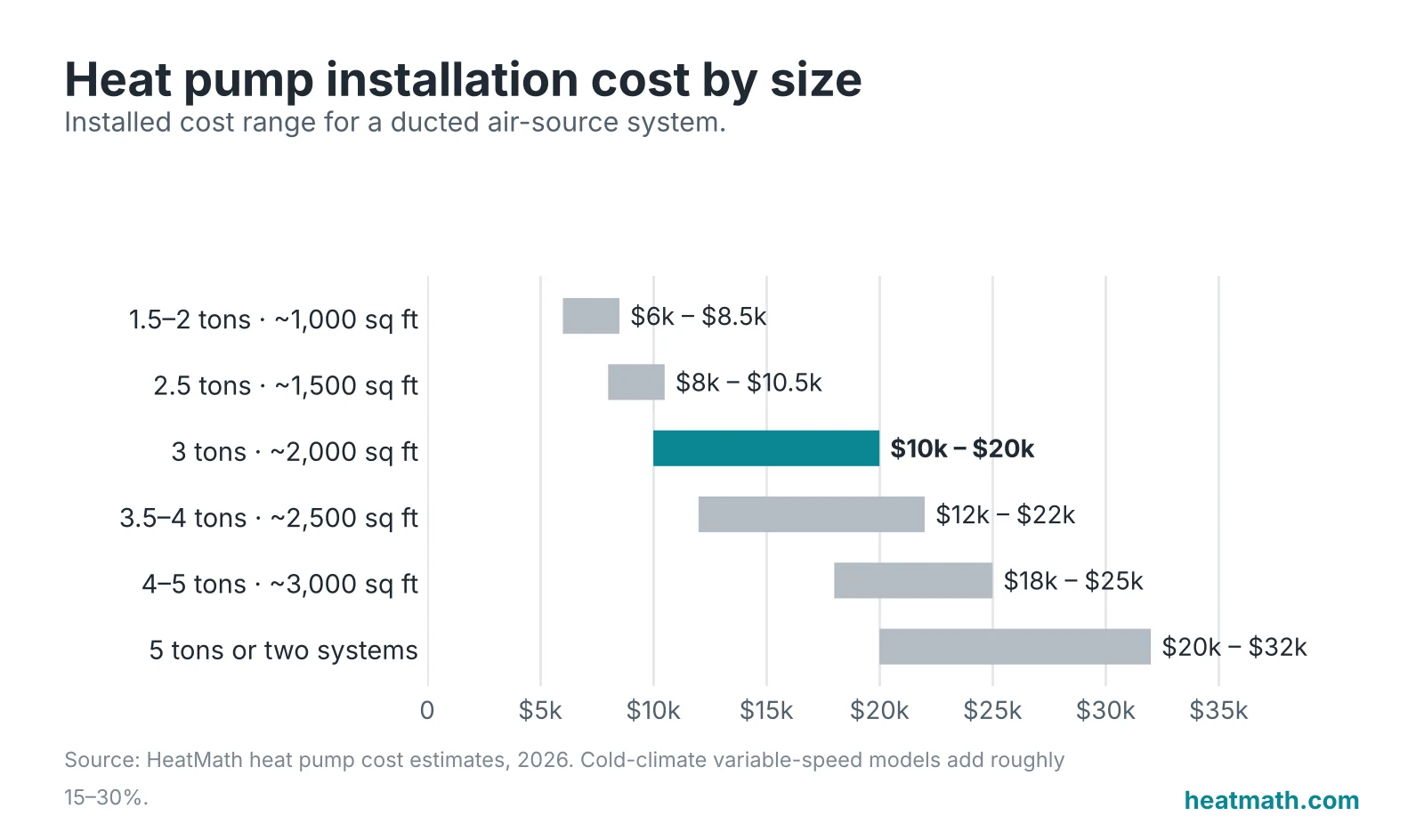
Square footage is only a proxy. A well-insulated 2,500 sq ft house in Georgia may need less capacity than a drafty 1,800 sq ft house in Ohio.
Heat pump cost by type
| Type | Installed cost | Best for |
|---|---|---|
| Ducted air-source (central) | $10,000 – $25,000 | Homes with existing ducts |
| Ductless mini split, 1 zone | $2,500 – $6,000 | One room, addition, garage |
| Ductless mini split, 3 zones | $6,500 – $11,000 | Homes without ducts |
| Cold-climate variable-speed | add 15–30% | Winters below 5°F |
| Geothermal (ground-source) | $20,000 – $50,000+ | Large lots, long ownership |
Heat pump installation cost by brand
Brand tier sets the starting point for a quote. For a typical 3-ton ducted system, installed prices fall into three rough groups:
| Tier | Example brands | 3-ton installed |
|---|---|---|
| Budget | Goodman, Amana, Heil, Payne | $3,500–$9,000 |
| Mid-range | Rheem, Ruud, York, Daikin | $5,000–$10,500 |
| Premium | Carrier, Trane, Lennox, American Standard | $6,500–$15,000 |
Within each brand, price climbs with efficiency and compressor type. A premium brand’s single-stage model can cost less than a budget brand’s variable-speed unit. Compare quotes on SEER2 and HSPF2 ratings and compressor type first, then brand.
What is included in the price
- Equipment: outdoor unit, indoor air handler or coil, and thermostat. Usually 40–50% of the total.
- Labor: most installs take one or two days for a crew of two. Labor rates run about $80 to $200 an hour depending on the region.
- Refrigerant line set, pad and disconnect: often reused if compatible, otherwise $500 to $1,500.
- Permits: $50 to $300 in most towns.
- Removal of the old system: sometimes itemized at $200 to $500.
Costs that push a quote higher
- Electrical panel upgrade: older 100-amp panels may not have room for a heat pump plus backup heat strips. An upgrade to 200 amps typically costs $1,500 to $4,000.
- Ductwork repair or replacement: sealing and repairs run a few hundred dollars; full replacement can add $5,000 or more.
- Backup heat: electric heat strips add $300 to $1,000. A dual-fuel setup that keeps your gas furnace for the coldest days is another option.
- High efficiency: moving from a basic single-stage unit to a variable-speed inverter model often adds $3,000 to $6,000, and pays off mainly in very hot or very cold climates.
How new refrigerants affect 2026 prices
Heat pumps went through the same refrigerant change as central AC. Systems built since January 2025 use R-454B or R-32, which require leak sensors and A2L-trained installers. Manufacturers and cost guides put the premium at roughly 8% to 20% over comparable R-410A models. Some contractors still stock leftover R-410A heat pumps, which a 2026 EPA rule lets them install until supplies run out (New York excepted). These can be cheaper, but future repairs will rely on a refrigerant with shrinking supply.
When you compare bids, ask each contractor which refrigerant the quoted system uses and whether that price includes the leak sensor and any other A2L safety parts. If one quote is far below the rest, check whether it is a leftover R-410A unit before you treat it as the better deal.
Running cost matters more than you think
A heat pump that costs $3,000 more but saves $600 a year pays back in five years. Whether it saves money depends on what you heat with now. Replacing propane, heating oil or electric baseboard usually cuts heating bills sharply. Replacing an efficient natural gas furnace can save less, or nothing, where electricity is expensive. See heat pump vs furnace for the break-even price.
How to get a fair quote
- Get at least three quotes, and give every contractor the same information.
- Ask each for a Manual J load calculation. Be wary of anyone who sizes the system by looking at the old one.
- Compare the exact model numbers, SEER2 and HSPF2 ratings, and warranty terms, not just the total price.
- Check what rebates your utility and state offer before you sign. The federal 25C tax credit ended on December 31, 2025, but many local programs still run. See heat pump rebates and tax credits.
Lowering the cost after the tax credit ended
The federal 25C tax credit ended for heat pumps placed in service after December 31, 2025. Other help remains:
- State HEAR rebates: up to $8,000 for a heat pump. Households under 80% of area median income can get up to 100% of the cost covered, and those between 80% and 150% up to 50%. The rebate comes off the contractor’s invoice, but only in states that have launched a program.
- Utility rebates: amounts vary widely, even between utilities in the same state. Check before you sign, since many require a pre-approved contractor.
Our heat pump rebates guide covers what is available and how to apply.
Handy gear for this job
As an Amazon Associate, HeatMath earns from qualifying purchases. These links open Amazon search results, so you can compare brands and prices yourself.
Frequently asked questions
How much is a 3-ton heat pump installed?
Most 3-ton ducted systems land between $10,000 and $20,000 installed. The low end is a single-stage unit replacing an existing system with good ducts; the high end is a variable-speed cold-climate model with electrical work.
Is a heat pump cheaper than a furnace and AC together?
Often, yes. A heat pump replaces both, so compare it with the combined price of a new furnace (about $3,800 to $10,000 for gas) plus a new central AC (about $5,000 to $10,500).
How long does installation take?
A straightforward replacement takes one to two days. Adding ducts or upgrading the electrical panel can stretch it to a week.
Is a heat pump cheaper to install than a furnace and AC?
Usually about the same. An air-source heat pump typically costs about $5,000 to $12,500 installed, while a new central AC and gas furnace together run roughly $5,000 to $12,500. The ranges overlap, so the bigger difference is operating cost, which depends on your gas and electric rates. Our heat pump vs furnace guide compares both.
Can I install a heat pump myself?
Not a standard ducted split system. Connecting the refrigerant lines and charging the system requires EPA Section 608 certification, and federal law bars uncertified people from handling refrigerant. Manufacturers also exclude damage from improper installation, so a DIY job can void the warranty. A few pre-charged mini-splits are sold for DIY install; read their warranty terms before buying.