The typical furnace replacement cost is about $1,600 to $10,000 installed in 2026, and the typical homeowner pays close to $4,800. Gas furnaces run $3,800 to $10,000, electric furnaces $2,000 to $7,000, and oil furnaces $6,750 to $10,000. Efficiency, size and the state of your venting and ducts decide where you land in that range.
Furnace replacement cost by fuel type
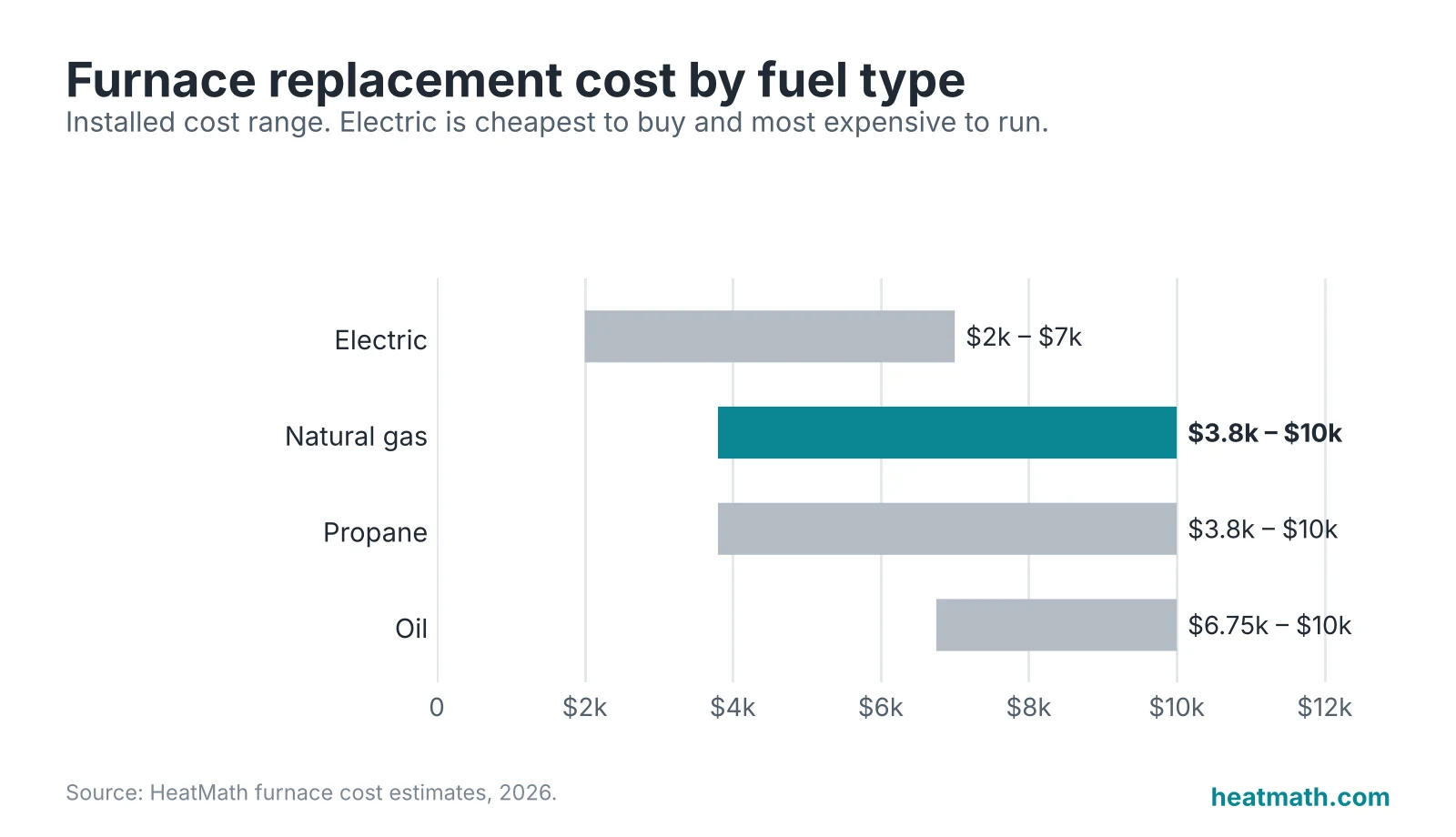
| Fuel | Installed cost | Notes |
|---|---|---|
| Natural gas | $3,800 – $10,000 | Most common; cheapest to run where gas is cheap |
| Propane | $3,800 – $10,000 | Same furnace as gas with a conversion kit; fuel costs much more |
| Electric | $2,000 – $7,000 | Cheapest to buy, most expensive to run |
| Oil | $6,750 – $10,000 | Needs a tank, chimney and yearly cleaning |
80% vs 95% AFUE furnaces
AFUE (annual fuel utilization efficiency) is the share of the fuel that ends up as heat in your home. An 80% furnace wastes a fifth of the fuel up the chimney. A 95–98% condensing furnace captures that heat, but it needs PVC venting and a condensate drain, which adds $1,000 to $2,500 to the job if your home is set up for an 80% unit.
The upgrade pays back fastest in cold climates. For a home that spends $1,200 a year on gas with an 80% furnace, moving to 96% saves about $200 a year. In a mild climate that spends $500 a year, the saving is under $100 and the payback can stretch past 15 years.
Single-stage, two-stage or modulating?
After efficiency, the burner type is the next big price lever. All three can be 80% or 95%+ AFUE.
- Single-stage: the burner is either fully on or off. Lowest price, but the loudest operation and the widest temperature swings.
- Two-stage: runs on a low setting most of the time and switches to high on the coldest days. Quieter, more even heat, at a moderate price bump.
- Modulating: adjusts output in small steps to match demand. The most even temperatures and the lowest fuel use, at the highest price.
Two-stage is the sweet spot for most homes in cold climates. In mild climates, where the furnace runs fewer hours, a single-stage unit is usually enough. Pair a two-stage or modulating furnace with a variable-speed blower, or you give up much of the comfort gain you paid for.
Furnace size and cost
Residential furnaces range from about 40,000 to 120,000 BTU of input. A bigger furnace costs a few hundred dollars more, but the bigger risk is buying one that is too large. Oversized furnaces short-cycle, which wastes fuel, wears parts and leaves hot and cold spots. Ask for a Manual J load calculation rather than matching the old furnace’s size.
Furnace replacement cost by brand
Brand moves the price less than size, efficiency and labor, but the gap is real. Budget brands such as Goodman and Amana run about 10% below mid-range pricing, while premium names such as Trane, Carrier and Lennox add roughly 20%. Typical installed prices for gas furnaces:
| Brand | Tier | Installed price |
|---|---|---|
| Goodman | Budget | $2,100–$6,300 |
| Amana | Budget | $2,100–$8,200 |
| Rheem / Ruud | Mid-range | $2,500–$7,800 |
| York | Mid-range | $2,300–$10,000 |
| Carrier | Premium | $2,400–$8,000 |
| Lennox | Premium | $3,000–$9,500 |
| Trane | Premium | $5,200–$13,500 |
The ranges are wide because every brand sells both basic 80% single-stage units and high-end modulating models. Compare quotes on the same efficiency and burner type, not the logo. The installer matters more than the brand: a poorly sized or badly vented furnace from a premium maker will still run poorly.
Extra costs to expect
- Venting changes: $500 to $2,500, mainly when switching to a condensing furnace
- Gas line work: $250 to $800 if the line needs extending or resizing
- Ductwork repairs: $300 to $1,500; full replacement much more
- Permit and inspection: $100 to $500
- Removal of the old furnace: often included, sometimes $100 to $300
Repair or replace?
A common rule of thumb multiplies the furnace’s age by the repair cost. If the result is over 5,000, replacement usually makes more sense. A 17-year-old furnace needing a $400 inducer motor (17 × 400 = 6,800) is a candidate for replacement; a 6-year-old furnace needing the same part is not. Most gas furnaces last 15 to 20 years.
Should you replace the furnace with a heat pump instead?
If your air conditioner is also more than 10 years old, a heat pump replaces both for less than buying a new furnace and a new AC separately. A heat pump costs $10,000 to $25,000, against roughly $4,800 for a furnace plus $5,000 to $10,500 for central air. It also removes the gas bill’s fixed monthly charge if nothing else in the house uses gas.
Whether it lowers your heating bill depends on your fuel prices. Run your numbers in the heat pump savings calculator or read heat pump vs furnace.
How to lower the cost
- Replace in spring or early fall, when contractors are less busy.
- Get three written quotes with model numbers and AFUE ratings.
- Ask your gas utility about rebates for 95%+ furnaces.
- Don’t pay for a bigger furnace than a load calculation shows you need.
The 2028 federal furnace rule
A Department of Energy standard requires new gas furnaces made after December 18, 2028, to reach at least 95% AFUE. That would end sales of new 80% furnaces. Condensing furnaces vent through PVC pipe and need a condensate drain, which can add installation work in homes built around an 80% unit and a masonry or metal flue.
The rule is under legal challenge. In June 2026 the Supreme Court vacated an appeals court decision that had upheld it and sent the case back for review. The standard stays in effect during that review, and DOE is weighing a delay to 2030. Nothing changes for a replacement today: 80% furnaces are still legal to buy and install. If you are torn, the rule is one more reason to price out a 95% unit, or compare both against a heat pump with our heat pump vs furnace guide.
What we would keep on hand
As an Amazon Associate, HeatMath earns from qualifying purchases. These links open Amazon search results, so you can compare brands and prices yourself.
Frequently asked questions
How long does a furnace last?
Most gas furnaces last 15 to 20 years, and some reach 25 with good maintenance. Electric furnaces often last longer, around 20 to 30 years, because they have no burner or combustion to wear the heat exchanger. If yours is past 15 years and needs an expensive repair, start collecting replacement quotes before you commit to the fix.
Should I replace my AC at the same time as my furnace?
Often, yes, if the AC is also near the end of its life. A new furnace and central AC installed together cost about $5,000 to $12,500, and one crew, one visit and one permit cost less than two separate jobs. You also get a matched system. Keep the AC if it is fairly new and working well. See our AC replacement cost guide.
Do you need a permit to replace a furnace?
In most places, yes. Most cities and counties require a mechanical permit for a furnace replacement, typically $50 to $400 depending on location. A licensed contractor usually pulls the permit and includes it in the quote, so ask to confirm. Skipping the permit can cause trouble with insurance claims and when you sell the house.