A heat pump defrost cycle is normal: on cold, damp days the outdoor unit reverses for roughly 5 to 15 minutes to melt frost off its coil, then goes back to heating. Expect steam, a whoosh and a brief pause in warm air. It becomes a problem only when defrosts come too often, last too long, or the coil stays white with ice afterward.
This guide explains what the unit is doing, gives you the numbers that separate normal from abnormal, and ends with a step-by-step check you can run from your driveway in five minutes.
Why a heat pump needs a defrost cycle
In heating mode, the outdoor coil is the cold side of the system. It pulls heat out of winter air by running colder than that air. When the coil drops below 32°F and the air holds moisture, that moisture freezes onto the fins. Frost acts like a blanket. It blocks airflow and cuts the amount of heat the unit can collect.
Lennox notes that the coil can be much colder than the surrounding air, so a defrost at 45°F outdoors is not unusual. According to Lennox, frost forms most often near freezing when humidity is high, so fog, drizzle and wet snow are prime defrost weather. On very cold, dry days the air holds so little water that the unit may barely frost at all.
What happens during a defrost
- The control board decides the coil needs clearing, based on a timer, a coil temperature sensor, or both.
- The reversing valve switches the system to cooling mode for a few minutes. Hot refrigerant now flows through the outdoor coil.
- The outdoor fan stops so the heat stays on the coil instead of blowing away. Hitachi’s documentation confirms the outdoor fan stops while the compressor keeps running.
- Many ducted systems switch on backup heat strips so the air coming out of your vents does not turn cool. Many mini splits simply stop the indoor fan instead.
- When the coil is warm enough, or a maximum time is reached, the valve switches back. You may hear a second whoosh and see a cloud of steam.
How often and how long: normal numbers
Lennox says most systems check for frost every 30 to 90 minutes in heating mode, and a typical defrost lasts 5 to 15 minutes. Hitachi’s mini split controls wait at least about 35 minutes between defrosts and end each one after about 10 minutes at most. Your manual will list the exact settings for your model. Many ducted units let a technician choose 30, 60 or 90 minutes on the defrost board.
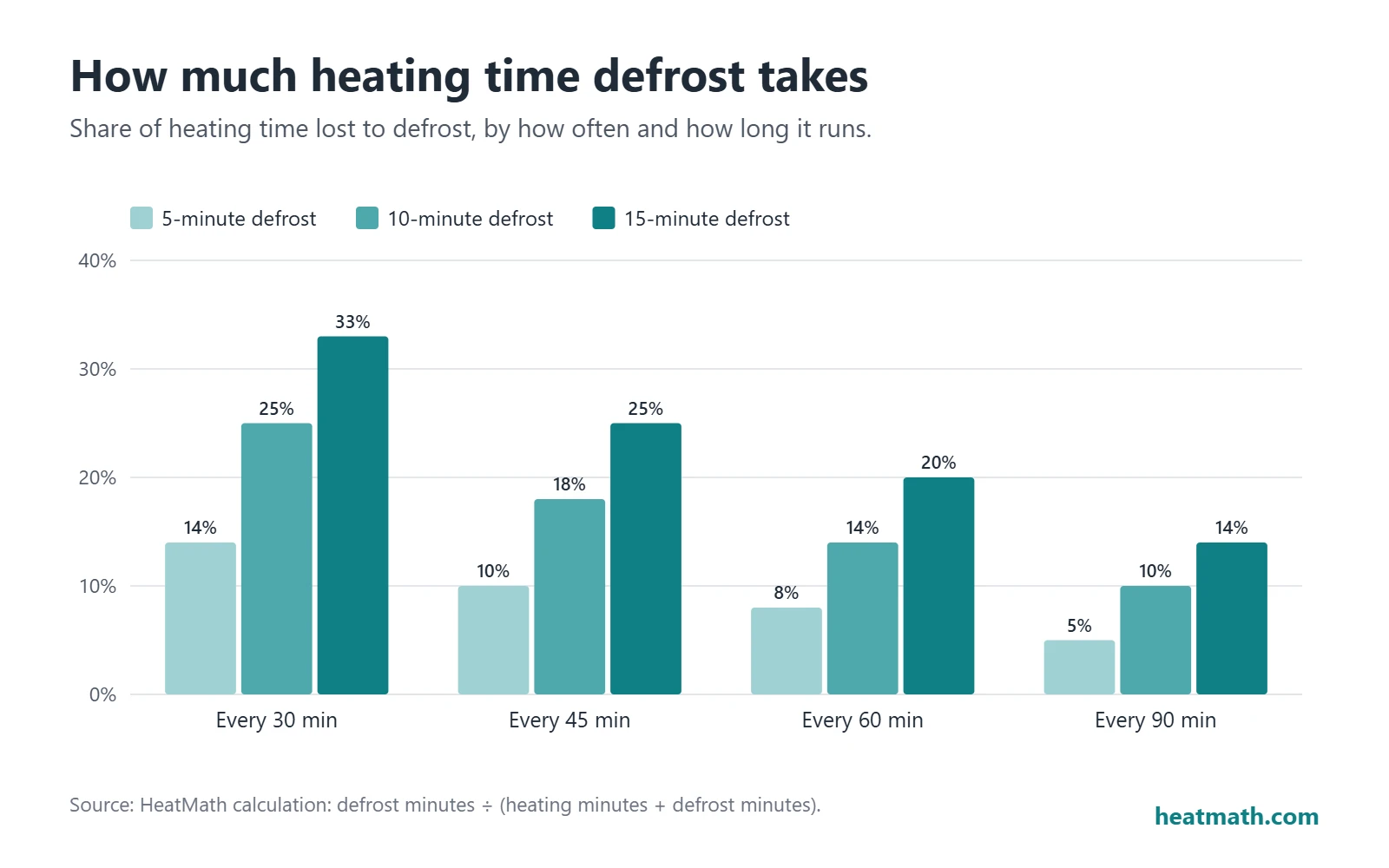
Here is what those intervals mean for heating time. We calculated the share of each hour the unit spends defrosting instead of heating, using the published ranges above:
| Heating time between defrosts | 5-minute defrost | 10-minute defrost | 15-minute defrost |
|---|---|---|---|
| 30 minutes | 14% | 25% | 33% |
| 45 minutes | 10% | 18% | 25% |
| 60 minutes | 8% | 14% | 20% |
| 90 minutes | 5% | 10% | 14% |
Share of time defrosting = defrost minutes ÷ (heating minutes + defrost minutes)
The takeaway: on a raw, foggy 33°F day, losing 15% to 25% of run time to defrost is within the normal envelope. If the unit spends a third of every hour defrosting for days on end, or defrosts in dry weather well above 45°F, something is off.
Heat pump defrost cycle signs that are normal
- Steam rising from the outdoor unit. It is water vapor from melting frost, not smoke. Lennox lists it as normal.
- A whoosh or hiss when the reversing valve shifts at the start and end of defrost.
- The outdoor fan stopping while the compressor keeps humming.
- Water dripping or pooling under the unit. That is melted frost, and it needs somewhere to drain.
- Cooler air from vents for a few minutes on systems without backup heat, or the indoor fan pausing on a mini split.
- “Defrost” or a blinking light on a mini split’s indoor unit or thermostat.
If your system shows “AUX” or “EM” heat during defrost, that is the backup heat covering the gap. Short bursts are fine. If aux heat runs for hours when it is not very cold, read our heat pump thermostat settings for winter, because thermostat setup is a common cause.
Signs the defrost is not working right
- The coil stays coated in solid white or clear ice even after a defrost ends.
- Ice builds from the bottom up, around the base pan or the lower rows of fins.
- The unit defrosts every 30 minutes on dry, mild days.
- Defrosts regularly run past 15 to 20 minutes.
- The outdoor fan keeps spinning while the coil is iced and the unit never seems to switch modes.
- Your heating bill jumps and the thermostat shows aux heat running much of the day.
Lennox lists dirty or blocked coils, faulty sensors or controls, and low refrigerant charge as common causes. A failed defrost thermostat or sensor, a stuck reversing valve, and a blocked drain path are other parts a technician will check. Low charge and valve faults need a licensed HVAC technician with EPA 608 certification. Do not try to chip ice off the fins. They bend easily and the coil can be punctured.
Five-minute check: is your defrost normal?
Run through this order. Stop at the first step that gives you an answer.
- Check the weather. Is it near freezing, or up to about 45°F, with rain, fog, snow or high humidity? If yes, frequent defrosts are expected. Go to step 2 only if the coil stays iced.
- Look at the coil 10 minutes after a defrost ends. Light frost returning is fine. A thick layer that never fully clears points to a defrost fault. Go to step 5.
- Look under and around the unit. Is it sitting in snow, a puddle or ice? Is a downspout or roof edge dripping onto it? Melted water that cannot drain refreezes at the base and builds up. Clear snow by hand, keep the space around the unit open (your manual lists the clearance), and redirect gutter water.
- Check airflow indoors. A clogged filter reduces heat transfer and can make the system run longer and colder. Replace or clean it. Also confirm supply vents and returns are open.
- Time two or three defrosts. Write down when each starts and stops. Compare with the table above. Repeated defrosts over 15 to 20 minutes, or intervals far shorter than your model’s setting, are worth a service call. Bring your notes; they save diagnostic time.
- Check the thermostat. Is it set to “Heat” rather than “Emergency Heat”? Is the heat pump configuration correct in the settings menu? A thermostat set up as a gas furnace can confuse a heat pump.
Safety first: turn off power at the thermostat and the outdoor disconnect before you touch anything near the outdoor unit. Never pour hot water on the coil or use a heat gun.
Defrost, backup heat and your bill
Defrost costs some energy. The compressor runs without delivering heat to the house, and backup strips, if they engage, run at a COP of 1. That is still small next to the overall savings of a heat pump in most climates. To see your total heating cost with your own electricity rate, try the heating cost calculator.
If you live where winter is long and damp and your bills feel high, a dual fuel setup can hand heating to a furnace in the coldest, frostiest hours. Our guide to the dual fuel heat pump explains how the switchover works. And if you are still weighing options, compare an electric furnace vs a heat pump to see why the heat pump wins on running cost even with defrost included.
Useful tools for winter checks
As an Amazon Associate, HeatMath earns from qualifying purchases. These links open Amazon search results, so you can compare brands and prices yourself.
Heat pump defrost questions
Can I turn off the defrost cycle?
No, and you should not try. Without defrost, frost would keep building until the coil was a block of ice and the unit could no longer heat. Hitachi also warns against switching the unit off mid-defrost and restarting it right away.
Why does my heat pump defrost when it is above freezing?
The outdoor coil runs colder than the air around it. On a humid 40°F to 45°F day the coil can sit below 32°F, so frost forms and a defrost follows. Lennox describes a defrost at 45°F as not unusual.
Is it normal for cold air to come out during defrost?
Briefly, yes, on systems without backup heat. Most ducted systems run heat strips during defrost to prevent this. If cool air lasts more than about 15 minutes, or happens outside defrost, the problem is something else, such as thermostat setup or a refrigerant issue.