In the electric furnace vs. heat pump decision, the heat pump almost always wins on running cost: it moves heat instead of making it, so it uses about half to a third of the electricity for the same warmth. An electric furnace is cheaper to buy, at roughly $1,900 to $5,600 installed versus $10,000 or more for a ducted heat pump, and it lasts longer. If you heat for more than a few mild months a year, the heat pump usually pays back the difference.
Below are the real numbers: purchase price, yearly operating cost in three climates, lifespan, and the cases where an electric furnace still makes sense.
Electric furnace vs heat pump: the short version
| Electric furnace vs. air-source | e heat pump | |
|---|---|---|
| How it heats | Resistance coils, like a toaster | Moves heat from outdoor air with refrigerant |
| Efficiency | 100% (COP 1.0) | COP about 2–4; seasonal often 2.1–3.2 |
| Installed cost | About $1,900 – $5,600 | About $10,000 – $18,000 ducted |
| Cooling | No; needs a separate AC | Yes; replaces the AC too |
| Typical lifespan | 20 – 30 years | 12 – 15 years |
| Cold-weather output | Full output at any temperature | Drops in deep cold; backup strips help |
| Electrical draw | Often 60 – 80+ amps | Compressor about 15 – 45 amps, plus strips |
Costs and efficiency figures from HomeGuide and PickHVAC 2026 data.
Why a heat pump uses less electricity
An electric furnace turns every kilowatt-hour of electricity into one kilowatt-hour of heat. That is 100% efficient, and it is also the ceiling. A heat pump uses electricity to run a compressor that pulls heat from outdoor air, even cold air, and pushes it inside. On a 47°F day, a modern unit can deliver three to four units of heat for each unit of electricity. On a 5°F day, that ratio drops, but cold-climate models still deliver well above 1.
The efficiency ratio is called the coefficient of performance (COP). Your yearly heating bill follows a simple formula:
Annual cost = heat needed (kWh) ÷ COP × electricity price ($/kWh)
Heat pumps are rated by HSPF2. The federal minimum for new heat pumps is 7.5 HSPF2, and cold-climate models often reach 9 or more. For background, see our guide to SEER2 and HSPF2.
Operating cost by climate
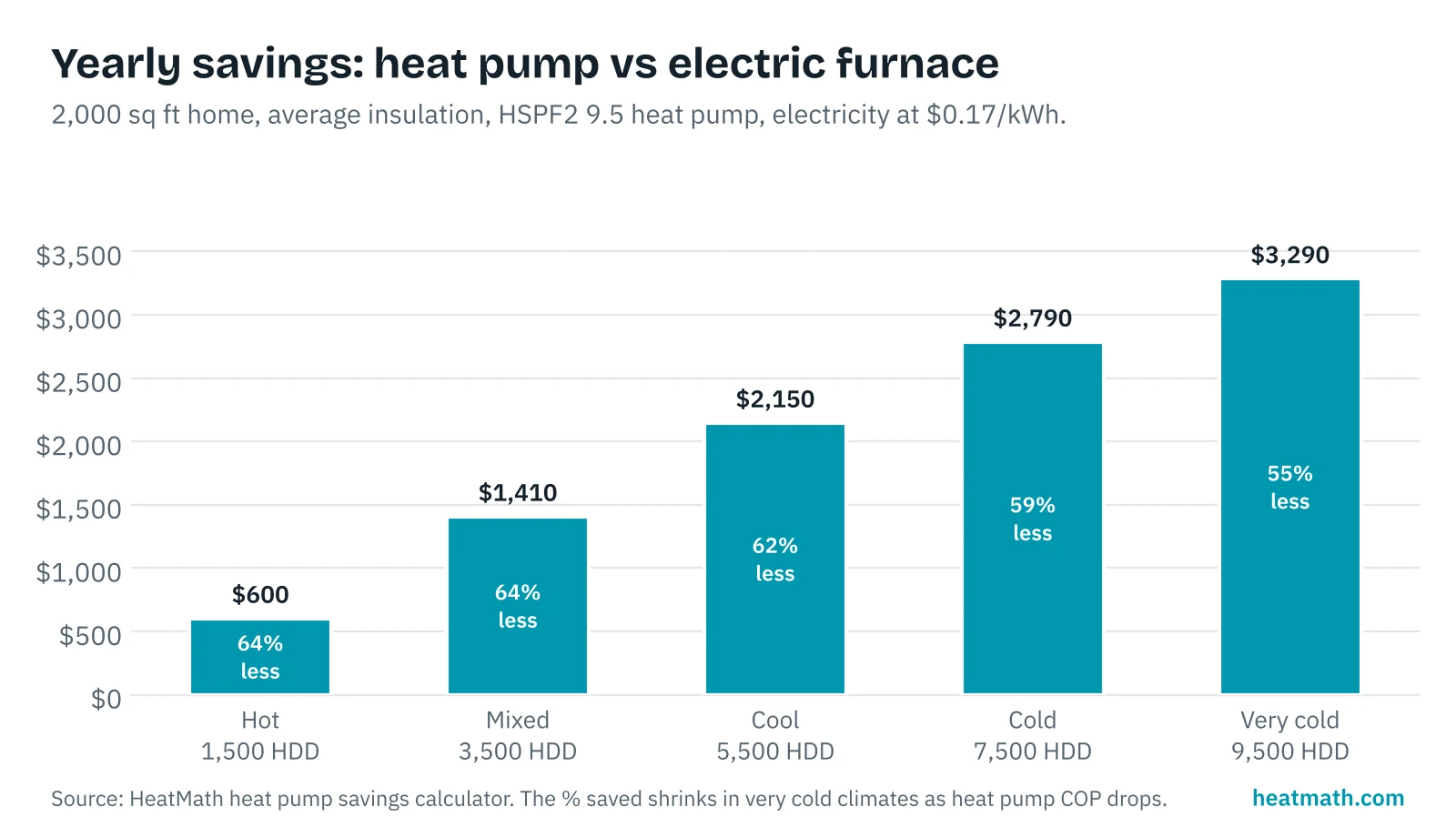
This example uses an 1,800 sq ft home and the EIA’s 2026 national average residential electricity price of 18.2 cents per kWh. Heat loads and seasonal COP values follow PickHVAC’s climate examples.
| Climate Electric | c furnace per year Heat | t pump COP Heat | t pump per year Yearly | savings |
|---|---|---|---|---|
| Hot (Phoenix) | $533 | 3.0 | $178 | $355 |
| Mixed (Atlanta) | $1,333 | 2.6 | $513 | $820 |
| Cold (Minneapolis) | $3,200 | 2.1 | $1,524 | $1,676 |
Your numbers will differ with insulation, thermostat habits, and local rates. Run your own figures here:
Your result
Yearly heating cost for this home, by fuel
| Heat your home needs per year | – |
| Heat pump seasonal COP | – |
| Heat pump electricity use | – |
| Net upfront cost | – |
For a deeper look at monthly bills, read our breakdown of what it costs to run a heat pump.
Those are national examples. To see the numbers for your own home, enter your size, climate, and electricity rate in the heating cost calculator, then use the heat pump savings calculator to get a payback period for the switch. If you only heat one or two rooms with resistance heat, the space heater cost calculator shows what that costs per month.
Upfront cost and payback
HomeGuide puts a typical electric furnace replacement at $1,900 to $5,600 installed, with a national average near $3,750. A ducted air-source heat pump usually runs $10,000 to $18,000, though that price also replaces your central AC.
That last point matters. Most homes with an electric furnace also have a central air conditioner. If both are near the end of their life, compare a heat pump against a furnace plus a new AC, not against a furnace alone.
Example: In a mixed climate, a new electric furnace plus a new AC might cost $7,000 to $11,000 together. A heat pump with a small backup strip might cost $11,000 to $14,000. If the gap is about $3,000, it is recovered in about four years at $820 a year in heating savings. If only the furnace needs replacing and the AC is new, payback stretches to 10 years or more.
The federal 25C tax credit for heat pumps ended on December 31, 2025, so do not count on it in 2026. Some utilities and states still offer rebates, so check before you buy.
Lifespan and maintenance
Electric furnaces are simple. With no combustion and few moving parts other than the blower, many last 20 to 30 years. Heat pumps work year-round, heating in winter and cooling in summer, so they wear faster. Expect 12 to 15 years for most air-source units, and longer with good maintenance. Our article on how long heat pumps last covers what extends their life.
Both systems need filter changes. A heat pump also needs its outdoor coil kept clear of leaves, snow, and debris, plus a yearly checkup.
Comfort, noise and wiring
Comfort is another real difference in the electric furnace vs heat pump comparison. An electric furnace blows air at a steady, fairly warm temperature no matter what the weather does. A heat pump delivers cooler supply air, often in the 90s, and runs longer cycles. Some people notice the cooler air at the vents, especially near a register. The upside is steadier room temperatures and fewer big swings.
A heat pump also has an outdoor unit, which makes a low hum when running and pauses now and then to defrost in damp, cold weather. An electric furnace is silent outside.
Wiring can change the math too. A whole-house electric furnace often draws 60 to 80 amps or more. Switching to a heat pump with smaller backup strips can free up panel capacity for an EV charger or other upgrades.
When an electric furnace still makes sense
- Very mild climates with only a few weeks of heating, where the savings are small.
- A tight budget right now and an AC that still has years left.
- Short ownership, such as a home you plan to sell within a few years.
- As backup heat. Many heat pump systems pair with an electric air handler that contains resistance strips for the coldest hours.
In most other cases, the electric furnace vs heat pump choice tips toward the heat pump as the stronger long-term option. Homes with natural gas available have a third option worth comparing: a dual fuel heat pump that uses gas only on the coldest days.
Tools to track your heating costs
As an Amazon Associate, HeatMath earns from qualifying purchases. These links open Amazon search results, so you can compare brands and prices yourself.
Frequently asked questions
Is a heat pump cheaper to run than an electric furnace?
Yes. In most US climates, a heat pump uses about 40% to 70% less electricity for heating, because it moves heat rather than generating it. The savings are largest in mixed and cold climates, where heating runs for many months.
Do heat pumps work in cold weather?
Modern cold-climate heat pumps keep heating well below freezing, and many still deliver most of their rated capacity at 5°F. In very cold areas, a small set of electric strips or a gas furnace covers the coldest hours.
Can I replace my electric furnace with a heat pump?
Usually, yes. The heat pump’s indoor air handler often replaces the furnace, and existing ducts can often be reused if they are sealed and sized for the airflow. Ask the installer for a load calculation and a duct check before you sign.