The cost to run a heat pump for a typical 2,000 sq ft U.S. home is about $70 to $150 a month in winter in a mixed climate, and $35 to $80 in a mild one, at 2026 average power prices. Cold northern homes can see $135 to $320 in the coldest months. Your real number depends on three things: how much heat your house loses, how efficient the heat pump is at your outdoor temperature, and what you pay per kWh.
This guide shows the simple math, gives cost tables at 2026 prices, and lists the changes that cut the bill the most.
How to calculate the cost to run a heat pump
A heat pump moves heat instead of making it. Its efficiency is measured as COP (coefficient of performance). A COP of 3 means one kWh of electricity delivers three kWh of heat. That is why a heat pump costs far less to run than baseboard heaters or a space heater, which have a COP of 1.
Monthly cost = Heat needed (BTU) ÷ (COP × 3,412) × Price per kWh
One kWh equals 3,412 BTU. So if your home needs 10 million BTU of heat in January, the heat pump averages a COP of 2.8, and power costs $0.182 per kWh, the math is:
- 10,000,000 ÷ (2.8 × 3,412) = 1,047 kWh
- 1,047 kWh × $0.182 = about $190 for the month
You do not need to do this by hand. Plug your own numbers into the heating cost calculator, or use the embedded tool below.
Cost of heat, cheapest first
Yearly cost for your heat use
| Fuel | $ per MMBtu delivered | Per year |
|---|
What electricity costs in 2026
The U.S. Energy Information Administration (EIA) forecasts an average residential electricity price of 18.2 cents per kWh for 2026, up from 17.3 cents in 2025. That is a national average. Rates in New England and California often run well above 25 cents, while parts of the South and Pacific Northwest sit closer to 12 to 14 cents. Check the “price per kWh” line on your own bill, including delivery charges, before you run any estimate.
Monthly cost by climate
The table below assumes a well-insulated 2,000 sq ft home. Ranges come from published usage data at about $0.16 per kWh, adjusted here to the 2026 average of $0.182.
| Climate (example city) | Winter month | Summer month |
|---|---|---|
| Mild (San Diego) | $35 – $80 | $45 – $100 |
| Mixed (Nashville) | $70 – $150 | $70 – $135 |
| Cold (Minneapolis) | $135 – $320 | $55 – $135 |
Most whole-home air-source heat pumps draw about 2 to 6 kW while running. Annual use usually lands between 2,000 and 8,000 kWh for heating and cooling combined. At 18.2 cents, that is roughly $365 to $1,460 a year.
Why the outdoor temperature changes everything
A heat pump pulls heat from outdoor air. The colder that air, the harder the compressor works, and the lower the COP. Typical figures:
| Outdoor temp | Standard heat pump COP | Cold-climate heat pump COP | Cost per million BTU at $0.182/kWh |
|---|---|---|---|
| 47°F | 3.0 – 4.0 | 3.5 – 4.0 | $13 – $18 |
| 17°F | 1.5 – 2.5 | 2.0 – 3.0 | $18 – $36 |
| Electric resistance (any temp) | 1.0 | $53 | |
Two things follow. First, a mild day costs a fraction of a frigid one. Second, the backup electric strips inside the air handler are expensive. When they kick on, you pay resistance-heat prices. A cold-climate heat pump keeps a higher COP at low temperatures, so it leans on those strips far less.
Heat pump vs. other heating: running cost
Comparing fuels on a cost per million BTU delivered makes the choice clear. EIA expects residential natural gas to average $15.93 per thousand cubic feet in 2026, which is about $1.54 per therm.
| System | Efficiency | Cost per million BTU (2026 avg prices) |
|---|---|---|
| Heat pump, mild weather | COP 3.0 | about $18 |
| Heat pump, seasonal average | COP 2.5 | about $21 |
| Gas furnace | 95% AFUE | about $16 |
| Gas furnace | 80% AFUE | about $19 |
| Baseboard or space heater | COP 1.0 | about $53 |
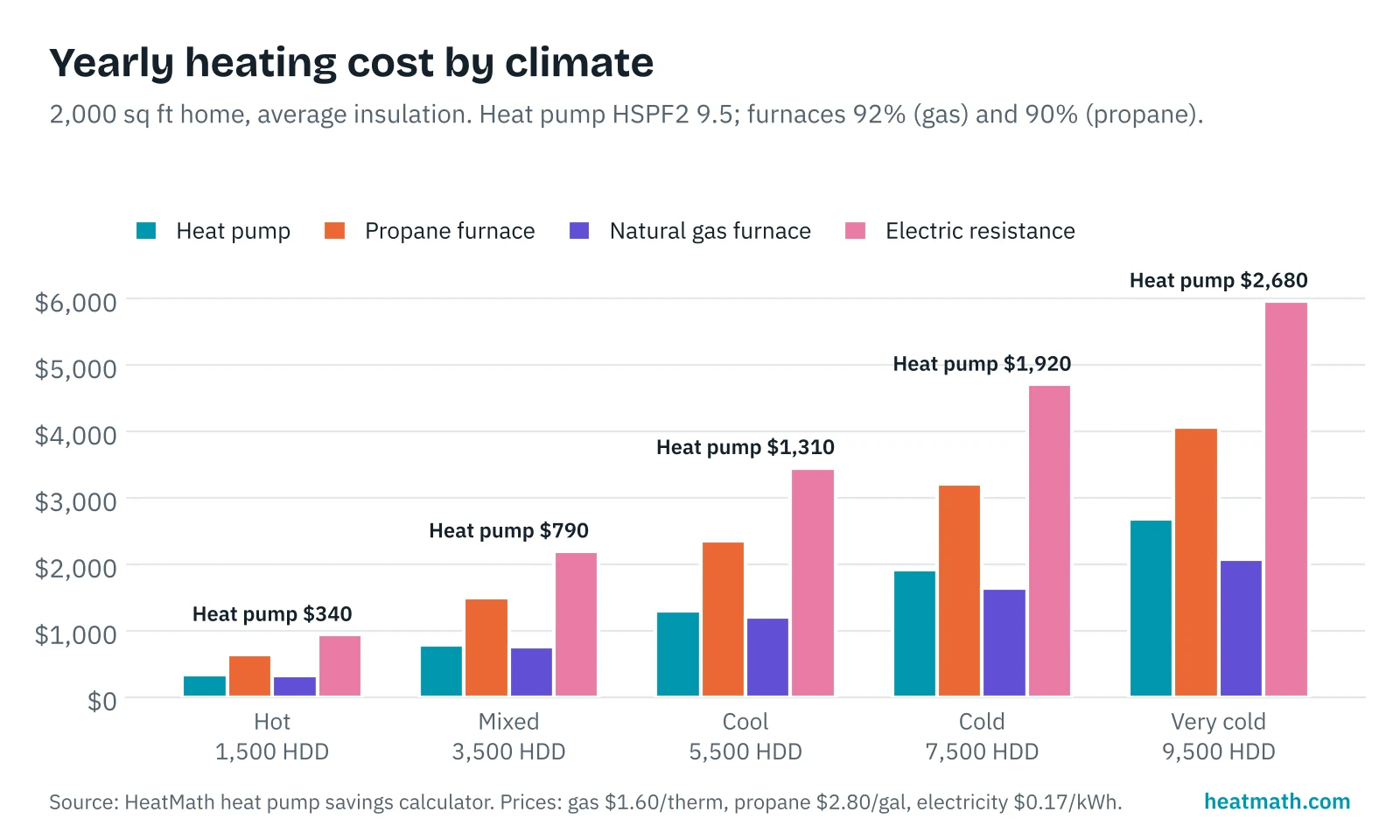
At national average prices, a heat pump and a gas furnace are close. Local rates decide the winner. If your power is cheap or your gas is expensive, the heat pump wins easily. For a full side-by-side, see heat pump vs. furnace. Against electric resistance, oil or propane, a heat pump is usually far cheaper to run.
What drives your bill up or down
Efficiency rating
HSPF2 measures seasonal heating efficiency, and SEER2 measures cooling. The federal minimum for a new heat pump is 14.3 SEER2 and 7.5 HSPF2. A unit rated 9.0 HSPF2 uses about 17% less electricity for the same heat than a 7.5 HSPF2 unit. Our SEER2 and HSPF2 guide explains how to read the labels.
Home size and insulation
A drafty house can need twice the heat of a tight one of the same size. Air sealing and attic insulation cut the load the heat pump has to carry every hour it runs.
Thermostat habits
Deep overnight setbacks can backfire with heat pumps. When the thermostat asks for a big jump in the morning, many systems call the backup strips. Keep setbacks to 2 to 4°F, or use a thermostat with adaptive recovery that avoids auxiliary heat.
Sizing and maintenance
An undersized unit runs on strip heat too often. A dirty filter or coil lowers airflow and efficiency. Change filters every one to three months and book yearly service; the heat pump maintenance checklist covers what to check.
How to lower the cost to run a heat pump
- Find your real rate. Some utilities offer lower winter or heat pump rates. Ask.
- Set a sensible aux heat lockout. Many thermostats let you block strip heat above a set outdoor temperature, such as 35°F.
- Seal ducts. Leaky ducts in an attic or crawlspace can waste 20% or more of the heat you pay for.
- Keep the outdoor unit clear. Remove snow, leaves and ice so it can defrost and breathe.
- Use “auto” fan, not “on”. A constantly running fan pulls in cool air from duct leaks and adds fan power to the bill.
Note: the federal 25C tax credit for heat pumps ended on December 31, 2025. Utility and state rebates may still lower the upfront price, but running cost now matters more than ever when you compare systems.
What we would keep on hand
As an Amazon Associate, HeatMath earns from qualifying purchases. These links open Amazon search results, so you can compare brands and prices yourself.
Frequently asked questions
Is it expensive to run a heat pump all day?
No, not in most climates. Heat pumps are designed to run long, steady cycles at low power. Running all day at a constant setting is usually cheaper than large swings, because it avoids calling the backup electric heat.
How many kWh does a heat pump use per day in winter?
A 3-ton unit in a mixed climate often uses 20 to 50 kWh on a cold day. That is about $4 to $9 at the 2026 average rate. On days near 0°F, older units can use much more, especially if strip heat runs.
Is a heat pump cheaper to run than a gas furnace?
It depends on local prices. At 2026 national averages, the two are close, with a high-efficiency gas furnace slightly ahead in cold weather. Where electricity is under about 13 cents per kWh or gas is above about $2.10 per therm, the heat pump usually costs less to run.