The best heat pump thermostat settings winter calls for are simple: pick one comfortable temperature, usually 68°F, and leave it there, or use a small night setback of 2 to 3°F at most. Keep the fan on Auto, leave emergency heat off, and if your thermostat allows it, lock out auxiliary heat above about 30 to 40°F outdoors. Big setbacks that work well with a gas furnace often cost more with a heat pump, because the morning recovery triggers expensive backup heat.
This heat pump thermostat settings winter guide explains why heat pumps need different settings than furnaces, gives you a setting-by-setting checklist, and shows what the numbers look like on your bill.
Why heat pumps need different settings
A gas furnace delivers very hot air, around 120 to 140°F at the register, and can raise a cold house several degrees quickly. A heat pump delivers a steady stream of warmer air, often in the 90s, and works best running long and slow.
Most ducted heat pumps also have electric resistance heat strips, called auxiliary or backup heat. These strips turn on when the heat pump cannot keep up, or when the thermostat sees a big gap between the room temperature and the setpoint. Heat strips have a coefficient of performance (COP) of 1. A heat pump in mild winter weather often runs at a COP of 2 to 4, so each kilowatt-hour of strip heat costs two to four times as much as heat pump heat.
That is why the U.S. Department of Energy notes that setting back a heat pump in heating mode can make it run inefficiently and cancel out the savings, unless you use a thermostat built to limit backup heat during recovery.
Recommended heat pump thermostat settings winter checklist
| Setting | Recommended value | Why |
|---|---|---|
| Daytime temperature | 68°F (66–70°F) | DOE suggests 68–70°F while awake; every degree lower saves a little |
| Night or away setback | 0–3°F | Small setbacks recover without strip heat |
| Mode | Heat (not Auto in shoulder season if it short cycles) | Avoids flipping between heating and cooling |
| Fan | Auto | Continuous fan blows cooler air and can feel drafty |
| Emergency heat | Off | Runs strips only; use it only if the heat pump fails |
| Aux heat lockout | Around 30–40°F outdoor | Stops strips running on mild days |
| Compressor lockout | Per manufacturer, often 0–15°F on dual fuel | Only for systems with a furnace backup |
| Recovery | Smart or adaptive recovery on | Starts warming early so strips are not needed |
Lockout temperatures depend on your climate and equipment. Cold-climate heat pumps can often keep the strips locked out down to 15 to 25°F. Older single-stage units may need them sooner. Check your installer’s notes or the outdoor unit’s capacity table before you change anything.
The setback question
For a furnace, the DOE rule of thumb is that turning the thermostat back 7 to 10°F for about 8 hours a day can save up to 10% a year, or roughly 1% per degree. With a heat pump, that math only works if recovery does not call on strip heat.
When a setback hurts
Say you drop from 68°F to 60°F overnight. At 6 a.m. the thermostat sees an 8°F gap. A standard thermostat assumes the heat pump cannot close that gap fast enough and brings on the strips. For an hour or two, you are heating at a COP of 1 instead of 2.5 or 3. That burst can wipe out everything the setback saved.
When a setback helps
- The setback is small, 2 to 3°F, so the heat pump can recover on its own.
- Your thermostat has heat pump recovery logic or an outdoor sensor with aux lockout.
- You use a slow, scheduled ramp: start warming two hours early, one degree at a time.
- The home is well insulated and tight, so it loses heat slowly overnight.
Rule of thumb: if your thermostat display shows “Aux” or “Aux Heat On” every morning after a setback, the setback is too deep. Cut it in half and watch for a week.
What these settings are worth in dollars
Here is a rough example using the EIA’s 2026 national average residential price of 18.2 cents per kWh. Assume a home uses 6,000 kWh a year for heat pump heating.
| Change | Rough effect | Annual impact |
|---|---|---|
| Lower setpoint 70°F → 68°F all day | About 1–3% per degree | Saves about $20–$65 |
| 2°F overnight setback, no aux on recovery | About 1–2% | Saves about $10–$20 |
| 8°F setback with strips on recovery | Can exceed savings | May cost money |
| Aux heat running 300 extra hours at 10 kW | 3,000 kWh at COP 1 | Adds about $545 |
The last row is the one that matters for heat pump thermostat settings winter planning. Controlling when the strips run is worth far more than any setback. Run your own numbers with the heating cost calculator, and see our guide on the cost to run a heat pump for the full formula.
Settings for special cases
Dual fuel systems
If your heat pump pairs with a gas or propane furnace, the key setting is the switchover, or balance, temperature. Below it, the furnace takes over. The right number depends on your gas and electric prices, not just comfort. Our dual fuel heat pump guide explains how to pick it.
Mini splits
Ductless units usually have no strip heat, so setbacks are less risky. Most owners still get the best comfort by setting one temperature and leaving the remote alone. Avoid turning heads fully off in cold rooms, which makes them work hard to recover.
Defrost and cold air
In cold, damp weather the outdoor unit defrosts itself every so often. You may feel cooler air for a few minutes, and many systems run strips briefly during defrost. That is normal. If the air feels cold for long stretches, read our guide on a heat pump blowing cold air.
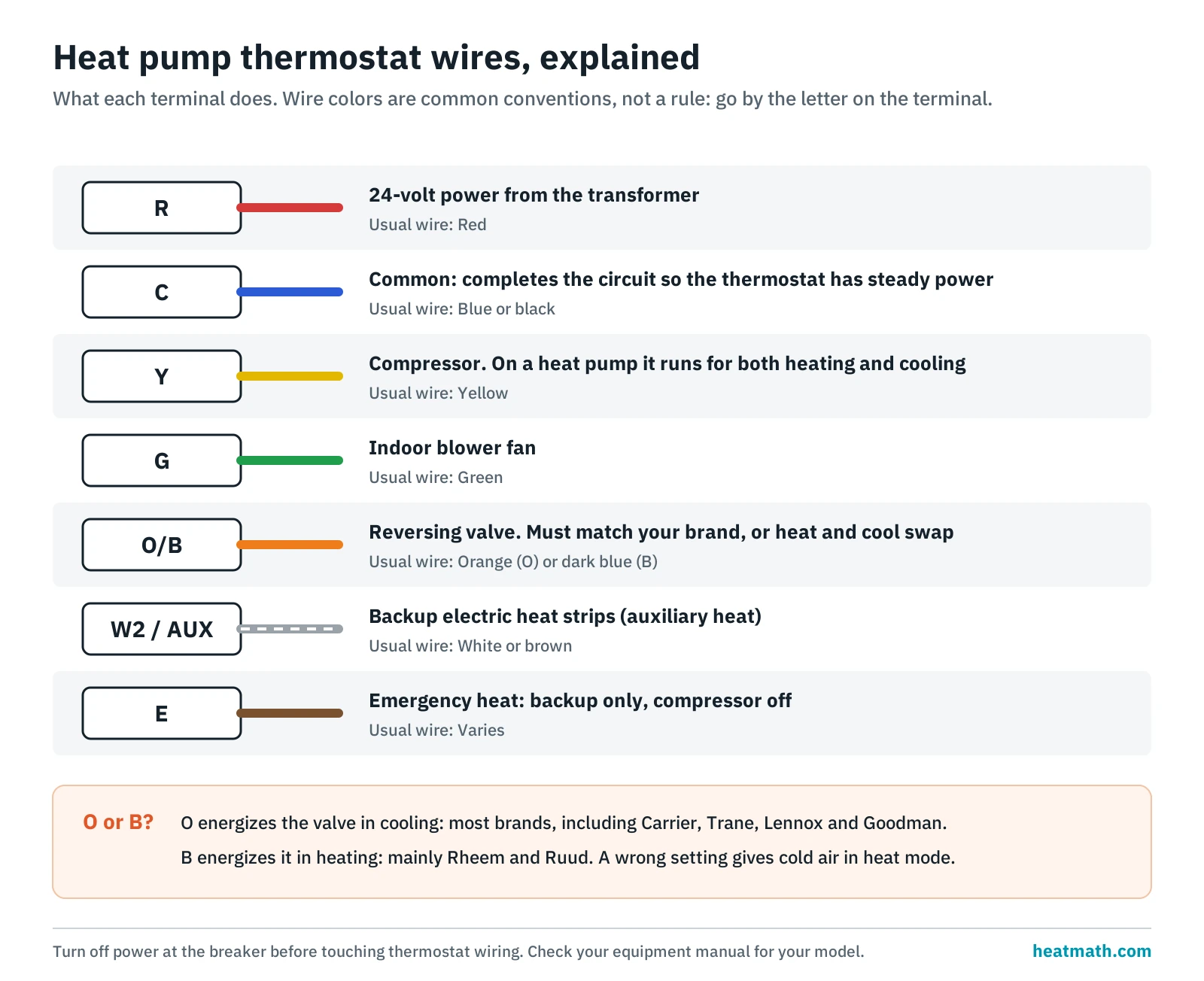
If you are replacing the thermostat, wiring is where most winter problems start. A heat pump thermostat has more terminals than a furnace-only one, and the reversing valve setting must match your brand.
Thermostat features worth having
If you are replacing a thermostat, look for these features rather than a brand name:
- Explicit heat pump support, with separate wiring for auxiliary and emergency heat.
- An outdoor temperature sensor or weather data for aux lockout.
- Adjustable aux lockout and compressor lockout temperatures.
- Smart or adaptive recovery for heat pumps.
- Adjustable temperature differential (often called cycle rate or threshold) to limit short cycling.
- Runtime reports that show compressor hours and aux hours separately.
Once your heat pump thermostat settings winter plan is in place, a one-week check during the first cold snap tells you more than any setting guide. Write down aux runtime each morning. If it falls after your changes, your settings are working.
Gear for dialing in your settings
- Heat pump compatible smart thermostat
- Wireless indoor and outdoor thermometer
- Digital humidity monitor
As an Amazon Associate, HeatMath earns from qualifying purchases. These links open Amazon search results, so you can compare brands and prices yourself.
Frequently asked questions
Should I turn my heat pump down at night in winter?
Only a little. A 2 to 3°F drop is usually safe and saves a small amount. Larger drops often trigger auxiliary heat in the morning, which can cost more than the setback saved. If your thermostat has heat pump recovery and aux lockout, you can experiment with slightly more.
When should I use emergency heat?
Use it only when the outdoor unit is broken, iced solid or shut down, and you are waiting for a repair. Emergency heat runs the strips without the compressor, so it is the most expensive way to heat an all-electric home. Turn it off once the heat pump is working again.
Is Auto mode a good idea in winter?
Auto mode switches between heating and cooling as needed. In winter it is rarely useful and can cause the system to cool on sunny afternoons. Set the mode to Heat from late fall to early spring, and keep the fan on Auto.