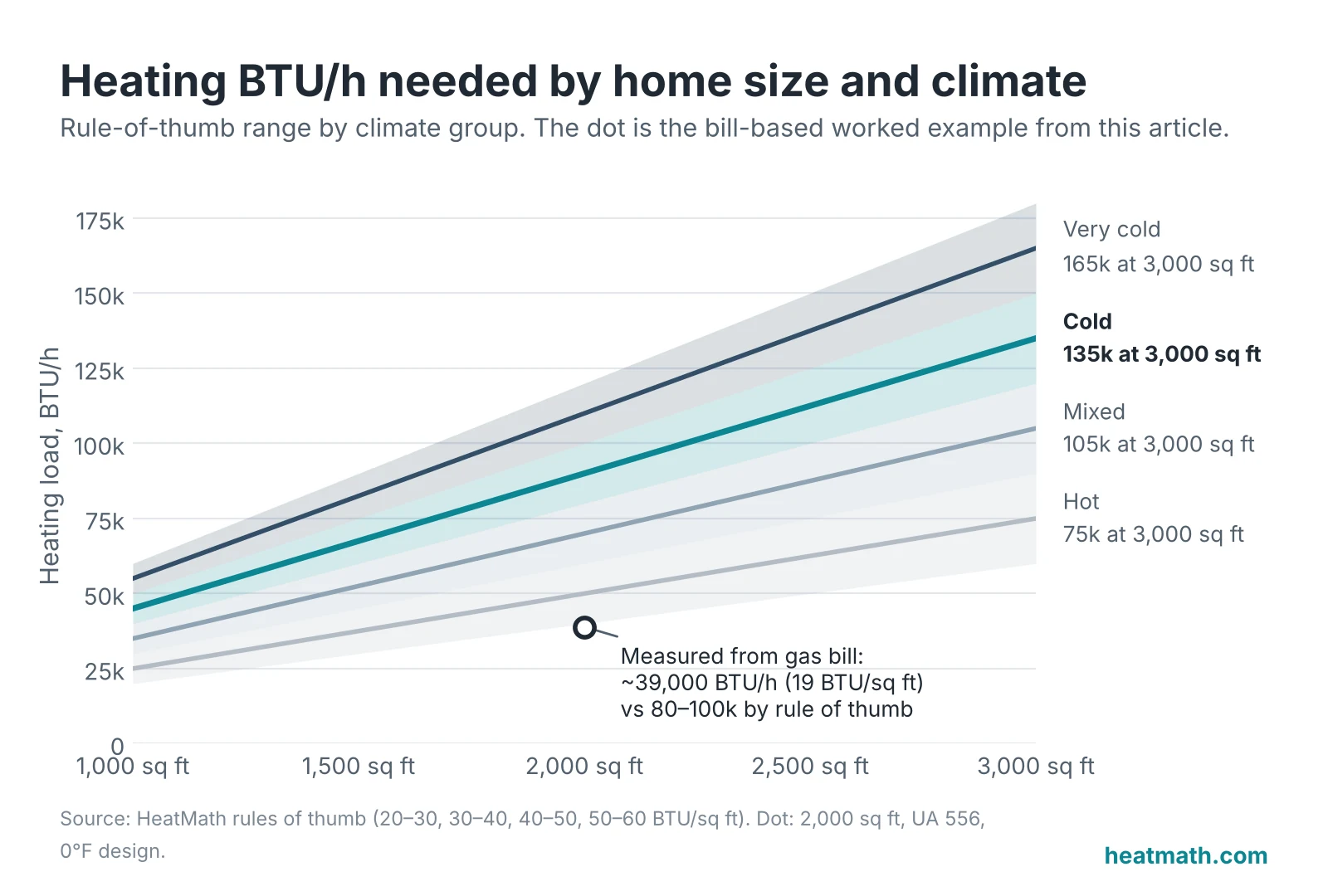
Most homes need roughly 20–60 BTU per square foot of heating capacity, depending on climate: about 20–30 in hot southern climates, 30–40 in mixed climates, 40–50 in cold climates and 50–60 in very cold northern ones. A 2,000 sq ft house in a cold climate therefore lands somewhere around 80,000–100,000 BTU/h by the rule of thumb.
Treat those numbers as a rough starting range, not a sizing answer. Insulation, windows, air leakage and ceiling height can move the real load by 50% or more either way. Below: a table by zone and home size, the adjustments that matter, and a method that uses your winter gas bill to measure what your house actually loses.
If you just want a number, plug your home into our heat pump size calculator or the general BTU calculator, then come back here to sanity-check the result.
Heating BTU per square foot by climate zone
The ranges assume 8 ft ceilings and average insulation, and describe heat loss on a design day (one of the coldest of a typical winter). This is heating load only; cooling tonnage is a different calculation covered in what size AC unit do I need.
| Home size | Hot (20–30 BTU/sq ft) | Mixed (30–40) | Cold (40–50) | Very cold (50–60) |
|---|---|---|---|---|
| 1,000 sq ft | 20,000–30,000 | 30,000–40,000 | 40,000–50,000 | 50,000–60,000 |
| 1,500 sq ft | 30,000–45,000 | 45,000–60,000 | 60,000–75,000 | 75,000–90,000 |
| 2,000 sq ft | 40,000–60,000 | 60,000–80,000 | 80,000–100,000 | 100,000–120,000 |
| 2,500 sq ft | 50,000–75,000 | 75,000–100,000 | 100,000–125,000 | 125,000–150,000 |
| 3,000 sq ft | 60,000–90,000 | 90,000–120,000 | 120,000–150,000 | 150,000–180,000 |
Roughly: hot = Gulf Coast, Florida and the desert Southwest; mixed = mid-Atlantic, mid-South and Pacific Northwest; cold = Midwest and New England; very cold = the far north and mountain towns.
The bands widen fast as homes grow. The dot is the bill-based worked example later in this article: a 2,000 sq ft cold-climate house that needs less than half what the rule of thumb predicts.
Adjustment factors that move the number
A per-square-foot figure hides what actually drives heat loss: surface area, insulation and air leakage. Use these rough multipliers to nudge the base number.
| Factor | Condition | Rough adjustment |
|---|---|---|
| Insulation / age | Built after about 2000, or fully upgraded attic and walls | −15% to −25% |
| Insulation / age | Pre-1980 with little wall or attic insulation | +20% to +30% |
| Ceiling height | 9 ft / 10 ft / vaulted | +12% / +25% / figure by volume |
| Windows | Lots of single-pane glass or large glass walls | +10% to +20% |
| Air leakage | Drafty: visible gaps, old doors, unsealed attic hatch | +10% to +20% |
| Basement / crawlspace | Uninsulated foundation walls or vented crawlspace under floors | +10% |
Ceiling height is just geometry: heat loss scales with wall area and air volume, so a 9 ft ceiling is 9 ÷ 8 = 1.125, or about 12% more than the 8 ft baseline. Heated basements lose less heat per square foot than above-grade rooms, so don’t count them at the full rate.
Worked example: adjusting the rule of thumb
A 1,500 sq ft house in a mixed climate, built in the 1970s, with 9 ft ceilings and noticeable drafts.
- Base load: 1,500 sq ft × 35 BTU/sq ft (middle of the mixed range) = 52,500 BTU/h
- Older, lightly insulated: 52,500 × 1.20 = 63,000 BTU/h
- 9 ft ceilings: 63,000 × 1.125 = 70,875 BTU/h
- Drafty: 70,875 × 1.10 = 77,963 BTU/h
Result: about 78,000 BTU/h, or 52 BTU/sq ft, well above the “mixed” range. Stacked multipliers compound fast, so the next two sections replace guesses with physics and your own data.
Why the design temperature matters
Heat flows out of a house in proportion to the temperature difference between inside and outside. Double the difference and you double the heat loss. That relationship is the core of every heating load method:
Heat loss (BTU/h) = UA × (indoor temp − outdoor design temp)
UA is the house’s overall heat-loss rate in BTU per hour per °F. It bundles every wall, window, ceiling and air leak into one number. The design temperature is roughly the coldest 1% of winter hours in your area, not the record low; your building department or HVAC contractor can give you the figure.
Here is the same house (UA of about 556 BTU/h·°F, from the bill example below) dropped into four cities with a 70°F thermostat:
| Location (approx. design temp) | Temperature difference | Design heat loss | Per sq ft (2,000 sq ft) |
|---|---|---|---|
| Houston (32°F) | 38°F | about 21,100 BTU/h | about 11 |
| Atlanta (22°F) | 48°F | about 26,700 BTU/h | about 13 |
| Chicago (0°F) | 70°F | about 38,900 BTU/h | about 19 |
| Minneapolis (−10°F) | 80°F | about 44,400 BTU/h | about 22 |
Same building, more than double the load from Houston to Minneapolis. That’s why climate dominates every BTU per square foot chart.
Measure your home’s heat loss from a winter gas bill
If you heat with natural gas, last winter’s bill already measured your UA for you. You need three numbers: therms used for heating in one cold month, your furnace’s AFUE (efficiency rating on the nameplate or in the manual), and the heating degree days (HDD) for that billing period, which free weather sites list for your nearest airport.
UA = therms × 100,000 × AFUE ÷ heating degree days ÷ 24
AFUE converts gas burned into heat delivered; dividing by degree days and 24 turns that into BTU per hour per °F.
Worked example: back-calculating UA from a January bill
A 2,000 sq ft house near Chicago. The January bill shows 220 therms; summer bills average 20 therms for the water heater and stove, so heating used about 200 therms. The furnace is 80% AFUE, and January had about 1,200 heating degree days.
- Gas energy used for heat: 200 therms × 100,000 = 20,000,000 BTU
- Heat delivered to the house: 20,000,000 × 0.80 = 16,000,000 BTU
- Per degree-day: 16,000,000 ÷ 1,200 = 13,333 BTU per °F-day
- Per hour: 13,333 ÷ 24 = about 556 BTU/h per °F (this is UA)
- Design load at 0°F with a 70°F thermostat: 556 × 70 = about 38,900 BTU/h
That’s about 19 BTU/sq ft, against 80,000–100,000 BTU/h from the cold-climate rule of thumb. This house has been air-sealed and re-insulated, and the bill proves it. Degree days are counted from a 65°F base, which already credits heat from people and appliances, so using 70°F indoors builds in a modest safety margin. Use your coldest full month with an actual (not estimated) meter read.
Heating with propane or oil? Same idea: gallons × 91,500 BTU (propane) or × 138,500 BTU (oil) replaces therms × 100,000.
Converting BTU/h to furnace input and heat pump tons
The load is heat delivered; equipment is labeled differently, so convert before shopping.
Furnace input (BTU/h) = heat load ÷ AFUE
Heat pump tons = heat load ÷ 12,000
For the 38,900 BTU/h house: a 96% furnace needs 38,900 ÷ 0.96 = about 40,500 BTU/h input, so a 40,000 input model is right at the edge and a 60,000 is plenty. An 80% furnace needs 38,900 ÷ 0.80 = about 48,600 BTU/h input. Many of these houses still have a 100,000 BTU furnace, which is two to two-and-a-half times too big.
For a heat pump, 38,900 ÷ 12,000 = about 3.2 tons. But nominal tons describe output at mild conditions. A standard heat pump may deliver only around 50–60% of that at 0°F, so the real question is: how many BTU/h does this model put out at your design temperature? Read the extended capacity table in the spec sheet, not the headline tonnage. That’s where cold-climate heat pumps earn their price, holding most of their capacity down into the single digits. Any shortfall below that is covered by backup strips or a furnace in a dual fuel setup.
I read spec sheets and service manuals every day, and the extended performance tables are almost always buried near the back. They’re worth finding: two “3-ton” units can differ by 10,000 BTU/h or more at 5°F.
The problem with oversizing
An oversized heating system satisfies the thermostat in a few minutes, shuts off, and starts again soon after. That short cycling means:
- Bigger temperature swings and cold spots in rooms far from the furnace.
- More wear on the parts that work hardest at startup. On the parts counter, igniters, flame sensors, inducer motors and contactors are steady sellers, and every extra start-up adds to their wear.
- Lower real-world efficiency, since more time is spent warming up.
- Higher upfront cost, and often ducts too small for the bigger blower.
With heat pumps, a modest oversize for heating can be fine when the unit is variable-speed, because it can turn down. A single-stage unit sized for cold-climate heating, though, may be oversized for cooling and dehumidify poorly in summer.
When to get a Manual J
Manual J is the industry-standard room-by-room load calculation. It uses wall and window areas, insulation levels, orientation, infiltration and your exact design temperature. It’s the right call for new construction, additions, major renovations, or when the rule of thumb and the bill method disagree by a lot. Ask whether a quote is based on a Manual J; one that simply matches the old unit’s size is a warning sign.
For most replacements, the gas-bill method plus a contractor’s Manual J is a strong pair: one measured, one calculated.
Frequently asked questions
How many BTU do I need to heat 2,000 square feet?
By rule of thumb, about 40,000–60,000 BTU/h in a hot climate, 60,000–80,000 in a mixed climate, 80,000–100,000 in a cold climate and 100,000–120,000 in a very cold one. A well-insulated home can need much less; the bill-based example in this article came out at about 39,000 BTU/h in a 0°F climate.
Is 50 BTU per square foot too much?
For a newer or upgraded home outside the coldest regions, usually yes. 50 BTU/sq ft fits an older, leaky house in a cold climate or an average house in a very cold one. Check it against your gas bill first.
Does the furnace BTU rating mean output or input?
The big number on a furnace is usually input. Multiply by AFUE to get output: a 60,000 BTU input furnace at 96% delivers about 57,600 BTU/h to the house. Compare that output to your heat load.
What size heat pump do I need for heating?
Divide your design heat load by 12,000 for a nominal tonnage, then confirm the model’s capacity at your design temperature in the manufacturer’s extended performance data. Our heat pump size calculator runs the numbers for your climate.
Can I use my electric bill instead of a gas bill?
Yes, if you heat with electric resistance: kWh used for heat × 3,412 replaces therms × 100,000 × AFUE, since resistance heat is close to 100% efficient. With a heat pump, efficiency varies with outdoor temperature, so the result is only rough.