In the window AC vs portable AC debate, a window unit wins for most rooms. It cools better per watt, runs quieter and usually costs less to buy. The DOE estimates portable ACs use about twice as much energy as a typical new window AC. Pick a portable only when you cannot use a window unit, such as with casement or sliding windows, strict building rules or a short-term rental.
Window AC vs portable AC: side-by-side
| Factor | Window AC | Portable AC |
|---|---|---|
| Energy use | Lower. Hot parts sit outside. | Higher. DOE puts typical use at about 2x a new window unit. |
| Noise | Quieter inside. Compressor is outdoors. | Louder. Compressor sits in the room. |
| Room size | Small rooms to large living spaces | Best in small rooms. Often struggles above 500 sq ft. |
| Installation | Needs a double-hung or slider window and a secure mount | Vent kit in almost any window. Rolls between rooms. |
| Floor space | None | Takes floor space plus the hose run |
| Window use | Blocks part of the window | Leaves most of the window usable |
| Typical price | Usually lower for the same capacity | Roughly $150 to $1,100 depending on BTU |
| Rental friendly | Sometimes not allowed | Usually allowed |
Why window units are more efficient
Every air conditioner moves heat from inside to outside. A window unit sits across the wall line. Its hot condenser coil and compressor are outdoors, and only the cold side faces the room.
A portable AC keeps the entire machine inside. It has to dump heat through a hose, and the hot body of the unit warms the room it is trying to cool. That alone costs efficiency.
The single-hose problem
Most portable ACs use one hose. They pull room air over the hot coil and blow it out the window. That air you already paid to cool is now gone, and the house replaces it by pulling warm outdoor air through gaps around doors and windows. The result is a constant leak of hot air back into your home.
Dual-hose models fix part of this. One hose draws outdoor air to cool the hot coil, and the other sends it back out. They do not depressurize the room the same way, so they usually cool better in real use. They cost more and take more setup.
Check the box for two BTU numbers on a portable AC. The SACC (seasonally adjusted cooling capacity) figure is lower than the older ASHRAE rating and better reflects real cooling. Size by SACC, not the larger number.
Efficiency ratings and new federal standards
Room air conditioners are rated by CEER, the cooling output in BTU per hour divided by watts. Higher is better. A newer federal standard for room ACs took effect on May 26, 2026. According to the Appliance Standards Awareness Project, it cuts energy use by 20% to 36% compared with the previous rules, depending on the product class.
Portable ACs got their first federal efficiency standard on January 10, 2025. It was expected to cut portable AC energy use by more than 20%. Even so, portables still trail window units on efficiency. When comparing models, look at CEER and the Energy Star label. Our SEER savings calculator uses central AC ratings, but the logic is the same: a higher rating means fewer watts for the same cooling.
How much does each cost to run?
Running cost depends on wattage, hours and your electric rate. Here is a simple way to estimate it:
Monthly cost = watts ÷ 1,000 × hours per day × 30 × price per kWh
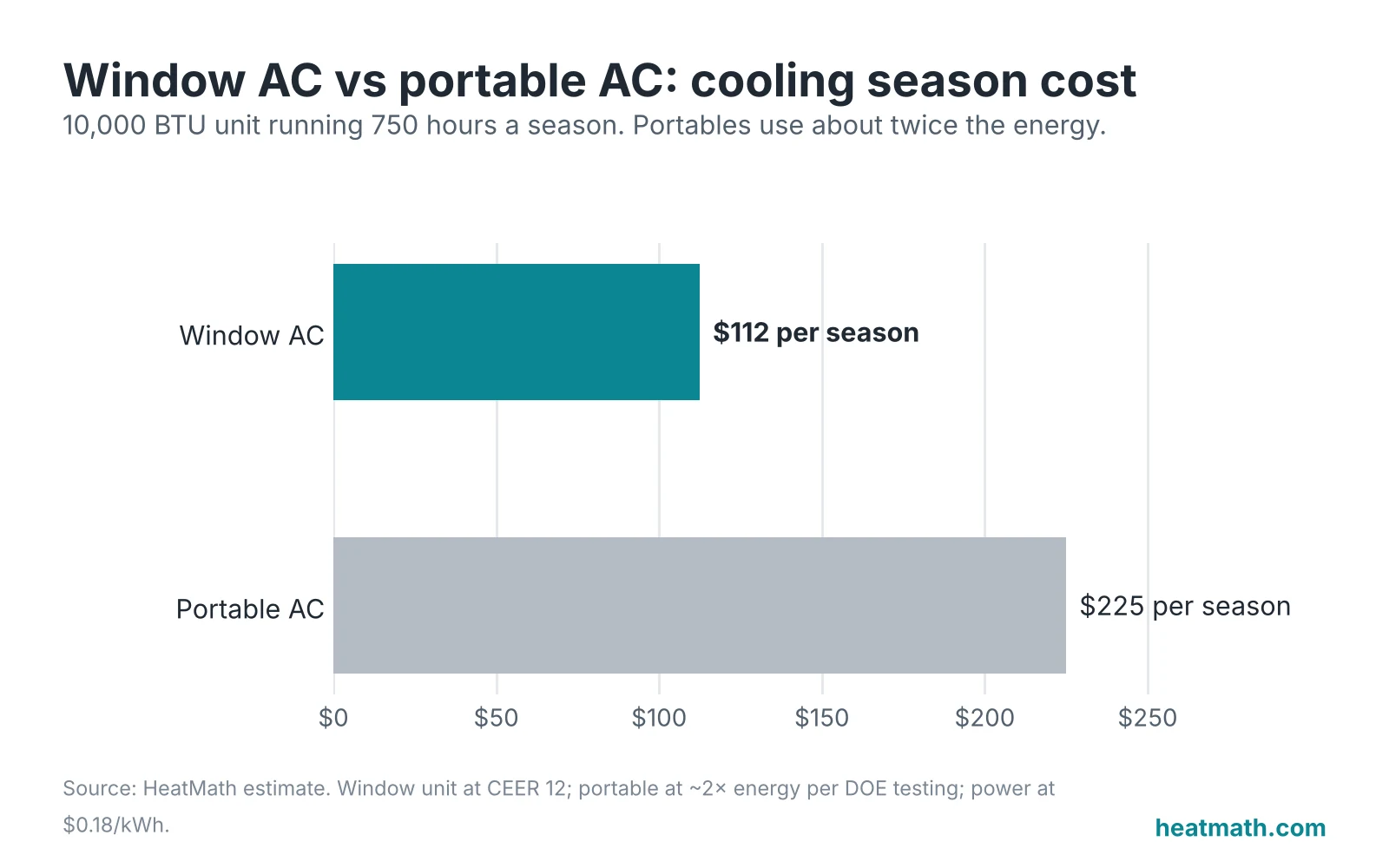
Take two units sold as 10,000 BTU. Say the window model draws about 850 watts and the portable draws about 1,100 watts. Run each 8 hours a day at $0.18 per kWh. The window unit costs about $37 a month. The portable costs about $48, and it will likely cool less because of the single-hose leak. These wattages are examples. Check the label on the units you compare.
Sizing: get the BTU right first
Sizing matters more than type. Too small and the unit runs nonstop without catching up. Too big and it short-cycles, leaving the room cold and clammy. Typical guidance pairs about 8,000 BTU with a 350 sq ft room and 12,000 BTU with rooms up to about 500 sq ft. Sunny rooms, kitchens and high ceilings need more.
Get a room-specific number with the BTU calculator. For a portable, compare that number against the SACC rating.
Maintenance: window AC vs portable AC
Upkeep is similar, with one extra chore for portables. Both types have a washable filter behind the front grille. Rinse it every two weeks in heavy use so airflow stays strong.
Portable units also collect condensate. Many evaporate most of it through the exhaust hose, but in humid weather the internal tank can fill and the unit shuts off until you drain it. Window units drip outside, so you rarely think about water.
At the end of the season, a window unit should come out or get a tight cover to stop drafts. A portable rolls into a closet. If storage space is tight, that is a small point in the portable’s favor in the window AC vs portable AC choice.
Which should you buy?
Choose a window AC if:
- You have a double-hung or horizontal slider window.
- Your landlord or HOA allows it.
- You want the lowest running cost and the quietest room.
- You need to cool a large room or open area.
Choose a portable AC if:
- Your windows are casement or awning style and cannot hold a window unit.
- Your lease or building rules ban window units.
- You need to move cooling between rooms.
- You only need cooling for a small room or a short period.
If you get the choice, pick a dual-hose portable over a single-hose model.
A third option: a ductless mini split
If you plan to cool the same room for years, a ductless mini split beats both. It is far quieter, much more efficient and also heats in winter. The trade-off is a much higher upfront price and professional installation. See whether it pays back against a window unit or electric heat with the heat pump savings calculator.
Compare room AC options
As an Amazon Associate, HeatMath earns from qualifying purchases. These links open Amazon search results, so you can compare brands and prices yourself.
Frequently asked questions
Is a window AC or portable AC cheaper to run?
A window AC is almost always cheaper to run. DOE estimates portable ACs use about twice as much energy as a typical new window unit, and single-hose portables also pull warm outdoor air back into the room.
Do portable air conditioners need a window?
Yes. A portable AC must vent hot air outside through a hose, usually with a window kit. Some people vent through a wall or a sliding door instead, but a vent is always required.
Can a portable AC cool a large room?
Not well. Portable units work best in smaller spaces and often struggle above about 500 sq ft. For a large room, a properly sized window unit or a mini split is a better fit.