A dual fuel heat pump is a heat pump paired with a gas or propane furnace, controlled so each runs when it is cheapest or most comfortable. The heat pump handles cooling and most heating days. When the outdoor temperature drops below a set switchover point, usually 25 to 40°F, the furnace takes over. A new dual fuel system typically costs $7,500 to $12,000 installed, or $2,500 to $8,000 if you add a heat pump to a furnace that still has years left.
This guide explains how the setup works, how to pick the switchover temperature, what it costs, and who should buy one.
How a dual fuel heat pump works
A dual fuel system (also called a hybrid heat system) has four main parts:
- Outdoor heat pump that cools in summer and heats in mild and cool weather.
- Gas or propane furnace indoors, which replaces the electric strip heat a standard heat pump uses as backup.
- Indoor coil sitting on the furnace, shared by both systems for airflow.
- Dual fuel thermostat or control board with an outdoor temperature sensor that decides which one runs.
The two heat sources do not run at the same time in most setups. Running the furnace while the heat pump coil sits above it would push hot air across the refrigerant coil and raise head pressure. The control locks one out while the other runs.
Thermal vs. economic balance point
Two temperatures decide when the system should switch.
Thermal balance point
This is the outdoor temperature where the heat pump’s output equals your home’s heat loss. Below it, the heat pump alone cannot keep up. For a standard heat pump sized for cooling, it often falls in the 25 to 35°F range. For a cold-climate unit, it can be 5°F or lower.
Economic balance point
This is where gas becomes cheaper per unit of heat than the heat pump. It depends on your electricity rate, your gas rate and your furnace efficiency. Use this formula:
Break-even COP = (Electric price per kWh × AFUE × 100,000) ÷ (Gas price per therm × 3,412)
If your heat pump’s COP at a given temperature is above the break-even COP, the heat pump is cheaper. Below it, the furnace is cheaper. Heat pump COP falls as it gets colder, so there is one crossover temperature.
At 2026 national averages, power is about $0.182 per kWh (EIA forecast) and gas about $1.54 per therm ($15.93 per thousand cubic feet). With a 96% AFUE furnace, break-even COP is about 3.3. Many standard heat pumps drop below COP 3.3 somewhere in the 35 to 45°F range, which is why some homes with cheap gas switch fairly early.
| Electric rate | Gas rate | Break-even COP (96% AFUE) | Likely switchover, standard HP | Likely switchover, cold-climate HP |
|---|---|---|---|---|
| $0.12/kWh | $1.80/therm | 1.9 | 15 – 25°F | Below 10°F |
| $0.15/kWh | $1.50/therm | 2.8 | 25 – 35°F | 15 – 25°F |
| $0.18/kWh | $1.54/therm | 3.3 | 35 – 45°F | 25 – 35°F |
| $0.25/kWh | $1.50/therm | 4.7 | Furnace most of winter | Furnace most of winter |
Switchover ranges are estimates. Check your model’s performance table for COP at each temperature. Set the switchover at the higher of the thermal and economic balance points, then adjust for comfort.
Recommended switchover temperatures
Installer guidance tends to cluster in these ranges:
- Standard heat pump + natural gas furnace: start at 30 to 40°F. Drop to 25 to 35°F if power is cheap or gas is expensive.
- Cold-climate heat pump + natural gas furnace: start at 15 to 30°F.
- Any heat pump + propane or oil furnace: start at 15 to 30°F, because those fuels usually cost more per BTU than gas.
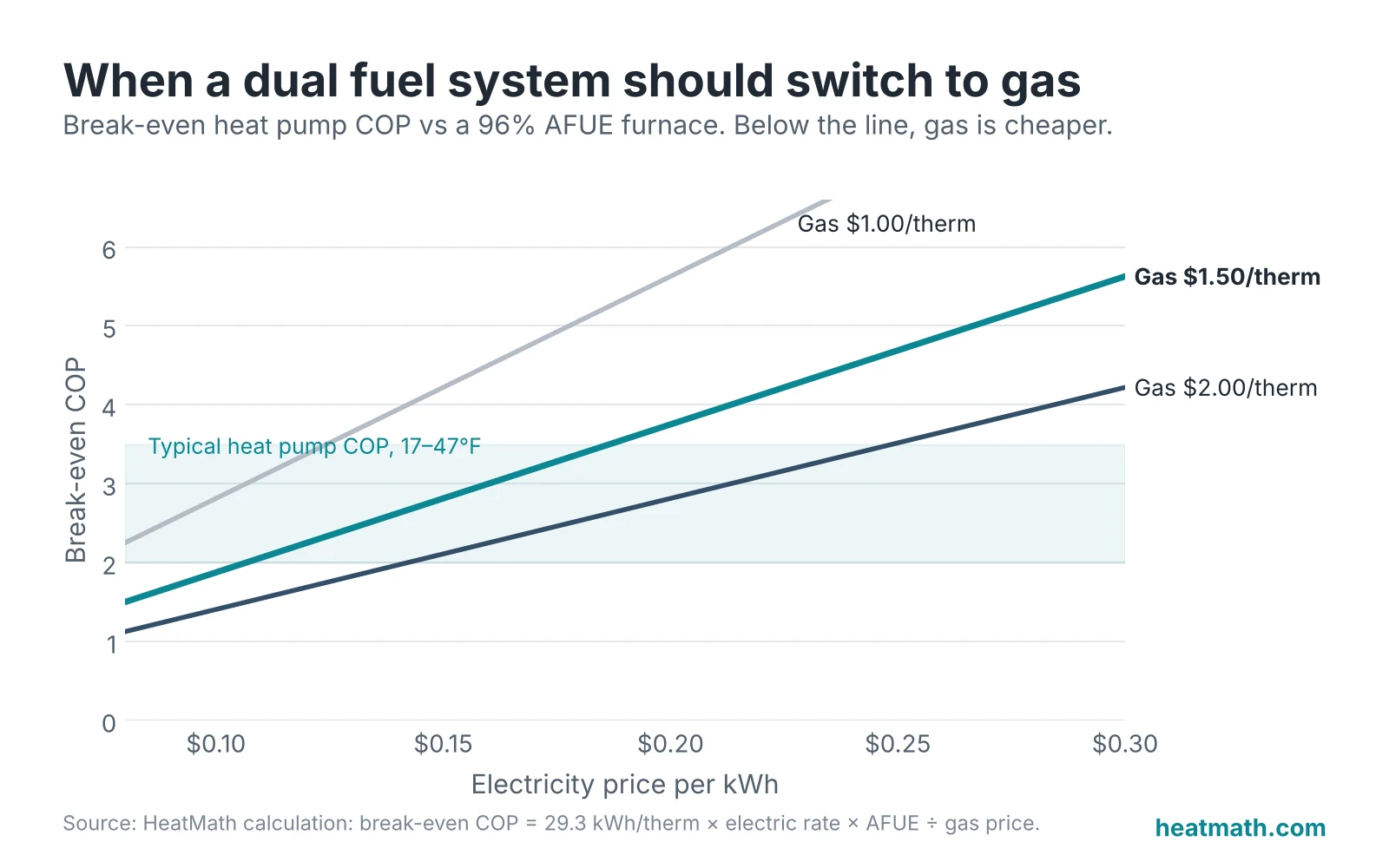
Many owners set it and never revisit it. Recheck your break-even COP when your utility changes rates.
Dual fuel heat pump cost
| Project | Typical installed cost |
|---|---|
| New heat pump + new furnace (full dual fuel system) | $7,500 – $12,000 |
| Add heat pump to existing furnace (replaces AC) | $2,500 – $8,000 |
A common full system is a 3-ton heat pump with a furnace sized for a 2,000 sq ft home. Adding a heat pump to a furnace is often the best value when your old central AC fails, because a heat pump costs only a bit more than a new AC. See AC replacement cost and heat pump installation cost to compare line by line.
The federal 25C tax credit that covered heat pumps and furnaces ended on December 31, 2025. Check your utility and state for current rebates; some still pay for hybrid systems.
Pros and cons
Advantages
- Lower heating bills in homes that used a gas furnace with central AC, because the heat pump covers mild days at COP 3 or more.
- Warm air in deep cold. Furnace air feels noticeably warmer at the vent than heat pump air on a very cold night.
- Backup. If one system fails, the other can still heat the house.
- No strip heat. You avoid the high cost of electric resistance backup.
Drawbacks
- Two systems to maintain, with gas venting, a heat exchanger and a refrigerant circuit.
- More upfront cost than a single system.
- Keeps you on gas, including the monthly gas connection fee.
- Setup matters. A wrong switchover setting can wipe out the savings.
Who should choose a dual fuel heat pump?
A dual fuel heat pump makes the most sense when you:
- Already have a gas furnace in good condition and need a new AC.
- Live in a cold climate but do not want to pay for a larger cold-climate heat pump.
- Pay a lot for electricity but have cheap natural gas.
- Use propane or oil today and want to burn much less of it.
An all-electric heat pump is often better if you have no gas line, cheap electricity, or a mild climate. Our heat pump vs. furnace guide covers that choice. To estimate yearly savings from adding a heat pump, try the heat pump savings calculator.
Worth having at home
As an Amazon Associate, HeatMath earns from qualifying purchases. These links open Amazon search results, so you can compare brands and prices yourself.
Frequently asked questions
Can I add a heat pump to my existing gas furnace?
Yes, in most cases. The installer replaces your AC condenser with a heat pump, swaps or reuses a compatible indoor coil, and adds a dual fuel thermostat. The furnace must have a variable or multi-speed blower that can handle the airflow. Expect $2,500 to $8,000.
What temperature should a dual fuel system switch to gas?
Most standard heat pumps paired with natural gas start at 30 to 40°F. Cold-climate models can run down to 15 to 30°F. The best setting is the higher of your thermal balance point and your economic balance point, based on your local rates.
Is a dual fuel heat pump worth it?
It is usually worth it if you need to replace your AC and already heat with gas, propane or oil. The extra cost over a new AC is modest, and the heat pump takes over many heating hours. It is less compelling if gas is very cheap and electricity is very expensive.