A standard 1,500-watt space heater costs about $0.26 per hour to run at the national average electricity price of $0.17/kWh. That works out to about $2.04 for an 8-hour night and roughly $61 a month if you run it 8 hours every day on high. A 750-watt heater on its low setting costs half that: about $0.13 an hour and $31 a month.
Those are worst-case numbers, because they assume the heating element never cycles off. With a built-in thermostat holding a small room at temperature, real bills often come in 30–50% lower. Plug your own wattage, hours and rate into our space heater cost calculator to get a figure for your home.
The formula for space heater running cost
Every space heater’s wattage is on its rating label. Divide by 1,000 to get kilowatts, then multiply by your electricity price and the hours you run it.
Cost per hour = watts ÷ 1,000 × price per kWh
Cost per month = cost per hour × hours per day × days
Your price per kWh is on your utility bill. Use the all-in rate: total bill minus fixed customer charges, divided by kWh used.
Almost every plug-in heater sold in the US tops out at 1,500 W, because that is about the most a standard 15-amp, 120-volt circuit can safely carry continuously (1,500 W ÷ 120 V = 12.5 A). The “low” setting is usually 750–900 W. A “5,000 BTU” heater is just 1,500 W (1,500 × 3.412 ≈ 5,100 BTU/h).
Cost per hour, day and month by wattage and electricity price
The table assumes the heater runs continuously at the stated wattage, 8 hours a day for 30 days. Electricity prices across the US range from about $0.12/kWh in parts of the South and Northwest to $0.35/kWh or more in New England and California.
| Heater setting | Price per kWh | Per hour | Per 8-hour day | Per month (8 h/day) |
|---|---|---|---|---|
| 750 W (low) | $0.12 | $0.09 | $0.72 | $21.60 |
| 750 W (low) | $0.17 | $0.13 | $1.02 | $30.60 |
| 750 W (low) | $0.25 | $0.19 | $1.50 | $45.00 |
| 750 W (low) | $0.35 | $0.26 | $2.10 | $63.00 |
| 1,500 W (high) | $0.12 | $0.18 | $1.44 | $43.20 |
| 1,500 W (high) | $0.17 | $0.26 | $2.04 | $61.20 |
| 1,500 W (high) | $0.25 | $0.38 | $3.00 | $90.00 |
| 1,500 W (high) | $0.35 | $0.53 | $4.20 | $126.00 |
Running a 1,500 W heater around the clock at $0.17/kWh costs about $6.12 a day, or $184 a month.
Worked examples
Example 1: bedroom heater, 8 hours a night for 30 days
A 1,500 W ceramic heater warms a bedroom from 10 p.m. to 6 a.m. every night for a month, at $0.17/kWh.
- Power: 1,500 W ÷ 1,000 = 1.5 kW
- Energy per night: 1.5 kW × 8 h = 12 kWh
- Energy per month: 12 kWh × 30 = 360 kWh
- Cost: 360 kWh × $0.17 = $61.20 a month
That’s the ceiling. If the heater’s thermostat holds the room once it warms up and the element is on about 60% of the time, the bill drops to 360 × 0.60 × $0.17 = about $36.70.
Example 2: home office, 6 hours a day on weekdays
A home office heater runs 9 a.m. to 3 p.m., Monday to Friday. Call it 22 workdays a month, at $0.17/kWh.
- On high (1.5 kW): 1.5 × 6 h × 22 days = 198 kWh × $0.17 = $33.66 a month
- On low (0.75 kW): 0.75 × 6 × 22 = 99 kWh × $0.17 = $16.83 a month
Whether that $17–$34 is extra spending or real savings depends entirely on what your central heating is doing during those hours, which is the next section.
Why every space heater costs the same per kWh
An electric resistance heater turns essentially 100% of the electricity it draws into heat. So 1 kWh in always means about 3,412 BTU out, whether the box is oil-filled, ceramic, infrared, a coil fan heater or a $400 “designer” model.
On the parts side this is easy to see: open any of them and the heat source is a resistance element (a nichrome coil, a ceramic PTC stone, or a sealed rod in oil), a bimetal or electronic thermostat, a thermal fuse and, on fan models, a small motor. None of those can make more heat per watt than another. What differs is how the heat reaches you:
- Ceramic and fan heaters blow warm air. Fast, but the room cools quickly when they cycle off.
- Oil-filled radiators heat slowly but store heat in the oil and keep radiating after the element shuts off. Silent; good for bedrooms.
- Infrared (quartz) heaters warm people and objects in their line of sight instead of the air. Best for drafty spots like a garage workbench.
Any “uses 50% less energy” claim really means fewer hours or a smaller space. Compare heaters on wattage, thermostat quality and comfort.
When a space heater saves money, and when it doesn’t
Because resistance heat is 100% efficient, it sounds cheap. It isn’t. A heat pump moves heat from outdoors instead of creating it, delivering about 2.6 units of heat per unit of electricity over a season (COP 2.6), and a gas furnace burns fuel that costs far less per BTU than electricity. Here is the cost per 1,000 BTU of delivered heat at the site’s standard prices:
- Space heater: $0.17 ÷ 3,412 BTU × 1,000 = about $0.050 per 1,000 BTU
- Heat pump at COP 2.6: $0.050 ÷ 2.6 = about $0.019 per 1,000 BTU
- 95% gas furnace at $1.60/therm: $1.60 ÷ (100,000 × 0.95) × 1,000 = about $0.017 per 1,000 BTU
Scaled up to a million BTU (roughly what a typical home burns on a cold winter day), the gap is hard to miss.
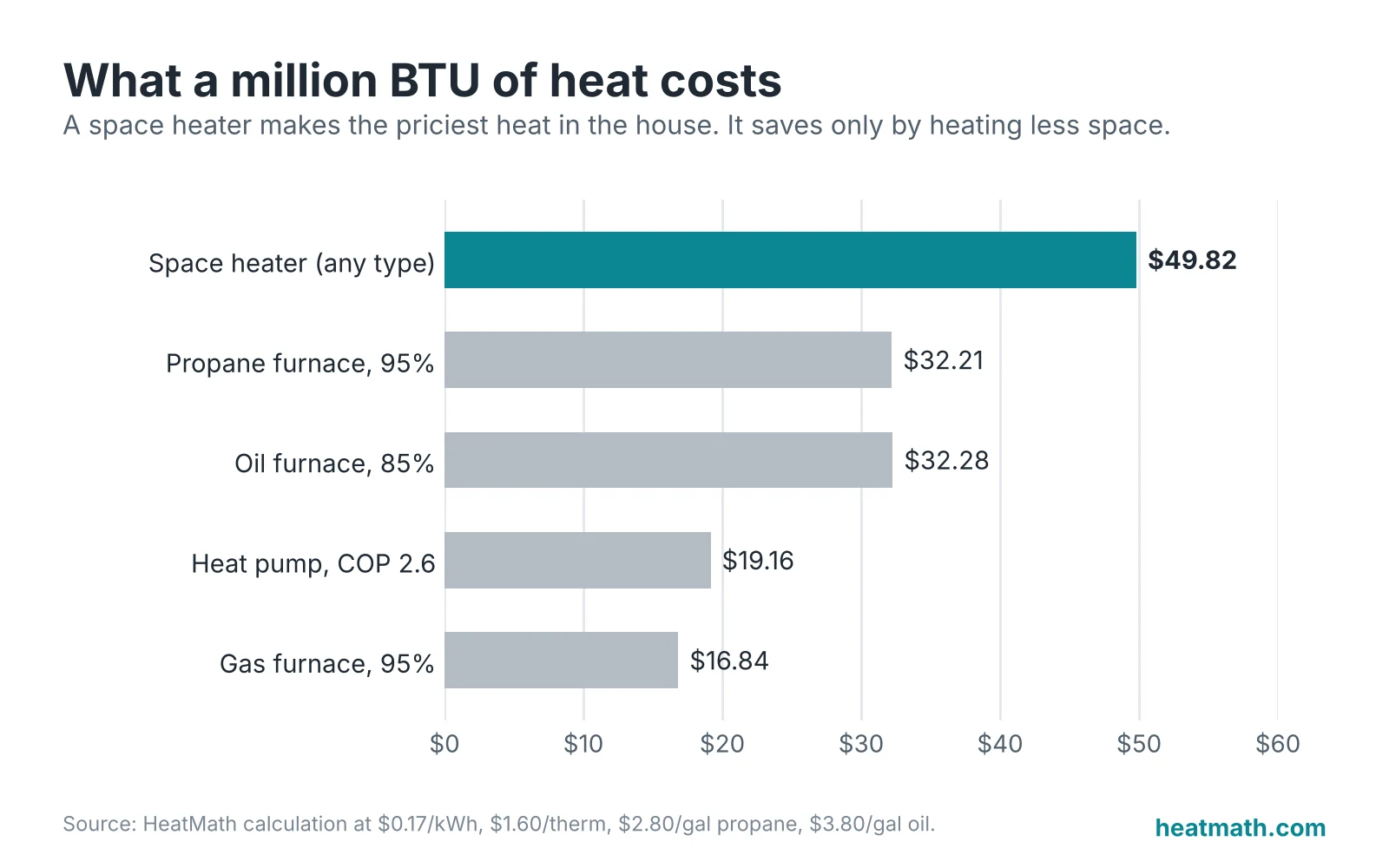
So a space heater only saves money through zone heating: you turn the central thermostat down and heat just the one room you’re in. The savings come from the rest of the house running cooler, not from the heater. The test is simple. For every BTU the space heater puts out, your central system has to deliver fewer BTU somewhere else by at least this much:
| Main heating system | Cost per 1,000 BTU | Central heat you must avoid per BTU of space heat | Verdict for zone heating |
|---|---|---|---|
| Electric baseboard or electric furnace | $0.050 | 1.0 BTU | Almost always saves |
| Propane furnace (95%) | $0.032 | 1.55 BTU | Often saves |
| Oil furnace (85%) | $0.032 | 1.55 BTU | Often saves |
| Heat pump (COP 2.6) | $0.019 | 2.6 BTU | Only with a big setback |
| Gas furnace (95%) | $0.017 | 3.0 BTU | Only with a big setback |
Take the home office example on low: 0.75 kW × 6 h = 4.5 kWh, or about 15,400 BTU for $0.77 a day. With a heat pump, that only pays off if lowering the house thermostat during those 6 hours cuts the heat pump’s output by about 40,000 BTU (2.6 × 15,400). Realistic if you live alone and drop the thermostat 8–10°F; pure added cost if the family keeps the house at 70°F anyway. Our heating cost calculator shows what your central system spends; the heat pump thermostat settings guide covers how far a heat pump can be set back without triggering backup strips, which are just a giant space heater inside the air handler.
Use the thermostat and eco mode
The single biggest control on your bill is how many minutes per hour the element is actually on. A few habits make a real difference:
- Use the thermostat, not the high switch. A heater on “high” with no thermostat runs 100% of the time. A heater set to 68°F in a closed room may run only half the time, cutting the bedroom example from $61 to about $31.
- Eco mode on most models starts on high, then drops to low or cycles once the set temperature is reached. It’s the same idea, automated.
- Close the door, or you’re heating the whole house at the priciest rate per BTU.
From the parts counter: cheap bimetal thermostats drift or stick closed. If your heater never cycles off in a warm room, suspect the thermostat; that’s a cost and a safety problem.
Space heater safety basics
Space heaters are involved in a large share of home heating fires, according to fire safety agencies.
- Plug directly into a wall outlet. No extension cords or power strips. Most aren’t built for 12.5 A for hours.
- Keep 3 feet of clearance from beds, curtains, furniture, paper and clothing.
- Buy a heater with a tip-over switch and overheat protection, and look for a UL or ETL listing.
- Never leave it running unattended or while you sleep unless it’s designed for that, such as an oil-filled radiator with a thermostat.
The failure I see most from the parts side isn’t the heater, it’s the connection. A worn wall receptacle with loose contacts, or a plug whose blades have lost their grip, adds resistance right at the joint. At 12.5 A that joint heats up: the plug gets hot, the faceplate browns, plastic can melt. Unplug and feel the plug after an hour of use. If it’s more than warm, or the outlet is browned, stop using that outlet. Have the receptacle replaced with the breaker off, and replace any heater with a scorched plug or damaged cord.
Frequently asked questions
How much does it cost to run a space heater all night?
A 1,500 W heater running 8 hours costs about $2.04 at $0.17/kWh, or about $1.02 on the 750 W low setting.
Is it cheaper to run a space heater or central heat?
Per BTU, central heat from a gas furnace or heat pump is about 2.6–3 times cheaper. A space heater only comes out ahead if you heat one room and turn the central thermostat down enough to cut the rest of the house’s heating by more than that ratio.
Do oil-filled heaters use less electricity than ceramic heaters?
No. At the same wattage they use exactly the same electricity and produce the same heat. A 1,500 W oil-filled radiator costs the same $0.26 an hour as a 1,500 W ceramic heater; it just releases heat more gently.
How much does a space heater add to my electric bill each month?
About $15–$60 a month at $0.17/kWh for typical use of 2–8 hours a day on high, and about $184 if it runs 24/7. Use the space heater cost calculator with your own hours and rate.
Can a space heater replace my heat pump to save money?
Not for the whole house. A heat pump at a seasonal COP of 2.6 delivers heat for about $0.019 per 1,000 BTU versus $0.050 for a space heater. Use a space heater for one occupied room, not as a substitute. If you’re comparing whole-house running costs, see how much it costs to run a heat pump.