Most heat pump noise is normal: a steady fan hum, a low compressor drone, and a short whoosh with a cloud of steam during defrost. The sounds worth acting on are new ones, such as grinding, screeching, loud banging, or constant buzzing with no airflow. This guide sorts the common sounds into “leave it”, “check it yourself”, and “call a technician”, and shows how much quieter a unit gets with distance.
How loud should a heat pump be?
According to Daikin, modern outdoor units typically run at about 40 to 60 dBA measured a few feet away, and the quietest models drop into the high 20s or 30s dBA at low speed. For context, Daikin places a modern refrigerator at 30 to 50 dBA and a washing machine at 50 to 60 dBA. Indoor air handlers and ductless heads are usually quieter than the outdoor unit, because the compressor and the big fan live outside.
Two things change how loud the same unit sounds. First, speed: inverter heat pumps ramp up on cold mornings and right after a thermostat change, so they sound louder at 6 a.m. than at noon. Second, ice and snow: frost on the coil restricts airflow, so the fan and compressor work harder until defrost clears it. If you want to know whether your unit is actually running hard, the heat pump thermostat settings winter guide explains how big setbacks force long high-speed recovery runs.
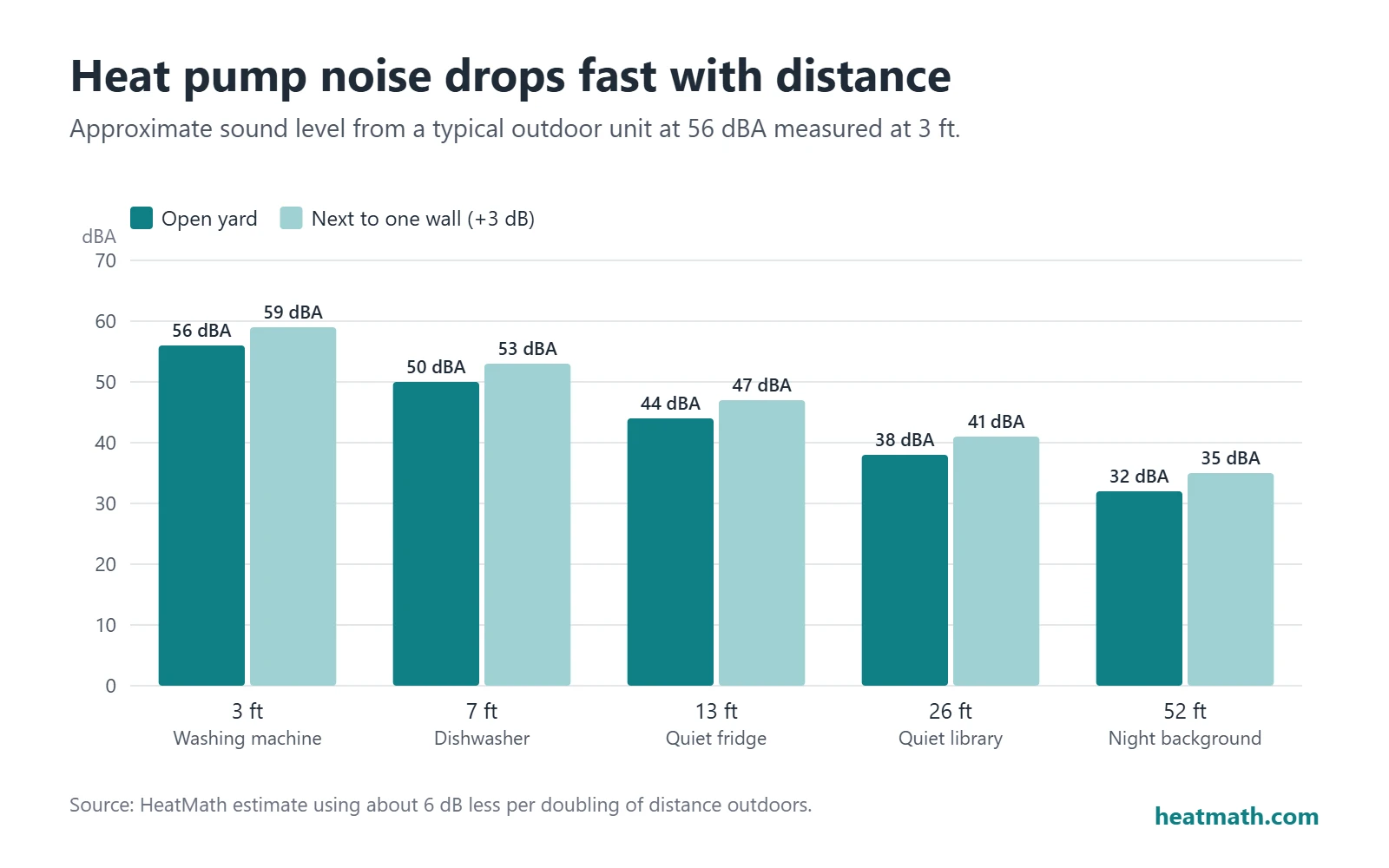
Heat pump noise and distance: a quick table
Sound from a small source outdoors falls by roughly 6 dB each time you double the distance (the inverse square law). We applied that rule to a unit rated at 56 dBA at 1 meter, the middle of Daikin’s 40 to 60 dBA range. Real yards are not open fields: a wall right behind the unit or a corner between two walls reflects sound and can add about 3 dB or more.
| Distance from unit | Approx. level (open yard) | Next to one wall (+3 dB) | What it compares to |
|---|---|---|---|
| 3 ft (1 m) | 56 dBA | 59 dBA | Washing machine |
| 7 ft (2 m) | 50 dBA | 53 dBA | Dishwasher |
| 13 ft (4 m) | 44 dBA | 47 dBA | Quiet refrigerator |
| 26 ft (8 m) | 38 dBA | 41 dBA | Quiet library |
| 52 ft (16 m) | 32 dBA | 35 dBA | Background at night |
Level at distance d = level at 1 m − 20 × log10(d). Assumptions: point source, free field, 56 dBA at 1 m. Your unit’s rated figure is on its spec sheet.
The takeaway: a unit placed 3 feet from a bedroom window will be heard; the same unit 15 feet away along a side wall usually blends into the background. A 10 dB drop sounds roughly half as loud to most people, so moving the listener from 3 feet to about 10 feet does more than any cover or “quiet kit”.
Normal sounds you can ignore
Most heat pump noise falls into this group. None of these sounds needs a service call on its own.
- Steady hum or whir. The fan and compressor running. Louder on cold mornings is expected.
- Whoosh plus steam. Trane describes a “swooshing sound as the refrigerant reverses course” at the start and end of defrost, with a cloud of steam as ice melts. Trane says its demand-defrost cycles usually last 3 to 5 minutes. Our dual fuel heat pump article covers why the furnace may fire briefly during this window on hybrid systems.
- Fan stops, compressor keeps running. Also part of defrost. The outdoor fan pauses so the coil warms faster.
- Clicks at start and stop. Contactors and relays switching. One or two clicks per cycle is normal.
- Ticking or creaking ductwork as metal ducts warm and cool. Annoying, but not a fault in the heat pump itself.
- Gurgling or trickling right after defrost or after a cycle ends, as refrigerant settles and meltwater drains.
Sounds that mean something: a decision table
Use this as a triage list, not a diagnosis. Anything involving refrigerant, the compressor, or the electrical panel inside the unit is a job for a licensed technician. Before you look at anything outdoors, turn the system off at the thermostat and at the outdoor disconnect.
| Sound | Common cause | Safe owner check | Call a pro if… |
|---|---|---|---|
| Rattling or vibrating | Loose panel screws, debris in the cabinet, unit off level | Clear leaves and sticks from around the unit; check that the pad is level | The rattle continues with panels tight and the pad level |
| Grinding or scraping | Fan blade hitting ice or debris, worn motor bearings | Look for ice or a stick touching the fan (power off) | Nothing is touching the blade; bearings are likely worn |
| Screeching or squealing | Failing fan motor bearings, or high pressure in the system | None beyond shutting the system off | Always. Do not keep running it |
| Loud bang at start-up | Compressor hard start, loose mounting, failing component | Note when it happens (start, stop, defrost) | It repeats on every start or is getting louder |
| Constant buzzing, fan not turning | Weak capacitor or failed contactor | None. Switch off to protect the compressor | Always. Capacitors hold a charge even with power off |
| Hissing that never stops | Possible refrigerant leak | Look for oily residue on lines and fittings | Hiss lasts more than a few minutes outside defrost |
| Long, frequent whooshes | Defrost running too often, low charge, sensor fault | Clear snow and make sure the coil is not iced solid | Ice keeps building or cycles get longer, as Trane advises |
The capacitor and contactor items deserve a note. Appliance service manuals of every kind carry the same warning: capacitors can store a dangerous charge after the power is off and must be discharged with the right tool. That rule applies to heat pumps too, so the electrical compartment stays closed unless you are trained.
Simple ways to reduce heat pump noise
- Use the quiet or night mode if the unit or thermostat has one. Daikin notes that night quiet modes typically cut about 3 dBA, with a small loss of capacity.
- Avoid deep setbacks. A 2 to 3 degree setback means shorter high-speed recovery runs than a 7 to 8 degree one.
- Keep 2 feet of clear space around the unit and a few feet above it. Restricted airflow makes the fan and compressor work harder.
- Keep it off the snow. A raised stand or wall bracket keeps the coil clear and lets defrost water drain.
- Fix the pad. A unit that sank on one side vibrates more. Rubber isolation pads under the feet help with vibration carried into the house.
- Plant or screen with care. A fence or shrubs can block line of sight to a window, but keep them well back from the coil.
If noise is part of a bigger question, such as whether to replace an old, loud system, our electric furnace vs heat pump comparison and the heat pump size calculator help with the next step. An oversized unit cycles on and off more, and every start is a noise event.
Neighbor check: some towns set nighttime noise limits at the property line. Daikin cites around 42 dBA at a neighbor’s window in some markets. Check your local code before you place a new unit near a lot line.
Heat pump noise FAQs
Why is my heat pump louder in winter?
In cold weather the compressor runs at higher speed for longer, and frost on the coil makes the fan work harder until defrost clears it. Louder winter operation is normal as long as the sound is a smooth hum, not grinding or banging.
Is it normal for a heat pump to make a loud whoosh?
Yes, a whoosh at the start and end of defrost is the reversing valve changing the refrigerant flow. It often comes with steam from the outdoor unit and usually lasts a few minutes.
How quiet is a quiet heat pump?
The quietest outdoor units are rated in the high 20s to around 40 dBA at low speed, according to Daikin. Compare the sound rating at the same test condition and speed, because some brands quote the lowest-speed figure only.