Heat pump short cycling means the compressor starts, runs only a few minutes, shuts off and starts again, over and over. As a rough guide, a single-stage heat pump that runs less than 5–7 minutes per cycle, or starts more than 5–6 times an hour, is short cycling; normal is about 2–3 cycles an hour with 10–20 minute run times.
The usual causes are an oversized unit, thermostat problems and airflow faults, then low refrigerant and failing electrical parts. It costs you in extra electricity, since every start wastes energy before the system reaches full efficiency, and in compressor wear.
If you suspect the unit is simply too big for the house, plug your square footage and climate into our heat pump size calculator before paying for any repair.
What normal heat pump cycling looks like
| System type | Normal pattern | Short cycling looks like |
|---|---|---|
| Single-stage | 2–3 cycles per hour, 10–20 minutes on | Runs under 5–7 minutes, 5–6+ starts per hour |
| Two-stage | Longer runs on low stage, 15–30+ minutes | Repeated starts on high stage with short runs |
| Inverter (variable-speed) | Runs for hours at low speed; may barely stop in mild weather | Frequent full stops and restarts, often with an error code |
An inverter heat pump that runs nearly nonstop at low speed is working as designed, not malfunctioning. Also don’t confuse defrost with short cycling: in winter, a heat pump may stop heating for 2–10 minutes every 30–90 minutes to melt frost off the outdoor coil. That is normal.
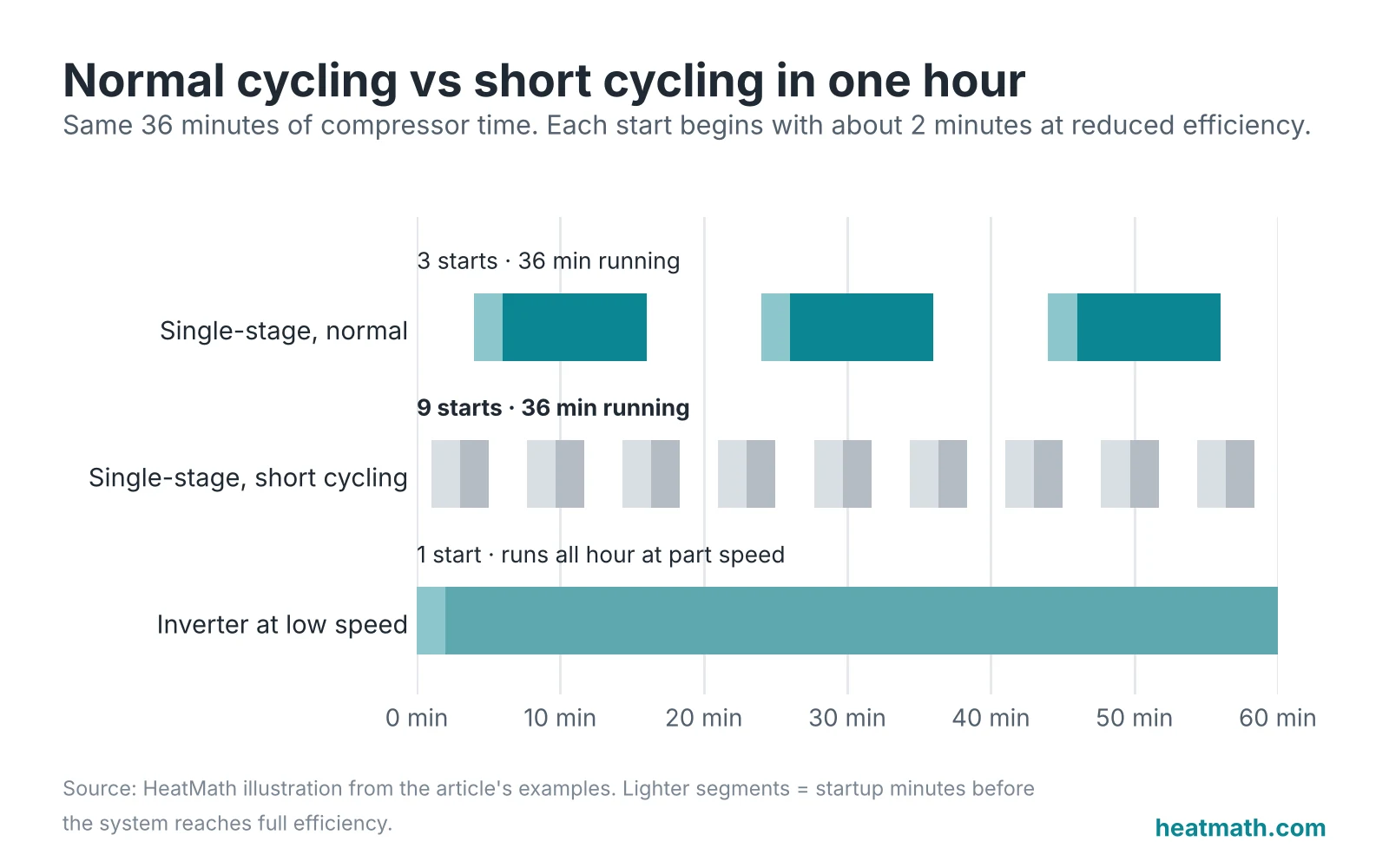
In the chart below, both single-stage examples run 36 minutes in the hour, but the short-cycling one needs nine starts instead of three, tripling its inefficient startup minutes.
How to time your heat pump cycles
Use your phone’s stopwatch and pick a moderate day, roughly 30–50°F for heating or 75–85°F for cooling.
- Listen at the outdoor unit and note when the compressor (not just the fan) starts and stops, for at least three cycles.
- Count starts per hour and average run length, and note whether the thermostat had reached setpoint when it shut off.
That last detail is the most useful clue. If the unit stops after the room reaches setpoint, the system is cycling on the thermostat (sizing or thermostat settings). If it stops before the room is comfortable, a safety device is probably tripping it (pressure switch, freeze-stat, overload).
Causes of heat pump short cycling, most likely first
1. Oversized unit
An oversized heat pump satisfies the thermostat in minutes, then shuts off. It’s the most common cause on single-stage systems, no repair fixes it, and the house also feels clammy in summer.
2. Thermostat placement and settings
A thermostat near a supply register, in sunlight or on an exterior wall shuts the system off early. Check the installer settings too: many digital thermostats have a cycles-per-hour (CPH) setting, and heat pump compressors are usually set to about 3 CPH. A thermostat configured for a gas furnace or electric heat may cycle far faster. A misadjusted heat anticipator on an old mechanical thermostat, or a differential as tight as 0.5°F, does the same.
3. Dirty filter or coil
Restricted airflow is the most common cause of safety trips. In heating mode, a clogged filter or dirty indoor coil lets head pressure climb until the high-pressure switch opens. In cooling mode, low airflow chills the indoor coil until it ices and a freeze-stat or low-pressure switch shuts the compressor off.
4. Low refrigerant
A leak drops suction pressure. The low-pressure switch opens, the compressor stops, pressure equalizes, the switch closes, and the cycle repeats. See why an AC freezes up.
5. Failing capacitor or contactor
A weak run capacitor makes the compressor draw high current and overheat, so its internal overload trips after a few minutes. A pitted contactor can chatter or drop out mid-cycle. On the parts counter, capacitors and contactors are among the most common outdoor-unit parts we sell, and the failed ones that come back often show a bulged capacitor top or burnt, pitted contactor points.
6. Defrost board or sensor problems
A failed defrost sensor or control board can trigger defrost far too often, or end it early. Service manuals list the sensor’s resistance by temperature, so it’s quick to check with a meter.
7. Bad thermostat or loose wire
A thermostat with a failing relay or a loose low-voltage wire at the thermostat, air handler or outdoor unit interrupts the call for heat intermittently. Failed thermostats are a regular sight from the parts side; the giveaway is short cycling with no pattern tied to temperature.
Diagnostic table: symptom, likely cause, who fixes it
Before opening any panel, switch off the outdoor disconnect and the breaker. Capacitors can hold a dangerous charge even with power off. Anything involving refrigerant requires an EPA 608-certified technician.
| Symptom | Likely cause | DIY or pro |
|---|---|---|
| Reaches setpoint in under 5–7 min, every cycle | Oversized unit or thermostat CPH/differential setting | DIY check settings; pro for sizing |
| Short cycles only when sun hits the thermostat | Thermostat location | DIY or electrician to relocate |
| Stops before house is warm, filter is gray | High-pressure trip from low airflow | DIY: replace filter |
| Ice on indoor coil or line set (cooling) | Low airflow or low refrigerant | DIY filter first; pro if it returns |
| Hums, then clicks off after 2–5 min | Weak capacitor or compressor overload | Pro |
| Buzzing or chattering at outdoor unit | Worn contactor | Pro |
| Constant defrost in mild, dry weather | Defrost sensor or board | Pro |
| Random stops, no temperature pattern | Loose wire or failing thermostat | DIY check terminals; pro if unsure |
What short cycling costs on your electric bill
Every time a heat pump starts, it takes a few minutes to build refrigerant pressures and bring the coil to operating temperature. It draws close to full power while delivering less heat, so efficiency is lower than at steady state. Treat each start as losing a fixed amount of energy:
Extra kWh per month = extra starts per month × kW draw × startup minutes lost ÷ 60
Worked example: extra kWh from short cycling
Assumptions (illustrative): a 3-ton single-stage heat pump drawing 3.5 kW, running 36 minutes an hour for 10 hours a day, and losing the equivalent of about 1 minute of full power per start (roughly 2 minutes at half output). Electricity at $0.17/kWh.
- Normal: 3 starts/hour × 10 hours = 30 starts per day
- Short cycling: 9 starts/hour × 10 hours = 90 starts per day
- Extra starts: (90 − 30) × 30 days = 1,800 per month
- Energy lost per start: 3.5 kW × 1 ÷ 60 = about 0.058 kWh
- Extra energy: 1,800 × 0.058 = about 105 kWh per month
- Extra cost: 105 × $0.17 = about $18 per month
For comparison, the base run time is 6 hours a day × 30 days × 3.5 kW = 630 kWh, or about $107. Short cycling adds roughly 17% to the bill in this example, more if weak output brings on backup electric strips. Check your own baseline with the heating cost calculator or see what it costs to run a heat pump.
Wear: why compressor starts matter
Starting is the hardest moment in a compressor’s life. Inrush current is several times running current and oil hasn’t fully circulated yet.
Assume the system is called on for about 2,000 hours a year across heating and cooling. At 3 starts an hour that’s 6,000 starts a year, or 90,000 over 15 years. At 9 starts an hour it’s 18,000 a year and 270,000 over the same period. Tripling starts means contactors and capacitors wear out sooner. See how long heat pumps last for typical lifespans.
Fixes and typical repair costs
| Fix | Typical cost | Notes |
|---|---|---|
| Replace air filter | $10–$40 | DIY, check monthly in peak season |
| Adjust thermostat CPH / differential | $0–$150 | DIY from installer menu, or a service visit |
| New thermostat | $30–$250 part; $150–$500 installed | Must be set up for heat pump (O/B wire) |
| Coil cleaning | $100–$400 | Indoor coil usually needs a pro |
| Capacitor replacement | $100–$400 | Part itself is often $15–$50 |
| Contactor replacement | $150–$450 | Often replaced with the capacitor |
| Defrost sensor or board | $150–$600 | Sensor is the cheaper end |
| Pressure switch | $150–$400 | Find out why it tripped first |
| Leak repair + recharge | $200–$1,600 | EPA 608 technician only |
| Replace oversized system | $8,000–$20,000 | Only when other causes are ruled out |
Diagnosis usually runs $75–$250. Start with the cheap items; see our heat pump maintenance guide.
How to check if your heat pump is oversized
A quick screen uses BTU per square foot. Moderate-climate, well-insulated homes typically need about 20–30 BTU per sq ft of cooling; hot climates and older homes need more. One ton = 12,000 BTU.
Oversizing % = (installed BTU ÷ estimated load BTU − 1) × 100
Worked example: is a 4-ton unit too big?
- House: 1,500 sq ft, moderate climate, about 25 BTU per sq ft
- Estimated load: 1,500 × 25 = 37,500 BTU, about 3.1 tons
- Installed: 4 tons = 48,000 BTU
- Oversizing: 48,000 ÷ 37,500 = 1.28, or about 28% oversized
Sizing guidelines generally allow a heat pump to exceed the calculated cooling load by only about 15–25%, so this 4-ton unit is a likely short-cycler on mild days; a 3-ton (36,000 BTU) would be the better match. Run the numbers in the heat pump size calculator, and see what size AC unit you need for climate-zone tables.
If an oversized unit is otherwise healthy, try a wider differential and lower CPH first. At replacement time, a variable-speed model throttles down instead of stopping.
Frequently asked questions
How many times per hour should a heat pump cycle?
A single-stage heat pump typically cycles 2–3 times an hour with 10–20 minute runs in moderate weather. More than about 5–6 starts an hour, or runs under 5–7 minutes, points to short cycling. Inverter units may run continuously at low speed, which is normal.
Is short cycling dangerous?
It’s not usually a safety hazard, but it accelerates wear on the compressor, capacitor and contactor and raises your bill. If a safety switch is tripping, get the fault checked rather than resetting it repeatedly.
Can a dirty filter really cause short cycling?
Yes. Low airflow raises head pressure in heating and freezes the indoor coil in cooling, and both trip safety switches.
Why does my heat pump stop and start in winter?
Some of it is normal defrost, a 2–10 minute pause every 30–90 minutes. If it happens every few minutes, or in dry weather above about 40°F, suspect the defrost sensor, board or thermostat.
How much does short cycling add to my bill?
In our worked example, tripling starts from 3 to 9 per hour added about 105 kWh, or about $18 a month at $0.17/kWh, roughly 17% more. Yours depends on unit size, run hours and backup heat use.