How long do heat pumps last? An air-source heat pump typically lasts 12 to 15 years, and a well-installed, well-maintained one can pass 20. Ductless mini splits have a similar lifespan. Geothermal systems last longer: 20 to 25 years for the indoor unit and 50 years or more for the underground loop.
How long do heat pumps last compared with AC units?
A heat pump runs in both summer and winter, so it clocks up more hours a year than an air conditioner that only runs in summer. The outdoor unit also goes through defrost cycles in winter, which add wear. Modern inverter heat pumps help, because they ramp up and down smoothly instead of starting and stopping at full power.
How long do heat pumps last by system type?
Not every heat pump ages at the same rate. The biggest split is between systems with an outdoor unit exposed to weather and systems that keep most of their parts indoors or underground.
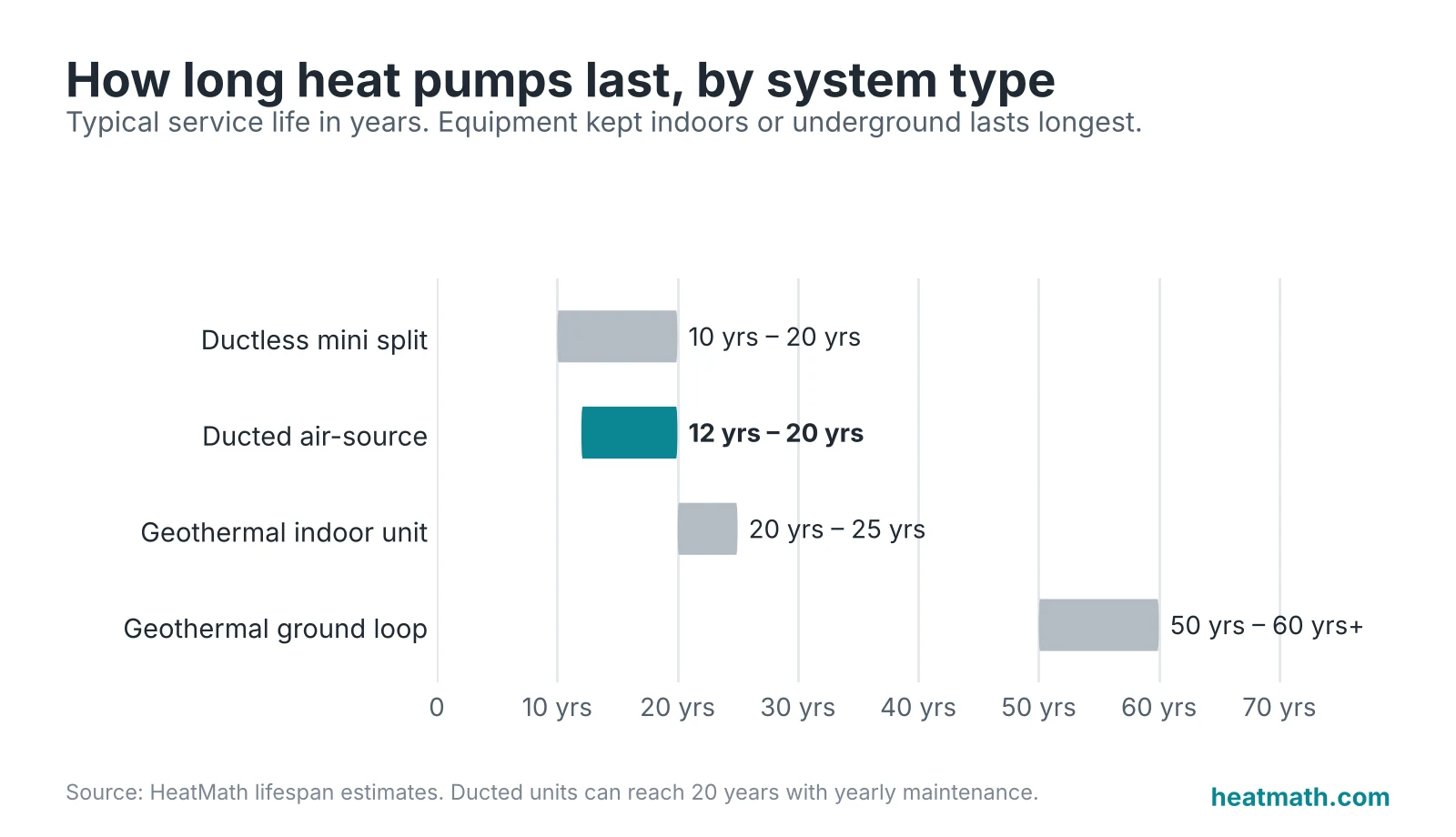
| System type | Typical lifespan | Why |
|---|---|---|
| Ducted air-source heat pump | 12–15 years (up to 20 for well-kept units) | Outdoor compressor runs in both heating and cooling seasons |
| Ductless mini split | 10–20 years | Inverter compressors ramp up and down instead of cycling hard on and off |
| Geothermal (indoor unit) | 20–25 years | Equipment sits indoors, away from weather |
| Geothermal ground loop | 50+ years | Buried pipe has no moving parts |
Climate moves these numbers. Units near the ocean face salt-air corrosion and can wear out closer to the 10-year mark. If you live on the coast, ask for a model with a corrosion-resistant coil coating and rinse the outdoor coil a few times a year. Very cold and very hot regions add runtime hours, which also shortens life. In cold areas, a unit built for low temperatures works less hard; see our guide to cold climate heat pumps.
A geothermal loop usually outlives two or three indoor units. When the indoor unit fails, you replace only that part, not the loop. That is a big reason geothermal costs more up front but can cost less over 30 or 40 years.
Installation quality matters as much as type. A unit that is oversized short-cycles, and one that is undersized runs nonstop. Both add wear. Check sizing before you buy with the heat pump size calculator.
What shortens a heat pump’s life
- Oversizing: a unit that is too big short-cycles, starting and stopping many times an hour. Starts are the hardest moment for a compressor.
- Poor installation: wrong refrigerant charge, a poor vacuum, or moisture left in the lines can cut years off the compressor.
- Dirty filters and coils: they force the system to run hotter and longer.
- Coastal salt air: corrodes coils. Coated coils or regular rinsing help.
- Skipping maintenance: small problems like a weak capacitor can take out a fan motor or compressor.
How to make a heat pump last longer
- Replace or clean the filter every 1–3 months.
- Keep the outdoor unit clear of leaves, snow and plants.
- Book a professional tune-up once a year. See the heat pump maintenance checklist.
- Avoid big thermostat setbacks that force long runs on backup heat.
- Fix leaks when found rather than repeatedly topping up refrigerant.
Signs your heat pump is near the end
- It is more than 12–15 years old and needs a major repair
- It uses R-22 refrigerant (phased out; recharges are very costly)
- Energy bills rise year after year without a change in use
- Rooms stay uncomfortable even after service
- Repeated repairs in the last two years
What your warranty says about lifespan
The warranty is a good hint of how long the maker expects key parts to hold up. It also decides who pays when something breaks.
| Warranty detail | Typical terms |
|---|---|
| Parts, unregistered | About 5 years |
| Parts, registered | About 10 years |
| Registration deadline | Usually 60 days after install |
| Labor | Not covered by the maker |
Three things to do on day one:
- Register the unit. Missing the 60-day window can cut parts coverage in half.
- Ask about labor. Many installers sell or include a labor warranty. Without one, you pay the service call and hours even when the part is free.
- Keep service records. Proof of yearly heat pump maintenance helps if a claim is ever questioned.
The warranty matters most for the compressor. Out of warranty, replacing a heat pump compressor usually costs about $1,000 to $3,000 installed. On a unit past 10 years old, that money often goes further toward a new system. If you plan to sell the home within a few years, a transferable warranty can also be a selling point, so check whether yours moves to the next owner.
Repair or replace?
Multiply the unit’s age by the repair cost. If the result is above about 5,000, replacement usually makes more sense. A compressor replacement on a 12-year-old system (12 × $2,000 = 24,000) is a clear case for replacement. A $200 capacitor on a 6-year-old unit is not.
When you do replace, a new system will almost certainly be more efficient than the old one. See heat pump installation cost and estimate your savings with the SEER2 savings calculator.
Useful tools and parts
As an Amazon Associate, HeatMath earns from qualifying purchases. These links open Amazon search results, so you can compare brands and prices yourself.
Frequently asked questions
Can a heat pump last 30 years?
An air-source heat pump almost never reaches 30 years. Most last 12 to 15 years, and the best-kept modern units reach 20 to 25. The exception is a geothermal heat pump: the U.S. Department of Energy puts the indoor unit at up to 24 years and the underground loop at 50 years or more, so the ground loop can easily outlast 30 years while the indoor unit is replaced once along the way (DOE: geothermal heat pumps).
How long should a heat pump last before you replace it?
Plan for replacement around year 12 to 15 for an air-source unit, earlier if repairs start costing more than half the price of a new system or if it still uses R-22 refrigerant. Before you decide, run your numbers through our heat pump savings calculator to see what a newer, more efficient model would save each year. If you live somewhere with hard winters, also read our guide to cold climate heat pumps.
Can a heat pump last 20 years?
Yes, but it is not the norm for air-source units. Most ducted heat pumps last 12 to 15 years. A well-built unit that was sized correctly, installed well and serviced every year can reach 15 to 20 years, especially in a mild climate. Geothermal indoor units often last 20 years or more, and the ground loop lasts much longer.
Do heat pumps wear out faster than furnaces?
Usually, yes. A heat pump runs in both summer and winter, so it builds up more hours each year than a furnace that only heats. Its outdoor unit also faces rain, snow and sun. That is why heat pumps tend to have a shorter service life than gas furnaces. Climate and maintenance still decide how big that gap is.
Is it worth repairing a 12-year-old heat pump?
It depends on the repair. Small fixes like a capacitor, contactor or fan motor are usually worth doing at any age. A failed compressor or a major refrigerant leak on a 12-year-old unit is different. Those repairs can cost $1,000 to $3,000, and the rest of the system is near the end of its expected life anyway.
Does a heat pump lose efficiency as it ages?
Yes, gradually. Dirty coils, worn fan motors and small refrigerant leaks make the system run longer to deliver the same heat. Yearly service slows the decline. If your bills climb while your usage and rates stay about the same, the unit may be losing efficiency.