A heat pump water heater (also called a hybrid water heater) uses the same technology as a heat pump for your home. Instead of heating water with an electric element, it pulls heat from the air around the tank and moves it into the water. That makes it three to four times as efficient as a standard electric water heater.
How much does a heat pump water heater cost?
| Type | Unit price |
|---|---|
| 50-gallon, 240V | $1,200 – $1,800 |
| 120V plug-in models (no new circuit) | $1,500 – $2,200 |
| 65–80 gallon | $2,800 – $3,500 |
Installation usually adds $800 to $2,000 when replacing an electric tank in the same spot. Replacing a gas water heater costs more because of the new electrical circuit and condensate drain.
How much will it save?
A standard electric tank for a family of four typically costs $800 to $900 a year to run. A heat pump model with a UEF (uniform energy factor) of 3.0 to 4.0 does the same job for about $200 to $300. That is a saving of around $500 to $600 a year at average US electricity prices.
Yearly cost = hot water energy (kWh) ÷ UEF × price per kWh
Against natural gas the saving is smaller and depends on local prices, in the same way as heat pump vs furnace.
Payback
Replacing an electric tank that has failed anyway, the extra cost over a new standard electric tank is often $1,000 to $1,500. At $550 a year in savings that pays back in two to three years. Many utilities offer $300 to $1,000 rebates on top, which shortens the payback further.
What to check before you buy
- Space: most units need about 700 cubic feet of air around them (for example a 10 × 10 ft room with a 7 ft ceiling), or a louvered door or ducting.
- Temperature: the heat pump works best in spaces that stay between 40°F and 90°F, such as basements and garages in mild climates.
- Height: the compressor sits on top, so these tanks are taller than standard ones.
- Drain: it produces condensate, so it needs a floor drain or a small pump.
- Noise: about as loud as a refrigerator or a quiet dishwasher.
- Cooling effect: it cools and dehumidifies the room. That is a bonus in a humid basement and a small penalty in a heated utility room in winter.
Operating modes
- Heat pump only: lowest cost, slower recovery.
- Hybrid: uses the heat pump and switches on the electric element when demand is high. Best for most homes.
- Electric only: use if the space gets too cold or during service.
- Vacation: keeps the tank warm with minimal energy.
How long do they last?
Expect 10 to 15 years, similar to a standard tank. The anode rod should be checked every few years and the air filter on top cleaned every few months.
Heat pump water heater vs. standard electric, gas and tankless
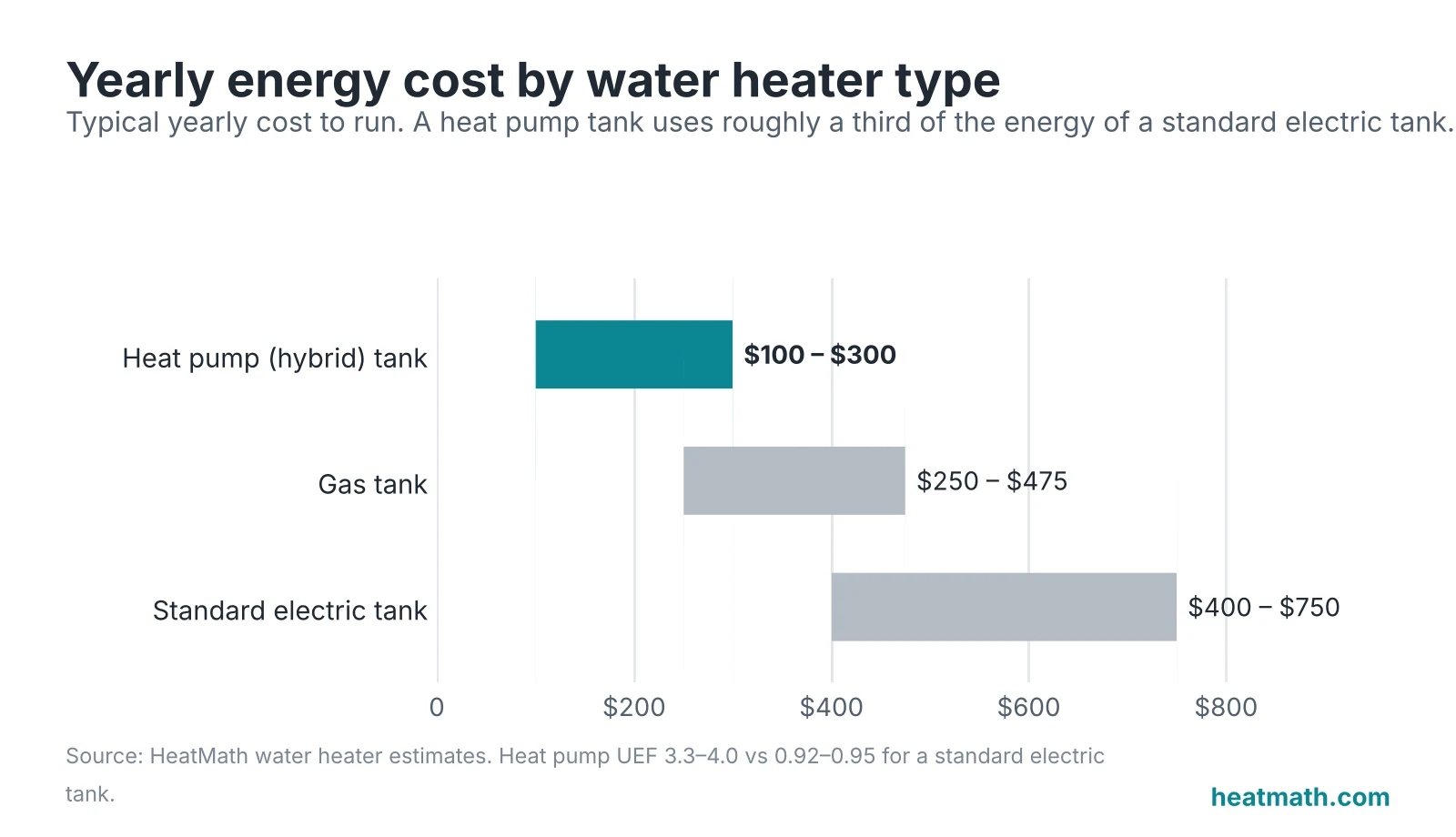
Efficiency is where a heat pump model pulls ahead. Water heaters are rated by Uniform Energy Factor (UEF): the higher the number, the less energy each gallon of hot water takes. A standard electric tank turns about 93% of its electricity into heat. A heat pump unit moves heat from the air instead, so it delivers three to four times more heat than it uses.
| Type | Typical UEF | Typical yearly energy cost |
|---|---|---|
| Heat pump (hybrid) tank | 3.3–4.0 | $100–$300 |
| Standard electric tank | 0.92–0.95 | $400–$750 |
| Gas tank | 0.60–0.70 | $250–$475 |
| Gas tankless | 0.81–0.97 | Usually below a gas tank |
Costs assume a typical family and average US rates. Your numbers depend on local electricity and gas prices, so run them through our heating cost calculator before you decide.
- Replacing an electric tank: the heat pump wins easily. It usually uses the same 240V, 30-amp circuit, and yearly energy costs drop by roughly two-thirds.
- Replacing a gas tank: the gap is smaller. Where gas is cheap, gas can stay competitive on running cost, and the switch may need new wiring.
- Tankless electric: it saves space, but efficiency is close to a standard electric tank, so it does not come close on operating cost.
Is a heat pump water heater worth it?
If you have an electric water heater and space in a basement, garage or large utility room, almost always yes. If you have cheap natural gas, it is closer; compare local prices before deciding.
Where to put it: basement, garage or closet
This type of water heater pulls heat from the air around it. Location therefore affects both efficiency and comfort.
- Basement or large utility room: usually the best spot. Most units need about 450–700 cubic feet of air. The unit also dehumidifies, which helps in damp basements.
- Garage: fine in mild climates or in an attached, insulated garage. The compressor needs air at about 40°F or warmer. Below that, the unit switches to its electric elements and savings disappear.
- Closet: possible with a fully louvered door, or with top and bottom vents, or with ducting. Check the model’s installation manual for the exact opening size.
Three side effects to plan for
- Cooler air: the exhaust air can drop the room temperature a few degrees. That is a bonus in a hot garage and a drawback next to a living area in winter.
- Noise: most run at about 45–55 dB, close to a refrigerator or a quiet conversation. Avoid mounting one on a wall shared with a bedroom.
- Condensate: the unit makes water as it cools the air. It needs a floor drain, a laundry sink or a condensate pump.
120-volt plug-in models for gas replacements
Most heat pump water heaters need a 240V circuit. That is easy when you replace an electric tank, but a gas home may not have one near the water heater. Running a new circuit adds cost, and far more if the panel needs an upgrade.
Plug-in models such as Rheem’s ProTerra plug-in line solve this. They run on a standard 120V outlet, and some versions can share an existing circuit. The tradeoff is slower recovery, because there is no high-power backup element. Installers usually choose a larger tank than the gas unit it replaces to make up for it. These models suit small and average households best. A large family with back-to-back showers is better served by a 240V unit.
Frequently asked questions
Do heat pump water heaters work in a cold garage?
Yes, but not efficiently in winter. Most compressors work best when the air around the unit stays above about 40°F. Colder than that, the unit falls back on its electric elements and runs like a standard electric tank. In a detached or unheated garage in a cold state, a basement or utility room is a better spot. Hybrid mode keeps hot water coming either way.
Does a heat pump water heater need a drain?
Yes. The unit pulls moisture out of the air and produces condensate, typically a few gallons a day in humid conditions. Route the condensate line to a floor drain, laundry sink or condensate pump. Skipping this step leads to water on the floor and possible mold, and it is one of the most common installation mistakes.
Can a heat pump water heater go in a closet?
Often, yes, if it gets enough air. Most models want roughly 450–700 cubic feet of space. A smaller closet can work with a fully louvered door, top and bottom vents, or ducting to another room. The exact requirement varies by model, so check the installation manual before you buy.
Can I still get a tax credit for a hybrid water heater?
No federal tax credit remains. The 25C credit ended for equipment placed in service after December 31, 2025. You may still qualify for utility rebates or income-based state rebates, which can cut hundreds of dollars or more from the price. See our heat pump rebates guide for where to look.
Related: heating cost calculator, heat pump rebates, heat pump installation cost.