The ductless mini split vs heat pump question is really ductless vs ducted, because a mini split is a heat pump. Choose ductless when the house has no ducts, when you are heating or cooling only a few rooms, or when existing ducts run through a hot or cold attic. Choose a ducted heat pump when you already have sound ducts and want even comfort in every room from one system.
Both move heat with the same refrigeration cycle. What differs is how the air reaches each room, and that changes upfront price, running cost, comfort and looks.
Same technology, different delivery
A ducted heat pump pairs an outdoor unit with one indoor air handler, usually in a basement, closet or attic. A blower pushes air through ducts to every room, and one thermostat controls the whole system.
A ductless mini split pairs an outdoor unit with one or more indoor heads mounted on walls, ceilings or floors. Each head heats or cools its own space and has its own controls. According to the U.S. Department of Energy, many models connect up to four indoor units to one outdoor unit, the outdoor unit can sit up to 50 feet from the indoor unit, and installation usually needs only a three-inch hole through the wall for the line set.
Side-by-side comparison
| Ducted heat pump | Ductless mini split | |
|---|---|---|
| Best fit | Homes with good existing ducts | Homes without ducts, additions, problem rooms |
| Top efficiency (DOE) | Up to about 25 SEER2 | Up to about 35 SEER2 |
| Duct losses | Can exceed 30% of heating and cooling energy when ducts run in unconditioned space | None |
| Zoning | One zone unless you add dampers | Every head is its own zone |
| Filtration | Central filter, easy to upgrade | Washable screens in each head |
| Looks | Hidden, only vents show | Visible indoor heads |
| Condensate | One drain at the air handler | A drain path for every head |
The 30% duct figure comes from the DOE, which notes that duct losses can account for more than 30% of energy consumption for space conditioning, especially when ducts are in an attic or crawl space.
Upfront cost of a ductless mini split vs heat pump
Installed price ranges reported in a September 2026 Fixr cost roundup:
- Single-zone mini split: $3,500 to $5,500.
- Multi-zone mini split (2 to 4 heads): $6,000 to $14,000.
- Ducted whole-home heat pump: $12,000 to $18,000 with usable ducts.
- New or modified ductwork: add $2,000 to $5,000.
For one room or a small home, ductless is clearly cheaper. For a whole house with many small rooms, the gap closes. Each extra head adds cost, and a home with eight or ten rooms may need two outdoor units. If your ducts are leaky or undersized, price their repair against going ductless; our guide to ductwork replacement cost has the per-foot numbers.
Running cost: what duct losses do
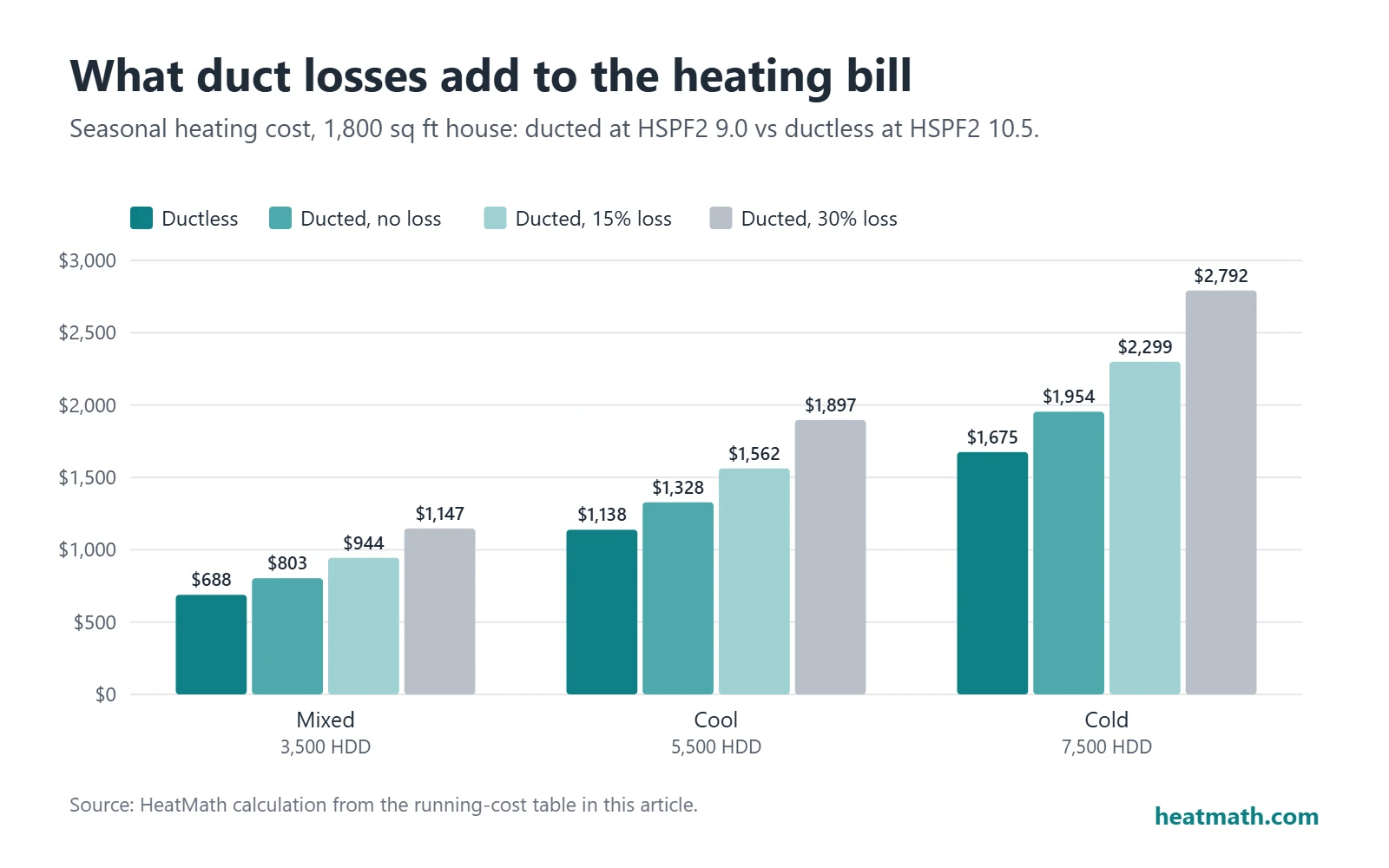
We ran an 1,800 sq ft house with average insulation through the formulas in our heat pump savings calculator. The ducted system is an HSPF2 9.0 heat pump with no, moderate (15%) or heavy (30%) duct losses. The ductless system is an HSPF2 10.5 multi-zone with no duct losses. Electricity is 18.2 cents per kWh, the 2026 national average the EIA forecast in October 2026.
| Climate | Ducted, no loss | Ducted, 15% loss | Ducted, 30% loss | Ductless |
|---|---|---|---|---|
| Mixed (3,500 HDD) | $803 | $944 | $1,147 | $688 |
| Cool (5,500 HDD) | $1,328 | $1,562 | $1,897 | $1,138 |
| Cold (7,500 HDD) | $1,954 | $2,299 | $2,792 | $1,675 |
Annual heating cost only. Duct losses modeled as extra load (load ÷ (1 − loss)). The HSPF2 values are example ratings, not specific products; the federal minimum for heat pumps is 7.5 HSPF2.
Two things stand out. First, the efficiency rating gap alone is worth about $115 to $280 a year here. Second, leaky ducts matter more than the rating: in a cold climate, a ducted system losing 30% costs about $1,100 more per year than the ductless option. Sealing and insulating ducts can close much of that gap for far less than a new system.
The same logic applies in summer. Ducts in a hot attic pick up heat before the air reaches your rooms, so a ducted system works harder on the hottest afternoons. Cooling ratings tell a similar story: federal minimums are 14.3 SEER2 for heat pumps, while many ductless models sit far above that. To put a dollar figure on a SEER2 upgrade for your own cooling hours and electric rate, try the SEER savings calculator. In hot, humid climates, cooling savings can matter as much as heating savings.
Comfort and daily living
- Room-by-room control. Ductless shines when people want different temperatures, or when some rooms sit unused.
- Even heat. Ducted systems spread air to every room, including bathrooms and closets that rarely get their own mini split head. With ductless, closed doors can leave rooms without a head cooler or warmer.
- Noise. Both are quiet when sized well. Mini split heads sit in the room, so you hear the fan; ducted air handlers sit farther away.
- Maintenance. Ductless heads need their filters rinsed every few weeks in heavy use and their coils and blower wheels cleaned periodically. Ducted systems need one filter change and occasional duct checks.
- Sizing risk. The DOE warns that each mini split head must be sized and placed correctly; an oversized head short cycles and wastes energy. Use the BTU calculator for a room-by-room first estimate.
Which one fits your house?
- Do you have ducts in good shape, inside the conditioned space? Yes: start with a ducted heat pump. No: go to step 2.
- Are the ducts in an attic or crawl space, leaky or undersized? Get two quotes: duct repair plus a ducted unit, and a multi-zone ductless system. Compare total cost, not just equipment.
- No ducts at all (boiler, baseboard or space heaters)? Ductless is usually the lower-cost route. Count the rooms that need a head.
- Only one or two problem areas? A single-zone mini split for an addition, garage office or bonus room is often the cheapest fix, and it can work alongside your existing system.
- Do you mind wall units? If yes, ask about concealed ducted mini split air handlers, which serve a few rooms through short duct runs.
If you are replacing electric resistance heat, either option will cut heating cost sharply. Our comparison of an electric furnace vs heat pump shows the size of that drop.
Mini split vs ducted heat pump FAQ
Is a mini split more efficient than a central heat pump?
Often, yes. DOE lists ductless units up to about 35 SEER2 versus about 25 SEER2 for ducted heat pumps, and ductless avoids duct losses. A well-sealed ducted system in conditioned space narrows the gap.
Can one mini split heat a whole house?
Only a small, open home with few interior walls. Heat does not travel well through closed doors, so most houses need several heads or a ducted system for even comfort.
Do mini splits work in cold climates?
Cold-climate models are built for it, with many keeping useful capacity well below freezing. Check the manufacturer’s capacity data at 5°F and plan backup heat for the coldest nights.