An AC not cooling the house usually comes down to one of three simple causes: a thermostat set wrong, a clogged air filter, or a dirty or blocked outdoor unit. Checking all three takes about 15 minutes and costs nothing. If the system runs but still blows warm air after that, the usual culprits are a failed capacitor, low refrigerant from a leak, or a frozen indoor coil, and those need a technician. Typical repairs run $150 to $650, with a national average near $360.
Work through the checks below in order. They go from free and safe to the point where you should stop and call a pro.
First, figure out what “not cooling” looks like
The symptom narrows the cause of an AC not cooling fast. Match what you see to the table before you start opening panels.
| What you notice Most | t likely causes DIY | Y or pro? |
|---|---|---|
| Nothing runs at all | Thermostat, tripped breaker, blown fuse, float switch | DIY first |
| Indoor fan runs, outdoor unit silent | Capacitor, contactor, outdoor disconnect off | Pro for parts |
| Outdoor unit hums but fan does not spin | Bad capacitor or fan motor | Pro |
| Both run, air is only slightly cool | Dirty filter or coil, low refrigerant, undersized unit | DIY then pro |
| Weak airflow at vents | Clogged filter, iced coil, closed vents, duct leak | DIY first |
| Ice on lines or indoor coil | Airflow problem or refrigerant leak | Thaw, then pro if it returns |
| Cools fine at night, falls behind on hot afternoons | Undersized system, dirty condenser, attic heat | Mixed |
Quick checks for an AC not cooling
1. Thermostat settings and power
Confirm the thermostat is on Cool, the setpoint is below room temperature, and the fan is on Auto. A fan set to On keeps blowing between cycles, which can push warm, humid air through the vents and feel like the AC has quit. Replace the batteries if the display is dim or blank.
Next, check the breaker panel for a tripped breaker labeled AC, condenser, or furnace. Reset it once. If it trips again, stop there and call a technician, because that points to an electrical fault.
2. The air filter
A clogged filter is the most common reason for weak cooling. It chokes airflow over the indoor coil, which cuts cooling and can freeze the coil. Pull the filter and hold it up to a light. If you cannot see light through it, replace it. Most 1-inch filters need changing every one to three months in cooling season.
3. The outdoor unit
The condenser outside has to dump the heat it removes from your home. Clear leaves, grass clippings, and plants for at least 2 feet around it. Look at the fins. If they are matted with dirt or cottonwood fluff, turn the power off at the outdoor disconnect and rinse the coil gently from the inside out with a garden hose. Never use a pressure washer.
4. Vents, returns, and the drain line
Make sure supply vents are open, and return grilles are not blocked by furniture. Then find the condensate drain line near the indoor unit. Many systems have a float switch that shuts the AC off if the drain backs up. If the drain pan is full of water, clear the line with a wet/dry vacuum at the outdoor end. A pro flush usually costs $75 to $250.
5. Ice on the coil
If you see frost on the copper lines or the indoor coil, switch the system to Off and set the fan to On for a few hours to thaw it. Running it frozen can damage the compressor. Our guide on an AC freezing up covers the causes and the safe way to thaw it.
Problems that need a technician
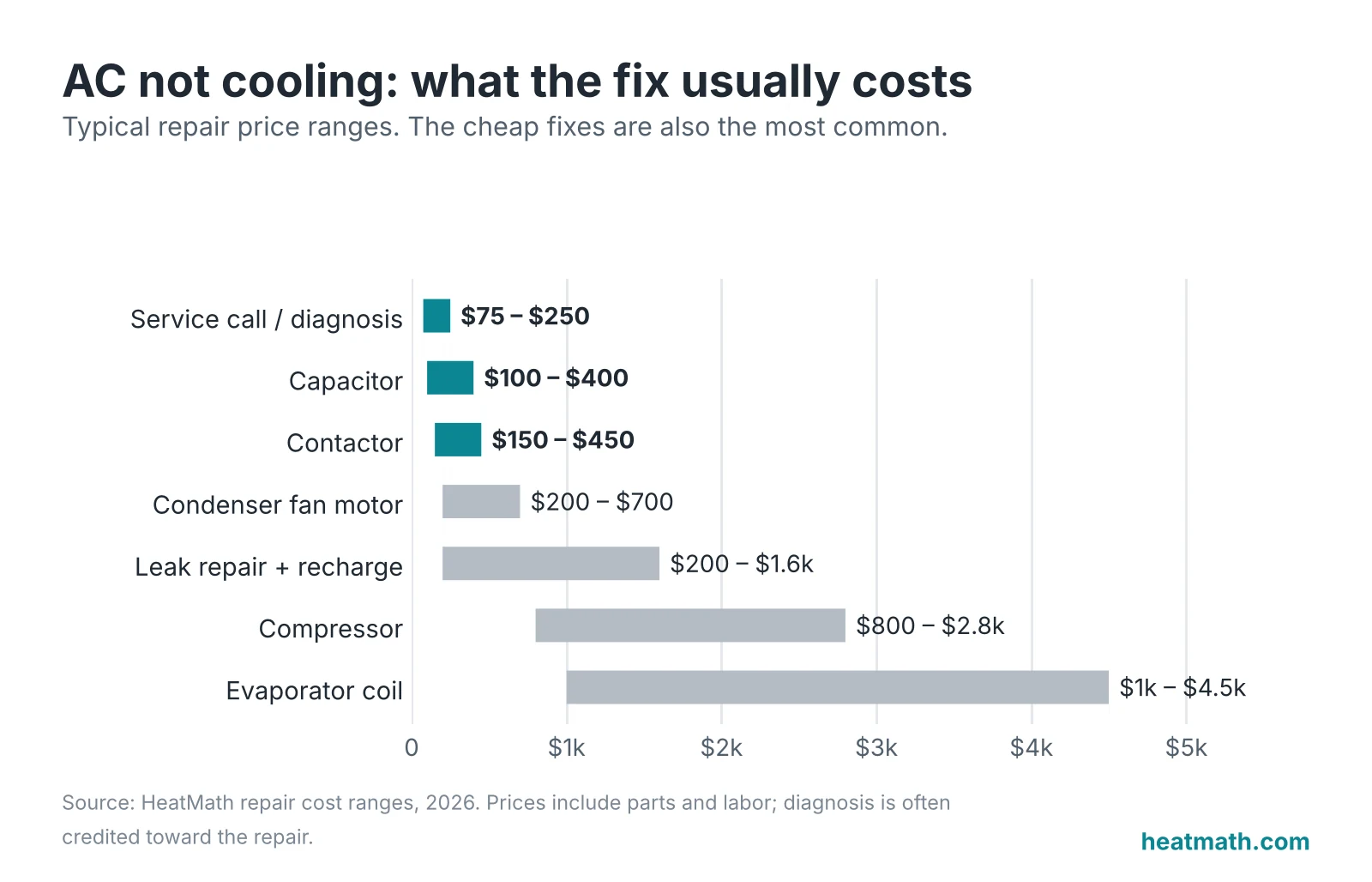
If the simple checks do not solve your AC not cooling problem, the cause is usually one of the parts below. Costs combine 2026 estimates from HomeGuide and Fixr and include parts and labor.
| Repair | Typical cost | Clues |
|---|---|---|
| Service call and diagnosis | $75 – $250 | Often credited toward the repair |
| Capacitor replacement | $100 – $400 | Outdoor unit hums, fan will not start |
| Contactor replacement | $150 – $450 | Outdoor unit will not start or will not stop |
| Condenser fan motor | $200 – $700 | Fan slow, noisy, or stopped |
| Refrigerant leak repair and recharge | $200 – $1,600 | Hissing, oily spots, ice, slowly worsening cooling |
| Evaporator coil replacement | $1,000 – $4,500 | Repeated leaks at the indoor coil |
| Compressor replacement | $800 – $2,800 | Breaker trips, loud clunk, unit runs but no cooling |
Low refrigerant is a leak, not a refill
An AC does not use up refrigerant. If it is low, it is leaking. A recharge without finding the leak just buys you a few weeks or months. Ask the technician to locate and repair the leak, and get the price for both before you agree to a top-off. Older systems that use R-22 are costly to recharge because that refrigerant is no longer produced.
Capacitors fail in the heat.
The run capacitor gives the compressor and fan motor the kick they need to start. It is the most common failed part on a hot day and one of the cheapest fixes. The part costs little, but it stores a dangerous charge, so leave the swap to a pro unless you are trained.
When the AC runs fine, but the house stays warm
Sometimes an AC not cooling well has nothing broken at all. On a 100°F afternoon, a properly sized central AC is designed to hold the house about 20°F below outdoor temperature, not 30 or 40. If the system runs nonstop on the hottest days but catches up at night, the cause may be:
- A unit that was undersized for the home, or a home that grew with an addition. Our guide on what size AC unit you need shows how to check.
- Leaky or uninsulated ducts in a hot attic, which can lose a big chunk of cooling before it reaches a room.
- West-facing windows with no shade, or low attic insulation.
- An aging system that has lost capacity through dirty coils and slow leaks.
Repair or replace?
Two quick rules help with a big repair bill. First, the 50% rule: if the repair costs more than half the price of a new system, replacement is usually the better deal. Second, the $5,000 rule: multiply the unit’s age by the repair cost. If the result is over $5,000, lean toward replacing.
Example: A 12-year-old AC needs a $1,800 compressor. 12 × $1,800 = $21,600, far above $5,000. With a new central AC typically running $3,000 to $7,500 installed, replacing makes more sense.
New systems must meet federal minimums of 13.4 SEER2 in the North and 14.3 SEER2 in the South. A higher rating costs more up front but cuts summer bills; our SEER2 and HSPF2 guide explains the ratings. Compare options in the SEER savings calculator.
Simple fixes you can keep on hand
As an Amazon Associate, HeatMath earns from qualifying purchases. These links open Amazon search results, so you can compare brands and prices yourself.
Frequently asked questions
Why is my AC running but not cooling the house?
The most common reasons are a dirty air filter, a dirty outdoor coil, a failed capacitor that stops the outdoor fan or compressor, or low refrigerant from a leak. Check the filter and outdoor unit first. If the outdoor fan is not spinning or the lines are icing, call a technician.
How long should an AC take to cool a house?
A properly sized system usually lowers the temperature by about 1°F every 15 to 30 minutes, depending on heat outside, insulation, and humidity. If it cannot pull the temperature down at all over a few hours, something is wrong.
Can I recharge my AC refrigerant myself?
No. Handling refrigerant in a home system requires EPA Section 608 certification, and topping off without fixing the leak does not solve the problem. A technician should find the leak, repair it, and charge the system to the manufacturer’s specifications.