The typical geothermal heat pump cost in 2026 is about $15,000 to $35,000 installed for an average home, and large or hard-to-drill sites can pass $50,000. The ground loop, not the heat pump itself, drives most of the price. The federal 30% tax credit for geothermal (25D) ended on December 31, 2025, so homeowners now pay the full price minus any state or utility rebates.
Below you will find price ranges by loop type and home size, what the money actually buys, the running-cost math, and a realistic payback estimate now that the federal credit is gone.
Geothermal heat pump cost at a glance
Published cost guides do not agree on one number, because loop work varies so much from site to site. Two of the larger guides land in overlapping ranges:
- Fixr puts the national range at $12,000 to $32,000, with an average near $17,300.
- HomeGuide quotes $20,000 to $50,000 or more for a whole-home system, and above $75,000 for complex projects.
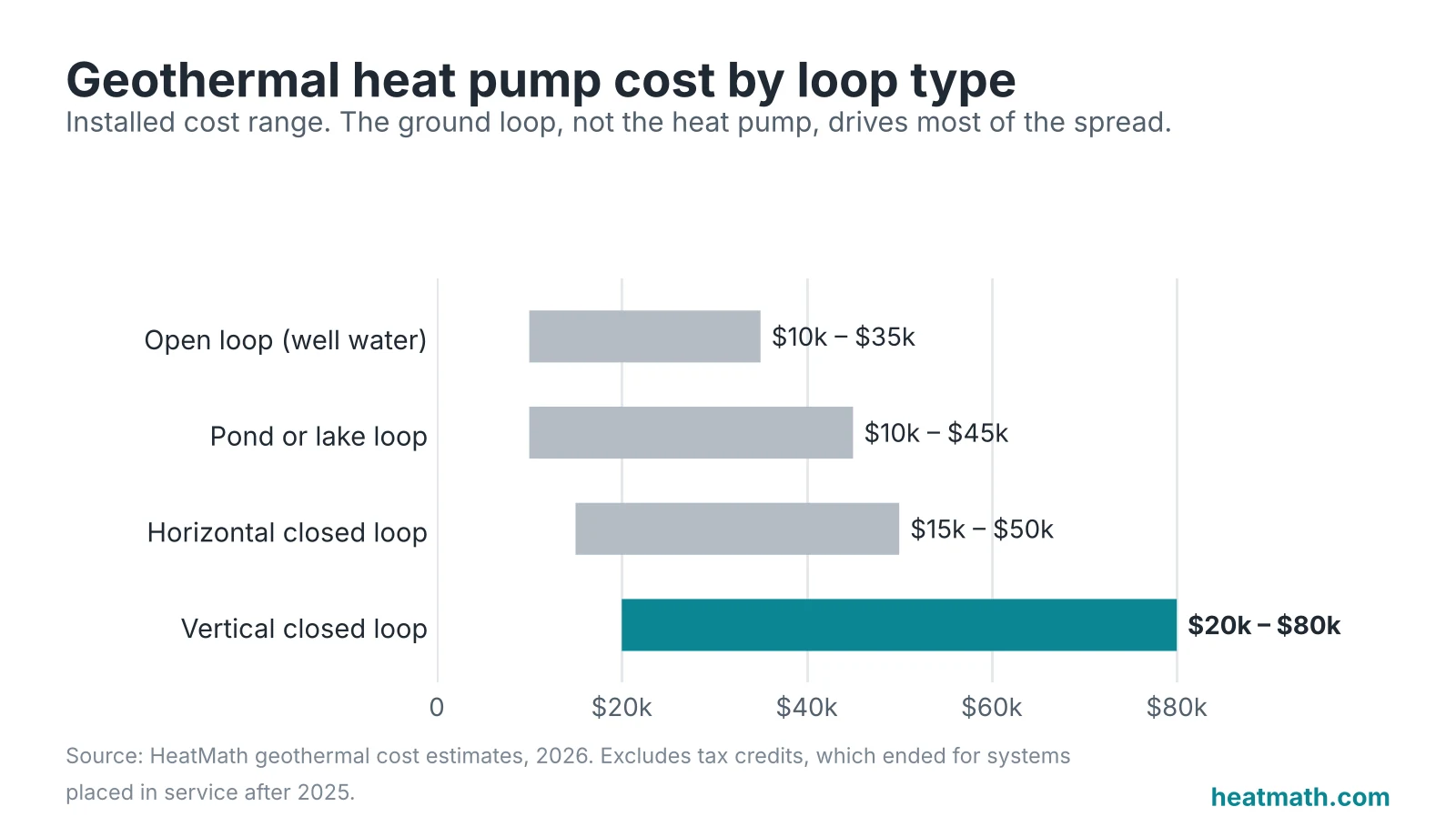
The gap in geothermal heat pump cost estimates comes from what each guide counts. Lower figures often assume an open loop or a horizontal loop on open land. Higher figures include vertical drilling, new ductwork and electrical upgrades. For budgeting, plan around $20,000 to $35,000 for a 3- to 4-ton system in an existing home and treat anything below $15,000 as a best case.
Cost by loop type
| Loop type | Typical installed cost | Best fit |
|---|---|---|
| Open loop (well water) | $10,000 – $35,000 | Homes with a strong well and legal discharge options |
| Pond or lake loop | $10,000 – $45,000 | Property with a deep enough pond nearby |
| Horizontal closed loop | $15,000 – $50,000 | New construction or large, open lots |
| Vertical closed loop | $20,000 – $80,000 | Small lots, rocky soil, retrofits |
Ranges combine Fixr and HomeGuide 2026 figures. Your quote depends mostly on soil, rock, access for the drill rig and local labor rates.
Where the money goes
A geothermal system has three parts: the indoor heat pump, the ground loop and the distribution system (ducts or radiant). Each has its own price driver.
The indoor unit
The heat pump itself is the smallest part of the bill. HomeGuide lists unit prices from about $3,500 for a 2-ton model to $14,000 for a 6-ton model. Variable-speed units with desuperheaters, which pre-heat your domestic hot water, sit at the top of that range.
The ground loop
The loop is where most of the geothermal heat pump cost goes. According to the U.S. Department of Energy, horizontal loops sit in trenches at least 4 feet deep. Vertical loops use bores about 4 inches wide, drilled 100 to 400 feet deep and spaced roughly 20 feet apart. Most homes need three to five bores. Drilling through rock, hitting water or working on a tight lot with limited rig access all push the price up.
Ducts, electrical and permits
If your home already has decent ductwork sized for a heat pump, you save a large chunk. If the ducts are leaky, undersized or missing, budget several thousand dollars more. Some homes also need a panel upgrade. Permits, well permits and loop-field restoration (regrading the yard) add smaller amounts.
Cost by home size
Geothermal heat pump cost scales with system size, and size follows the home’s heat loss, not just square footage. As a rough guide, one ton equals 12,000 BTU per hour, and an average 1,800 sq ft home needs about 2 to 3 tons. Use our heat pump size calculator for a first estimate before you talk to installers.
| Home size | Typical capacity | Installed cost range |
|---|---|---|
| 1,200 – 1,500 sq ft | 2 tons | $15,000 – $23,000 |
| 1,500 – 2,000 sq ft | 2.5 – 3 tons | $18,000 – $28,000 |
| 2,000 – 2,500 sq ft | 3 – 4 tons | $20,000 – $36,000 |
| 2,500 – 3,500 sq ft | 4 – 5 tons | $30,000 – $50,000 |
| 3,500+ sq ft | 5 – 6 tons | $40,000 – $75,000 |
Figures are based on HomeGuide’s 2026 ranges. A well-insulated home can often drop half a ton or more, which shortens the loop and cuts the price.
What it costs to run
The big selling point of geothermal is low operating cost. The ground a few feet down stays between about 40°F and 70°F all year, so the heat pump works from a stable source instead of cold winter air. That keeps efficiency high on the coldest days, when air-source units lose capacity.
Here is a simple way to compare heating costs:
Annual kWh = heat needed (kWh) ÷ COP | Annual cost = kWh × your electricity rate
The example below uses a cold-climate home that needs about 60 million BTU of heat a year (about 17,600 kWh of heat) and the EIA’s 2026 national average residential rate of 18.2 cents per kWh. The COP values are illustrative seasonal averages, not ratings for a specific model.
| Heating system | Seasonal COP | kWh used | Annual cost |
|---|---|---|---|
| Electric furnace or baseboard | 1.0 | 17,600 | $3,200 |
| Air-source heat pump | 2.1 | 8,380 | $1,525 |
| Geothermal heat pump | 3.5 | 5,030 | $915 |
Plug in your own heating load and rate with the heating cost calculator. For the air-source side of the comparison, our guide to the cost to run a heat pump walks through the same math in more detail.
Payback without the federal tax credit
Before 2026, the 30% Residential Clean Energy Credit (25D) cut a $30,000 system to about $21,000. That credit ended on December 31, 2025, and many cost guides still quote it. Check the date on any page that promises 30% back.
Without it, the full geothermal heat pump cost lands on you, and payback depends on what you replace and what you would have bought anyway. A fair way to judge it is to compare the extra cost of geothermal against an air-source heat pump you would install instead.
Example: A geothermal quote of $30,000 versus a ducted air-source heat pump at $14,000 is a $16,000 premium. If geothermal saves $600 a year on heating and $150 on cooling, simple payback is about 21 years. Against oil, propane or electric resistance heat, savings can run $1,500 to $2,500 a year, and payback drops to 7 to 11 years.
The Department of Energy cites 5 to 10 years with incentives. Without federal help, expect something longer unless you are replacing an expensive fuel or your state offers a large rebate. Search the DSIRE database for state, county and utility programs before you sign.
Lifespan and long-term value
Longevity is the second argument for geothermal. The DOE says indoor components last up to about 24 years and ground loops 50 years or more. The loop is a one-time investment: when the indoor unit wears out, you replace only that part, typically for the price of a standard heat pump. Compare that with the 12 to 15 years covered in our guide on how long heat pumps last.
There is no outdoor unit to bury in snow or bake in the sun, which also means less noise and fewer coil cleanings.
How to get a fair quote
- Get at least three bids from installers accredited by IGSHPA or a similar program.
- Ask for a room-by-room Manual J load calculation. Loop length is based on that number, so an oversized system means paying for extra drilling.
- Ask who does the drilling or trenching and whether rock, water or restoration is priced in.
- Get the loop warranty in writing. Good HDPE loops often carry 50-year warranties.
- Confirm the efficiency ratings (EER and COP) of the exact model quoted.
- Ask your utility about rebates and time-of-use or heat pump rates.
Frequently asked questions
Is geothermal worth it without the tax credit?
It can be, mainly if you plan to stay 15 years or more, heat with oil, propane or electric resistance, or build new and can trench the loop cheaply. For a home that already has an efficient air-source heat pump or cheap natural gas, the payback is usually too long to justify the premium.
How much does geothermal drilling cost?
Drilling is usually the largest single item in a vertical loop system. Total loop costs for a typical home often run from about $10,000 to over $30,000, depending on bore depth, rock and site access. Ask installers to price the loop separately so you can compare bids line by line.
Can I add geothermal to my existing ductwork?
Often yes, if the ducts are sealed and sized for the airflow a heat pump needs. Heat pumps deliver air at lower temperatures than furnaces, so undersized ducts can cause noise and comfort issues. Have the installer test static pressure and inspect the ducts before quoting.